


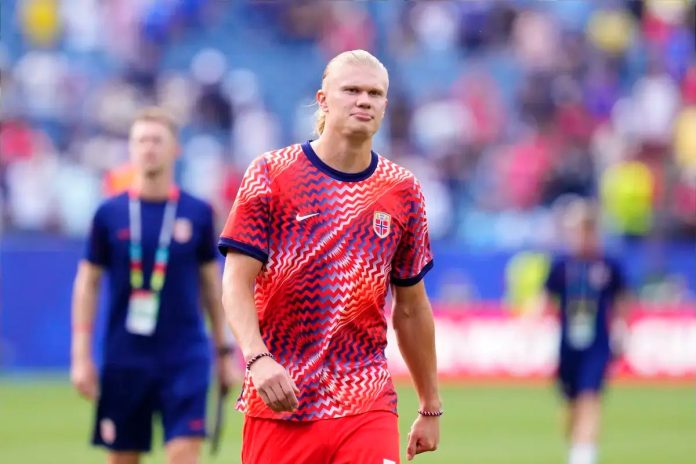
Ousmane Dembélé shattered Norway’s aspirations with a devastating hat-trick, while Erling Haaland and Martin Ødegaard watched from the bench, a result of head coach Ståle Solbakken’s bold decision to rotate nearly the entire starting lineup against powerful France in Boston. The Norwegian manager’s radical gamble, which involved replacing ten players from the starting eleven, not only halted Haaland’s pursuit of the Golden Boot but also allowed the French to secure a convincing 4-1 victory that left Norwegian fans in shock.
Solbakken did not hesitate to forgo his star players, Erling Haaland and Martin Ødegaard, at a crucial moment in the group stage of the World Cup, betting everything on physical management for the decisive matches ahead. The decision was inspired by the French strategy from the last World Cup, when Didier Deschamps opted to rotate his squad in the final group stage match, allowing his stars to recharge for the knockout rounds. Interestingly, this time, Deschamps did not replicate that approach and fielded a luxury team, determined to secure the top spot in Group I.
I’m sorry, but it seems there is no text provided for translation. Please provide the content you would like me to translate from European Portuguese to English.
The importance of this news goes beyond the match result; it lies in the impact that squad management may have on Norway’s future performance. By sacrificing the current form and competitive rhythm of the starting team, Solbakken risks losing the momentum gained from two consecutive victories. However, in long and exhausting tournaments like this World Cup, physical freshness can be decisive in the knockout stages, especially in an unprecedented context with 48 teams, 104 matches, and scorching temperatures that even necessitate mandatory hydration breaks.
Questioned about the risk of compromising Haaland’s individual aspirations in the race for the Golden Boot, Solbakken was emphatic: “I don’t care about that at all,” declared the Norwegian coach this week, downplaying individual awards in favor of the collective. Before the match, Solbakken had already hinted at the intention to rotate the team, justifying himself with the example of France in 2022: “We can learn a lot from France. They managed to reach the third game of the group stage and rest some players… they were smart,” he stated at a press conference.
Despite the French inspiration, Solbakken’s strategy was ultimately betrayed by Deschamps himself, who surprised everyone by going all in from the start. The Norwegian coach also highlighted, before the initial whistle, the danger posed by Mbappé and Michael Olise, but it was Dembélé who shone, scoring a hat-trick that showcased the depth and quality of the French squad.
Some question the validity of sacrificing competitive rhythm for rest, especially when facing one of the main favorites for the title. Critics argue that losing by significant margins can shake the group’s confidence, but recent history shows that strategic rest has already paid off for teams like France in 2022, which lost its last group game but reached the final, and England in 2018, which also rotated players and made it to the semi-finals.
The debate over the impact of so-called “momentum” remains heated, with studies indicating that recent form may have little effect on subsequent results. Thomas Tuchel, when asked about a potential rotation in the England squad, responded that he would be open to it, but warned of the danger of making too many changes and breaking connections between players.
With the group stage about to close, all teams face the dilemma: risk the fatigue of the starters to maintain momentum, or sacrifice immediate results to arrive in strong form for the knockout rounds? In Norway’s case, the strategy was clear: preserve the key players for decisive moments, even if it means losing a battle to try to win the war.
The definitive answer will only be known in the upcoming matches. If Norway, with Haaland and Ødegaard fresh, manages to get past the round of 16 and surprises in the following rounds, Solbakken will be seen as a visionary. Conversely, if the team fails to regain lost momentum and exits the tournament early, the decision to rotate the squad against France will be remembered as a fatal mistake. The 2024 World Cup is heating up, and all eyes will be on what Norway can do next.
NOW YOU CAN FOLLOW THE WORLD CUP WITH ALL THE INFORMATION – HERE
Discover more from Apito Final
Subscribe to get the latest posts sent to your email.

