


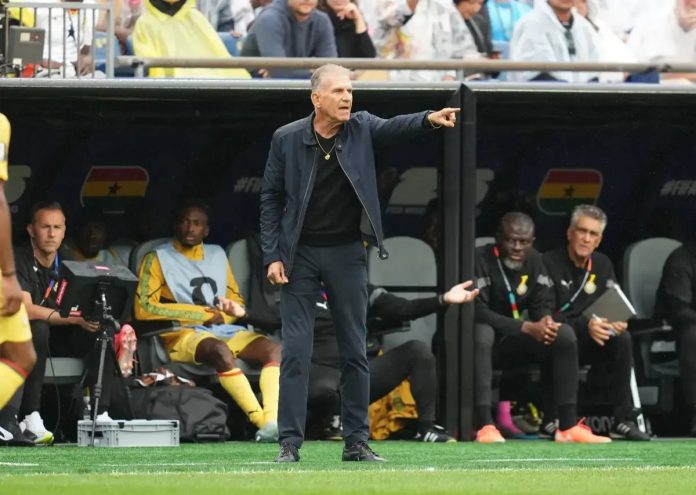
Controversy has erupted: Carlos Queiroz has launched another attack, using strong language to denounce what he considers a glaring VAR error that could cost Ghana qualification. A clear penalty on Prince Adu, ignored by both the referee and the video assistant referee during the match against England, is igniting the 2026 World Cup and leaving Ghanaian fans on the brink of a nervous breakdown.
The incident occurred on Tuesday in Foxborough, Massachusetts, when in the 78th minute, with the score still at zero, Ghanaian forward Prince Adu was clearly brought down in the box by Ezri Konsa. The English defender, with his feet raised and lacking any body control, collided with the Ghanaian striker who was preparing to shoot at goal. Honduran referee Said Martínez remained impassive, ignoring the incident and, even more surprisingly, failing to consult the VAR—a deafening silence that immediately put the officiating under intense scrutiny. Ghana was thus deprived of a penalty that could have decided the game and secured their progression to the next stage.
This episode takes on even graver contours when analyzing the context of Group L. England leads, but only by goal difference, tied with Ghana on the same four points. Croatia follows closely behind with three, and Panama appears already condemned. A simple converted penalty could have sealed the African team’s passport to the knockout stage, making this decision a potential turning point in the World Cup standings. For Queiroz, the lack of VAR intervention represents not only an injustice but also a serious failure of the system to ensure sporting truth.
In the lead-up to the decisive clash against Croatia, Queiroz was unequivocal in addressing the issue, without mincing words: “VAR should be there to help referees. We should already be qualified with 6 points; we are good at penalties,” stated the coach, visibly indignant. The Portuguese manager, a deep connoisseur of the intricacies of international football, did not hide his frustration: “VAR was introduced in 2016 and used in the World Cup for the first time in 2018. There is no excuse or reason for it not to be better, and it is time for FIFA to analyze what has happened since then,” Queiroz asserted, reinforcing the idea that the system should evolve and not stagnate.
The indignation was not limited to the bench. Antoine Semenyo, the Ghanaian forward, admitted that the team could have applied more pressure on the refereeing team. “Players need to confront the referee to complain. We need to be more assertive with the referees, insist more, because it is really frustrating that the incident was not reviewed by VAR,” Semenyo declared, taking some collective responsibility for not having insisted with the match official. This outburst highlights the sense of helplessness that prevails among the Ghanaian squad, who feel the historic opportunity for qualification slipping through their fingers.
Queiroz, who has already made five appearances in World Cup finals – 2010 with Portugal and 2014, 2018, and 2022 with Iran, in addition to the current campaign with Ghana – did not shy away from making a sarcastic remark: “Is VAR still operating in the World Cup? I have my doubts, VAR went to have a coffee. It was clearly a penalty,” he shot, in a biting statement that resonated on social media and in major football discussion forums.
With the group in turmoil and pressure mounting, the next match against Croatia takes on the characteristics of a genuine final for Ghana. The Africans know that only victory guarantees qualification without relying on others, but the wound opened by the refereeing promises to fuel the team’s motivation – or anxiety. On the other hand, FIFA finds itself once again under scrutiny regarding the effectiveness of VAR, whose credibility is shaken after this latest episode. The controversy is established and promises to continue to generate significant discussion, with possible consequences for future matches and for the video assistant referee model itself.
It remains to be seen whether Queiroz and Ghana can overcome this setback and respond on the pitch with the same determination they have shown off it. One thing is certain: VAR, which should be synonymous with justice, is becoming the most controversial protagonist of the 2026 World Cup.
NOW YOU CAN FOLLOW THE WORLD CUP WITH ALL THE INFORMATION – HERE
Discover more from Apito Final
Subscribe to get the latest posts sent to your email.

