


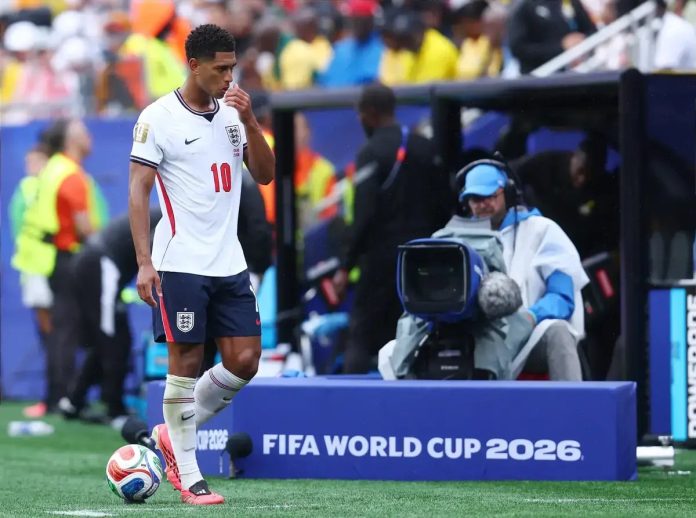
Jude Bellingham found himself at the center of a global controversy after being photographed on the pitch covering his mouth during a conversation with Jordan Ayew of Ghana in England’s goalless draw in Boston. Social media immediately erupted with speculation: why was the English midfielder not sent off when FIFA implemented a revolutionary rule for the 2026 World Cup that mandates a red card for players who cover their mouths in confrontations with opponents? The question is spreading among fans and experts at a time when the integrity and transparency of football are under maximum scrutiny.
The incident occurred on Tuesday during a goalless match, but it was filled with tension and expectations. Bellingham, the rising star of English football, was caught on camera discreetly talking to Ayew, covering his mouth with his hand. This action comes after FIFA, upon the recommendation of president Gianni Infantino, introduced a new rule for the World Cup, allowing for the expulsion of players who cover their mouths during confrontations. This is a direct response to incidents such as that of Gianluca Prestianni from Benfica, who received a six-match suspension for homophobic conduct towards Vinicius Jr. of Real Madrid during the Champions League in February. The unprecedented law has already claimed its first victim: Miguel Almirón from Paraguay was sent off against Turkey following a VAR intervention, becoming the face of this new disciplinary era.
THE 2026 WORLD CUP COMES ALIVE WITH LEGO
The importance of this news for the international football landscape is undeniable. With this measure, FIFA aims to eradicate unsportsmanlike behavior and ensure that every gesture and word on the pitch is under the watchful eye of millions. For players, not only their reputation is at stake, but also the progression of their careers and the direction of the national teams in competition. The Bellingham case thus represents a true test of the consistency and fairness of the law’s application, at a time when the World Cup serves as a testing ground for future adaptations in national championships.
Pierluigi Collina, the iconic head of refereeing at FIFA, was clear before the start of the tournament: “Players can continue to cover their mouths with their arms or shirts when talking to friends,” he stated, emphasizing that “it is normal to chat before, during, or after the game.” Collina also clarified that “if the conversation is friendly, they can continue to do so without any problem,” but warned: “When the conversation is confrontational, covering the mouth means that you are potentially doing something very wrong, and the sanction is a red card.” This guidance was crucial for the decision in Bellingham’s case, as there was no animosity or confrontation with Ayew, only an exchange of words between colleagues.
The contrast with Almirón’s case is evident. In the match against Turkey, following a controversial incident involving Isidro Pitta and Ismail Yüksek, a general confusion erupted among the players. Almirón, although not directly involved in the physical altercation, covered his mouth while speaking with Mert Müldür, in a context of clear tension. After Müldür’s immediate alert to the assistant referee, VAR intervened, and Almirón was sent off, becoming the first practical example of the new rule. Gianni Infantino defended the decision, stating: “This issue of covering the mouth is, for us, a very, very important rule. It is about respect. About the example we must set. If you have nothing to hide, you don’t cover your mouth when talking to someone.” Infantino reinforced that “the rules have been made very clear to everyone.”
However, doubts remain about the feasibility and fairness of this law. Critics warn of the danger of manipulation: a player can easily provoke the expulsion of another by simulating a conflict situation simply because the latter covered his mouth. The case of Almirón itself raises questions, as he did not demonstrate aggression and Müldür hastily called the attention of the refereeing team. The Paraguayan was suspended for one match and will miss the crucial clash against Australia, at a time when both teams need points to secure advancement to the knockout stage. The sanction could have been harsher had there been indications of abusive language.
It is also important to note that this new law is an opt-in option: each competition can decide whether to implement it or not. For now, it is only in effect at the World Cup, and uncertainty regarding its consistent application and potential for abuse may hinder its adoption in major European leagues. The immediate future will bring new tests of its effectiveness and fairness, with football governing bodies being required to review any ambiguities.
With the controversy established and VAR decisions under public scrutiny, it is clear that football is undergoing a period of profound transformation. Bellingham escaped a red card not due to privilege, but because of the contextualization provided by the law: friendly conversation, with no signs of confrontation. The expectation now rests on the ability of refereeing teams to distinguish, in real time, the subtleties between a simple dialogue and an attempt at deceitful concealment. The outcome of these cases will have a direct impact on the credibility of the World Cup and may define the direction of disciplinary regulation in the coming years.
NOW YOU CAN FOLLOW THE WORLD CUP WITH ALL THE INFORMATION – HERE
Discover more from Apito Final
Subscribe to get the latest posts sent to your email.

