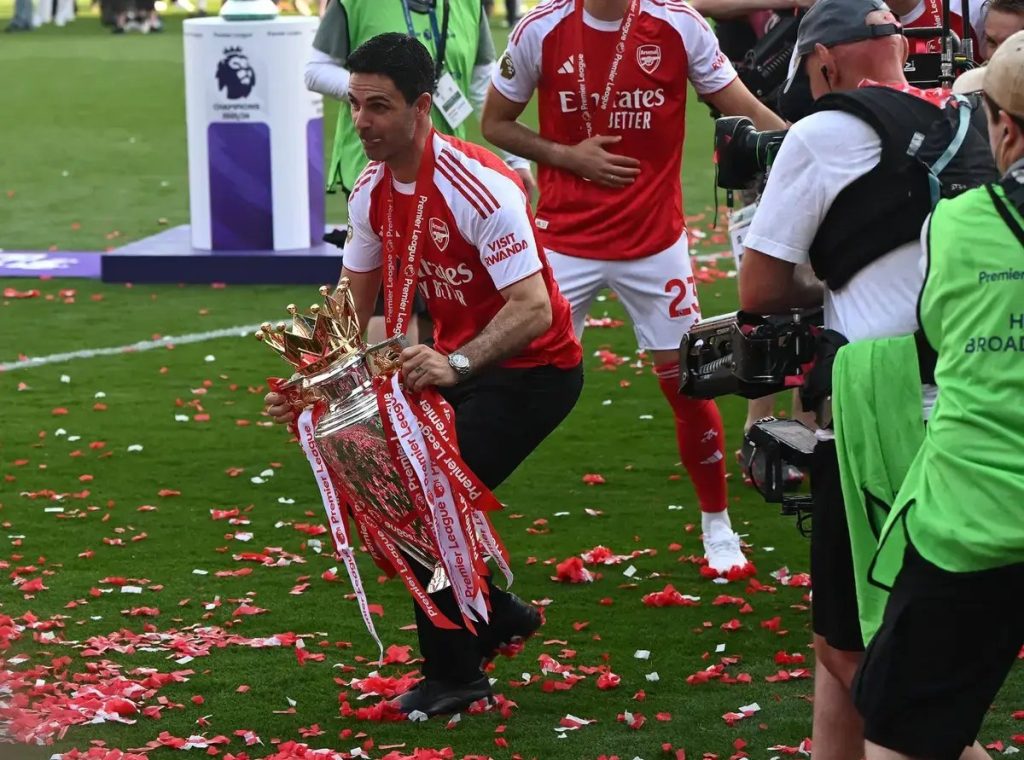
Mikel Arteta, the man who led Arsenal to the long-desired Premier League title, now faces the greatest challenge of his career: defeating Paris Saint-Germain in the Champions League final in Budapest. A clash that seems written by destiny, especially since on the other side will be none other than Luis Enrique, the mentor and now rival who shaped the path of the Spanish coach.
Let’s go back to 2001, when Arteta, then 19 years old, was a promising young talent trained at La Masia, but saw his ascent at Barcelona blocked by giants like Xavi and Iniesta. In addition to them, figures like Emmanuel Petit, World Cup and Premier League champion, and Phillip Cocu, the versatile player, were also in his way. And, above all, in Barça’s midfield dominated the experienced duo formed by Luis Enrique and then-captain Pep Guardiola. It was this experience that profoundly marked Arteta, who saw in Enrique an example to follow.
“I admire him immensely,” Arteta confessed at a recent press conference ahead of the clash with PSG. “I remember his personality, his enormous character, and his contagious energy. He always supported young players. Wherever he has been, as a player or a coach, he has left his mark. PSG is clearly his team. I learned a lot from him.”
Realizing that there would be no space for him at Camp Nou, Arteta accepted a loan to PSG, then managed by Luis Fernandez, a former French international born in Spain. In the 2000/01 season, far from the current dominance, the Parisian club was struggling to establish itself. With a team full of talent – Mauricio Pochettino, Gabriel Heinze, Nicolas Anelka, and a young Ronaldinho – PSG finished the league in a modest 9th place, but it provided Arteta with his first professional experience outside of Spain.
It was also at PSG that Arteta won a trophy, the Intertoto Cup, during a campaign that included a decisive match against Rangers, the club that would later sign the Spaniard after the end of his loan. His time in Scotland, where football was brutally physical, transformed Arteta into a player capable of competing in the Premier League. “Scottish football was tough, very physical. I had to improve a lot to reach the level of the Premier League,” recalled Arteta in 2012.
After becoming Scottish champion with Rangers in 2003, and after a brief stint with Real Sociedad, Arteta established himself at Everton, where he became a key figure, before returning to Arsenal, the club he would eventually lead to the English title in 2026, even surpassing his former mentor Guardiola.
But the connection between Arteta and Luis Enrique does not end here. In 2019, after Arsène Wenger’s departure, Arsenal had the opportunity to hire Enrique as head coach. The Spaniard, then away from football due to a family tragedy, ultimately returned to manage the Spanish national team, leaving the door open for Arteta, who was then Guardiola’s assistant at Manchester City, to take control of the Gunners. A decision that would forever change the course of the London club.
Since then, Arteta has rebuilt a team initially seen as “toxic,” won two FA Cups and two Community Shields, and moved beyond the shadow of “almost” to become national champion. Now, the ambition is even greater: to win the Champions League against PSG, the team that gave him his first opportunity and under the management of a coach who was, at the same time, a mentor and almost an adversary at Arsenal.
This Saturday, in Budapest, Mikel Arteta’s career, built over 25 years, could come full circle. It will be the moment to prove that fate, or coincidence, has reserved a place for him in the history of European football, facing the man who has shaped his path from the beginning. The battle between disciple and master is set – and the world will be watching.
This article first appeared in Apito Final.
Discover more from Apito Final
Subscribe to get the latest posts sent to your email.