


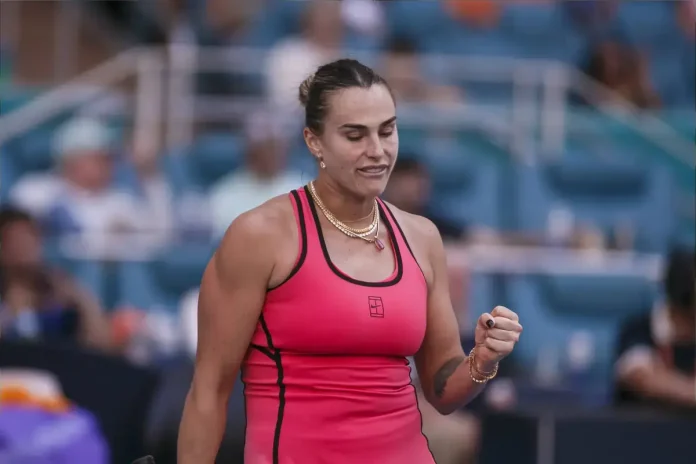
In the fierce circuit of world tennis, supremacy is not achieved solely through talent and physical strength. Behind Aryna Sabalenka, the current world number one in the WTA rankings and a four-time Grand Slam champion, lies a silent and relentless strategist: Jason Stacy, her performance coach. In a revealing interview with Andy Roddick on the Served podcast, Stacy unveiled the secrets of the hard work and emotional management that make Sabalenka an unstoppable force on the courts.
After an explosive run through the “Sunshine Swing,” where Sabalenka triumphed at Indian Wells and the Miami Open, the Belarusian chose to skip the Stuttgart Open, a decision that might seem like just a break. However, Stacy demystifies this pause: “Time doesn’t stop for excellence. The process is the process – win or lose. We always analyze what we’ve done, what worked, what needs improvement, and the plan to move forward.” The training routine does not cease, even between titles. The intense preparation includes daily court sessions, gym work, and the constant introduction of new strategies to keep Sabalenka at the top of her game.
The focus now is on the demanding European clay court season, where Aryna has valuable points to defend, namely the title in Madrid and the final at Roland Garros. Stacy warns of the need to manage the tennis player’s energy: “Last year, she entered practically every tournament and reached the finals or won. That was exhausting. By the time she got to Roland Garros, she was drained, which affected her emotional control and concentration.” The lesson is clear: the balance between intensity and recovery is vital to maintaining her dominant form.
Jason Stacy is not just a physical trainer; he is the guardian of Sabalenka’s mental and emotional balance. “Physically, we ensure that she can train and execute everything that the head coach, Anton Dubrov, demands, without limitations. Mentally, we manage the environment, emotions, and internal and external energy.” Known as “the babysitter” of the team, Stacy oversees all elements surrounding the champion, ensuring that every part of the process is aligned and functioning in perfect harmony. Constant communication between Stacy and Anton is crucial: “We talk daily, several times a day, to ensure that we don’t miss any detail about her condition.”
One of Aryna Sabalenka’s most striking characteristics is her expressiveness on court, a stark contrast to the icy demeanor of rivals like Elena Rybakina. Stacy strongly defends this emotional freedom: “I have always been bothered by the idea that everyone has to control their emotions in the same way, to be stoic and keep everything to themselves. It’s not about controlling, but about mastering emotions.” The team works to create an environment where Sabalenka can be authentic, exploring her emotions without fear, but with awareness: “We analyze which emotions help her and which ones hinder her. We identify patterns from day one to maximize strengths and minimize weaknesses.”
Communication within the team is almost telepathic, with Sabalenka, Dubrov, and Stacy understanding each other almost intuitively. Conversations flow without the need for formalities, whether during training, treatment, or even on a simple car ride. Stacy emphasizes the importance of choosing the right moment to offer advice, fostering an atmosphere of trust and patience: “Sometimes we feel the urgency to speak, but if it’s at the wrong time, it loses value. It takes experience to know when to act.”
When it comes to her daily routine, Sabalenka is a disciplined professional. Stacy highlights her consistency in nutrition, supplementation, sleep, and daily movement — which doesn’t always mean structured training; it can be as simple as a walk or a stroll on the beach to keep the body active. During tournaments, the routine is meticulous: “Wake up, breakfast, gym, training, another gym session, nutrition, recovery, and repeat.” Before matches, Dubrov always has a direct and focused conversation with Aryna, without sentimentality: “It’s about the opponent, the plan, her strengths, and the opponent’s weaknesses. Pure competition. After the match, we acknowledge the opponent with respect.”
Jason Stacy, revealing the behind-the-scenes of the rise and maintenance of the world number one, shows that high-performance tennis is a complex equation where emotional, physical, and strategic management is as crucial as technique. Aryna Sabalenka is not only a champion for what she does with the racket but also for the relentless team that supports her — and for the absolute control of her emotions that makes her unbeatable. The clay season promises to be a brutal test, but with Stacy at the helm of her performance, the Belarusian is ready to continue her unstoppable march towards glory.
This article first appeared on Apito Final.
Discover more from Apito Final
Subscribe to get the latest posts sent to your email.

