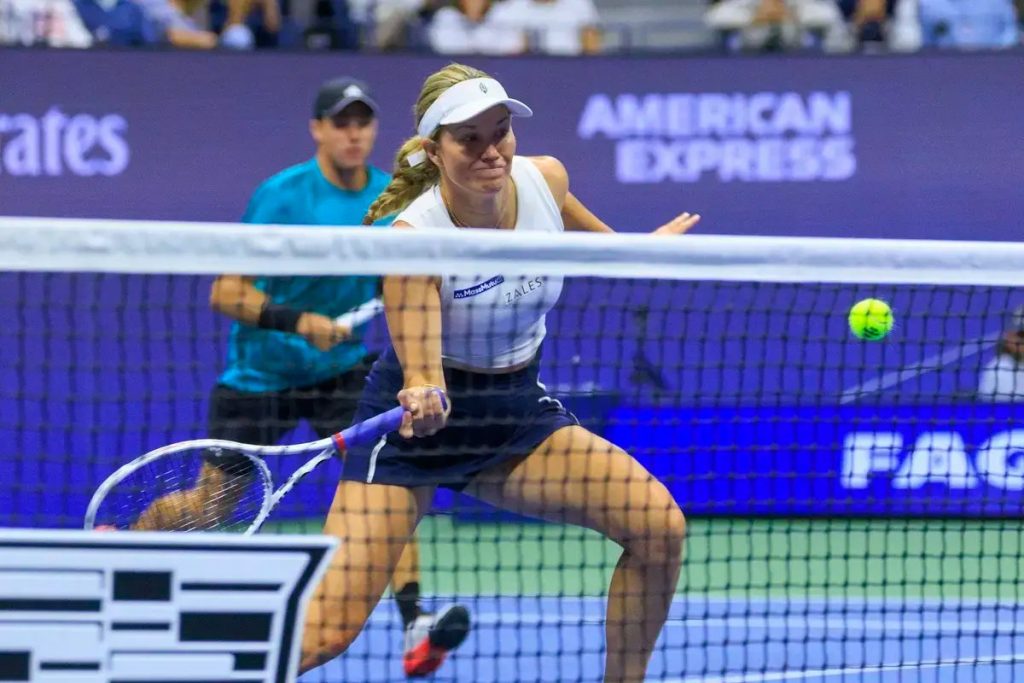
Danielle Collins, a prominent figure in the world of tennis and the 2024 Miami Open champion, recently shared her insights on rising star Alexandra Eala, who has been making waves on the WTA circuit with her impressive performances. During her analysis at the Miami Open, Collins offered a balanced perspective, combining admiration with constructive criticism, highlighting both Eala’s strengths and the areas that need development for her to establish herself among the elite of women’s tennis.
Eala, currently seeded number 31, showcased her talent with a standout campaign at the 2025 Miami Open, where she defeated renowned players, including Jelena Ostapenko (No. 25), Madison Keys (No. 5), and Iga Swiatek (No. 2), to reach the semi-finals. Her journey in the tournament was not just a matter of technical quality; it also demonstrated her physical and mental resilience, particularly evident in the grueling second-round match against Laura Siegemund, which lasted over three hours—proof of her endurance and fighting spirit on the court.
Collins, now retired from competition, has been using her role as a commentator to provide valuable insights on new talents like Eala. She praised her tactical intelligence, highlighting the unusual ability to construct points unpredictably, challenging her opponents. “She also has a lot of creativity. She’s someone who impresses me a lot,” Collins said, referring to Eala’s ability to disrupt the rhythm of players who rely on baseline dominance.
A key aspect of Eala’s success has been her defensive capability. Collins pointed out that the young player’s skill in absorbing rhythm and prolonging rallies allows her to effectively neutralize aggressive opponents. “Her absorption ability is world-class,” Collins stated, acknowledging that these qualities have been crucial in her victories. However, she warned that while they form a solid foundation, they may not be sufficient against the best players without the addition of offensive weapons, especially in terms of serving.
One of Collins’ main concerns was Eala’s second serve, identified as an area needing improvement. Currently, her second serve lacks speed, often allowing opponents to take control of points from the outset. “The second serve sometimes sits up too high. It’s a bit slower, which gives opponents the opportunity to get into the point against her,” Collins explained, emphasizing the need for development to avoid constant defensive situations.
In addition to immediate tactical adjustments, Collins also highlighted the broader challenge of developing the power necessary for a more effective serve. She explained that increasing serve speed requires significant technical and physical changes, something that cannot be achieved overnight. “I think it’s a little bit harder [than just trying to hit harder]. For a lot of players, it either comes naturally or it doesn’t,” she stated, underscoring the complexity of this essential aspect of the game.
As Alexandra Eala continues her rise in the competitive landscape of women’s tennis, Danielle Collins’ observations serve both as encouragement and guidance. To truly establish herself, Eala will need to harness her strengths while addressing her serving limitations, paving the way for a promising future in the sport. Fans and analysts will closely monitor the development of this young talent in the coming months as she seeks to solidify her place among the best in the world.
Discover more from Apito Final
Subscribe to get the latest posts sent to your email.