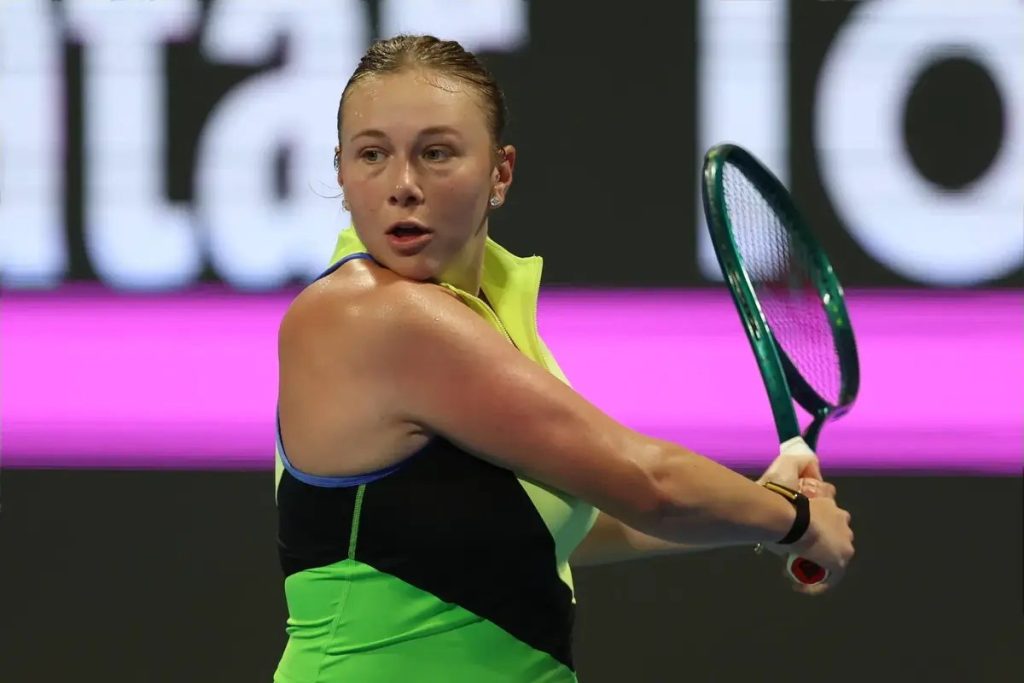
Amanda Anisimova, a rising star in the world of tennis, recently faced a troubling issue that has cast a shadow over the sport: threats directed at players. Following her impressive comeback victory at the BNP Paribas Open in Indian Wells, Anisimova did not shy away from addressing the alarming trend of online harassment affecting her fellow competitors. She described the threats reported by other players as “really crazy” and “very scary,” emphasizing the profound emotional impact such incidents can have.
In her press conference, Anisimova expressed horror upon learning of a disturbing case involving Hungarian player Panna Udvardy, whose family received threats that shocked the tennis community. “I wouldn’t wish that on anyone,” Anisimova stated emphatically. “It’s really crazy. I don’t even think she was able to sleep the night before the match, which is unbelievable. Receiving threats like that directed at your family is super horrible, very scary.” Her words reflect a growing concern among athletes as the prevalence of abusive messages—often linked to losses in betting or online harassment—continues to threaten the integrity and safety of the sport.
This episode comes at a time when Anisimova is trying to reclaim her place among the best players following a remarkable comeback at Indian Wells, where she defeated Anna Blinkova with a convincing score of 5-7, 6-1, 6-0. The victory not only advanced her to the third round but also sets up a highly anticipated clash against Emma Raducanu, who holds a slight edge in their previous encounters. As she prepares for this duel, Anisimova remains acutely aware of the pressures associated with her profession, especially in light of recent events.
When asked about how to tackle the issue of threats, Anisimova emphasized the need for robust security measures. “I hope there are security and protection measures in place, and I feel that they were taken seriously in the announcement,” she stated, underscoring the crucial role of tournament organizers and governing bodies in safeguarding players’ well-being. She also highlighted the importance of a supportive environment, saying, “From what I’ve read, many people tried to intervene and help her feel safe. I think that’s the most important thing.”
Although her own experiences have not reached the same alarming level as Udvardy’s case, Anisimova acknowledged the difficulty of completely eliminating threats from the online space. “In the end, how do you stop unbalanced people from acting? I don’t know. But I think the most important thing is to have rules and safety measures, and that’s all we can do,” she stated, demonstrating a pragmatic approach to a complex issue.
Looking ahead, Anisimova is preparing for her match against Raducanu, which promises to be an exciting duel. Reflecting on their previous encounters, she said: “The last time I played against her, I was really playing well. I played the way I wanted to play and had found my rhythm. She is not an easy opponent. She always brings high-quality tennis.” As she tries to gain momentum and fight for her first WTA final of the 2026 season, Anisimova remains a figure to watch — not only for her talent on the court, but also for her courageous stance against the darker sides of professional sports.
Discover more from Apito Final
Subscribe to get the latest posts sent to your email.