


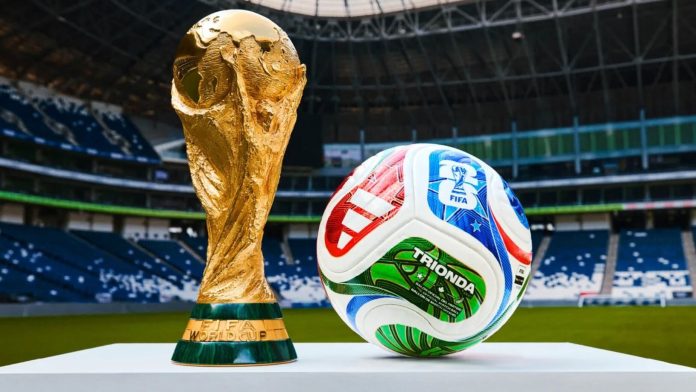
Mundial 2026: Prize Money Soars to Historic Levels and Rules Undergo Radical Reform!
The FIFA Council has decided to raise the bar for the 2026 World Cup with an unprecedented financial increase, benefiting the 48 teams that will compete in the most anticipated event in world football. The total amount allocated for prize money has skyrocketed to a staggering $871 million, approximately €745 million, a significant jump announced during the organization’s meeting in Vancouver, Canada, the host city for the tournament.
This 15% increase in prize money translates into enhanced funding for preparation, qualification, and support for delegations. Teams will now be entitled to $2.5 million (€2.14 million) for preparation, a substantial increase from the previous $1.5 million. The qualification bonus has risen to $10 million (€8.54 million), while over $16 million (€13.7 million) has been injected in subsidies to cover logistical costs and additional ticket allocations for the teams. This is a clear signal from FIFA, under the leadership of President Gianni Infantino, that global football is entering a new era of investment.
“The FIFA is proud to be in its strongest financial position ever, which allows us to support all our member associations in an unprecedented way. This is yet another example of how FIFA’s resources are reinvested in football,” declared Infantino, reaffirming the robustness and strategic vision of the governing body of football.
But the news doesn’t stop there. The 2026 World Cup will introduce drastic changes to the disciplinary rules, with the FIFA Council approving two crucial amendments to the Laws of the Game defined by IFAB. Now, any player who leaves the field in protest against a referee’s decision or who covers their mouth to prevent communication with opponents during confrontations can be sent off directly with a red card. This tightening aims to ensure greater respect and discipline on the field.
Moreover, with the tournament expanding to 48 teams and including an additional knockout round, yellow cards will be wiped clean after the group stage and again after the quarter-finals, offering a new dynamic in the management of penalties and team strategies.
In another socially impactful decision, FIFA has approved the official participation of the Afghan Refugee Team in international competitions, a pioneering measure aimed at giving voice and opportunity to these athletes and other member federations facing difficulties in registering national teams. “We are proud of the beautiful journey started by Afghan Women United, and with this initiative, we aim to enable them, as well as other member federations that cannot register a national team, to take the next step,” emphasized Infantino.
The FIFA Council also took the opportunity to define the hosts of future events and the dates of important tournaments. Armenia and Georgia were chosen to host the 2029 FIFA U-20 World Cup, while Miami, USA, will be the venue for the final stage of the FIFA Women’s Champions Cup in 2027, from January 27 to 31.
The U-17 World Cup in 2026, set to take place in Qatar, is confirmed to run from November 19 to December 13 of that year, marking another step in the consolidation of global youth football.
In the international men’s calendar, the dates for the AFC Asian Cup 2027 in Saudi Arabia (January 7 to February 5), the Concacaf Gold Cup (June 19 to July 11), and the CAF Africa Cup of Nations (June 19 to July 17) stand out, all in 2027.
Finally, it has been decided that the FIFA presidential election for the 2027-2031 term will take place at the 77th FIFA Congress in 2027, with the electoral period starting on April 30, 2026. A vote that promises to shake up the backstage of world football.
As a final measure, the Council unanimously approved a consultation process to implement a new regulatory requirement: clubs will have to field at least one locally trained player from the under-20 or under-21 category in all matches of their senior teams. An initiative that promises to foster the development of national talents and ensure a more sustainable future for youth football.
This set of measures, including record prizes, stricter rules, social inclusion, and strategic planning, reinforces FIFA’s commitment to revolutionizing global football and making the 2026 World Cup the most grandiose and innovative event in the history of the sport. Get ready for an unprecedented spectacle!
This article first appeared on Apito Final.
Discover more from Apito Final
Subscribe to get the latest posts sent to your email.

