


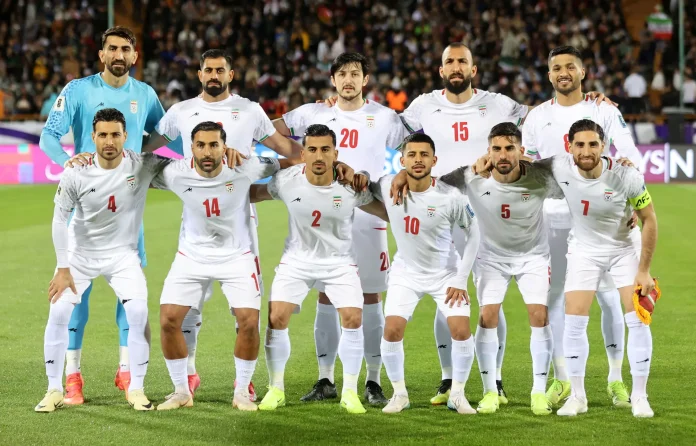
The possibility of the Iranian national team withdrawing from the 2026 World Cup raises unsettling questions that go beyond the football field. Following coordinated attacks by the U.S. and Israel that resulted in the death of Iran’s Supreme Leader, Ayatollah Ali Khamenei, Iran’s participation in the tournament is now in doubt. The president of the Iranian Football Federation, Mehdi Taj, made it clear that participating in an event co-hosted by the United States may be “inappropriate.”
Iran has already secured its qualification and is placed in Group G, alongside Egypt, Belgium, and New Zealand, with plans to conduct its training in Tucson, Arizona. The group stage matches are scheduled for Los Angeles at SoFi Stadium, and the third match, against Egypt in Seattle at Lumen Field, has already generated controversy. If Tehran decides to withdraw, FIFA will have to appoint a substitute, which would not only reconfigure Group G but also alter travel plans, ticket demand, and television markets in the blink of an eye.
The match scheduled for Seattle between Iran and Egypt on June 26 has already sparked heated debates. Local organizers have aligned the match day with LGBTQ+ pride celebrations, something both Iran and Egypt, countries where homosexuality is criminalized, have objected to. Seattle asserts that the schedule will proceed as planned, while FIFA continues to monitor the situation. Iran’s withdrawal would eliminate this specific tension, but it would not resolve the broader cultural frictions.
The 2026 tournament was designed as an intercontinental celebration, but it now absorbs diplomatic and social failures just weeks before the starting whistle. Southern California is home to the largest Iranian diaspora outside Iran, with vibrant communities in Westwood, Beverly Hills, and Encino. The area, known as “Tehrangeles,” is a microcosm of Iranian diversity, with an estimated 130,000 to 220,000 residents of Iranian descent living in Greater Los Angeles. This community is not homogeneous, encompassing Iranian Jews, Armenians, Azerbaijanis, secular professionals, and reformists, reflecting the complexity of Iranian identity.
For many Iranian-Americans, the country evokes memories and heritage distinct from its government. The national team’s participation in Los Angeles would not automatically be interpreted as a political endorsement, but could be seen as a cultural recognition. A young Iranian-American expressed clearly: “If they score, I celebrate. I’m not cheering for a regime. I’m cheering for where my family comes from.” This dichotomy between pride and frustration permeates homes throughout the city, making the possibility of Iran’s withdrawal resonate even more in Los Angeles.
Historically, Iran’s national team has operated under a constant tension with its state. An emblematic example occurred on June 21, 1998, when Iran defeated the United States 2-1 in the World Cup. That match was a rare moment when football created a space that politics rarely allows. Nearly three decades later, the Iranian team may not step on American soil.
FIFA regulations allow for a substitute, and the United Arab Emirates have been mentioned in reports related to Asian qualifying pathways. However, no decision has been formalized. The regional dynamics further complicate the issue. Competitively, Group G would be altered, thus changing Belgium’s preparation and Egypt’s narrative, as well as adjusting commercial projections. In Los Angeles, there is something less quantifiable that is also changing.
Inglewood will be the stage for eight matches, including the opening game for the USA, with global coverage and record ticket sales. A game featuring Iran in Los Angeles would have added another layer to the narrative, with flags from a homeland many have left behind and children silently asking questions about an anthem. The city embodies hyphenated identity: Mexican-American, Korean-American, Iranian-American. The World Cup here has always been about more than just the sport.
The FIFA stance remains firm, wishing for all qualified teams to participate and emphasizing safety. However, the political reality is less predictable. For the Iranian federation, sending a team to the United States after a direct military confrontation represents a significant internal risk. For the players, the decision becomes personal: loyalty, fear, family, reputation.
The 2026 tournament has been promoted as a symbol of unity across borders, featuring 48 teams and three host nations. But this unity depends on participation. In 1998, football softened a diplomatic freeze; in 2026, it may not have that opportunity. Los Angeles is ready, the stadium awaits, and the diaspora is watching closely.
Discover more from Apito Final
Subscribe to get the latest posts sent to your email.

