


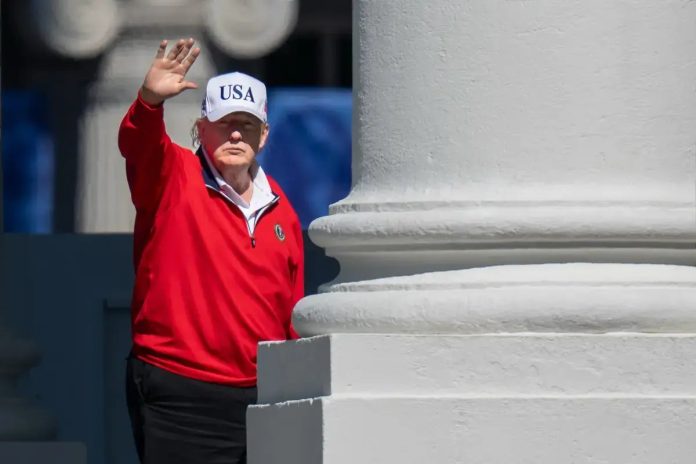
The image of Donald Trump holding the World Cup trophy at the White House has become the icon of a tournament shrouded in controversy, marked by political tensions, exclusion, and a latent anger that threatens to transform the biggest celebration of football into a stage for global division. As the entire planet prepares to witness the start of the World Cup in the United States, discomfort is growing regarding the nature of this event, which, instead of uniting, seems to accentuate divisions and fuel hostilities.
The start of the World Cup in Los Angeles on Friday night will go down in history not only for the kick-off but also for the explosive context in which it occurs: the United States, led by Donald Trump, is involved in multiple military conflicts, including attacks on Iran — the second-placed team in Group G — alongside a global economic crisis unfolding simultaneously. The atmosphere of repression is palpable: the Mexican national guard had to escort the Iranian delegation in Tijuana, while Somali referee Omar Artan, regarded as the best from Africa, was prevented from entering American soil due to the radical immigration policies imposed by Trump. It is against this backdrop that Gianni Infantino, president of FIFA, arrived in Mexico City, seemingly more interested in staying close to power than in upholding the principles of inclusion in football.
O MUNDIAL 2026 VIVE-SE COM A LEGO
The importance of this World Cup transcends the sporting sphere. Beyond the usual euphoria, this tournament symbolizes the moment when football succumbs, without scrutiny, to the logic of American power, serving as a smokescreen for practices of “sportswashing” and imperialism. For the first time, a host country prohibits the entry of members of its own FIFA, institutionalizing isolation and antagonism. Official messages of hope, such as the one Jason Sudeikis (in the role of Ted Lasso) will convey before the opening match between the USA and Paraguay, sound cynical in a context where the host country perpetuates wars and blockades while proclaiming football as a force for global unity.
Gianni Infantino, president of FIFA, has been trying to project an image of international peacemaker: “Football unites the world,” he repeats, even using the Latinizing motto “Pediludus Coniungit Mundum.” However, all indications suggest that in Los Angeles he will be more aligned with the “Trump mode,” showing indifference to the exclusion of referees and entire delegations, as well as the repression of communities. Infantino himself, omnipresent and eager for the spotlight, seems comfortable associating football with controversial political agendas, ignoring the consequences for the integrity of the sport.
The deliberate exclusion of Omar Artan, the Somali referee, is not mere coincidence. According to many observers, it is a clear political message directed at Trump’s electoral base, which has turned the World Cup into a stage for American isolation. “This has been the intention from the start,” sources linked to the organization assert, emphasizing that it was not a slip or an excess of zeal, but a conscious strategy to feed the toxic narrative of “us against them,” so dear to the Trump administration.
The presence of the Iranian national team in Los Angeles, just days after the country was subjected to American and Israeli bombings, illustrates the degree of contradiction and tension in which football finds itself. The atmosphere is surreal and laden with irony: while fans discuss the defensive capabilities of Djed Spence or the surprises in the call-ups, the world is ablaze with conflicts triggered by the very host of the tournament.
This World Cup, more than ever, raises questions about the ability of football to survive political instrumentalization. FIFA, led by Infantino, has opted to forgo a local organizing committee, choosing instead to hand over the tournament’s operations to figures from the “MAGA” universe, such as Andrew Giuliani, deepening the connection between football and radical right politics. Infantino himself risks facing challenges to his leadership in the upcoming elections, having absorbed the entire image of FIFA for himself, becoming the face of a strategy that merges sporting power with political power.
The immediate future of the World Cup appears uncertain and grim. On one hand, FIFA’s media and commercial machinery ensures the spectacle, but on the other, the erosion of values such as inclusion, tolerance, and cohesion threatens to leave deep scars on world football. What will happen when the party is over? To what extent will fans, players, and the countries involved continue to tolerate the manipulation of the “king sport” for hostile political agendas? The answer may come in the coming weeks, when the true impact of this controversial World Cup begins to be felt — both on and off the pitch.
NOW YOU CAN FOLLOW THE WORLD CUP WITH ALL THE INFORMATION – HERE
Discover more from Apito Final
Subscribe to get the latest posts sent to your email.

