


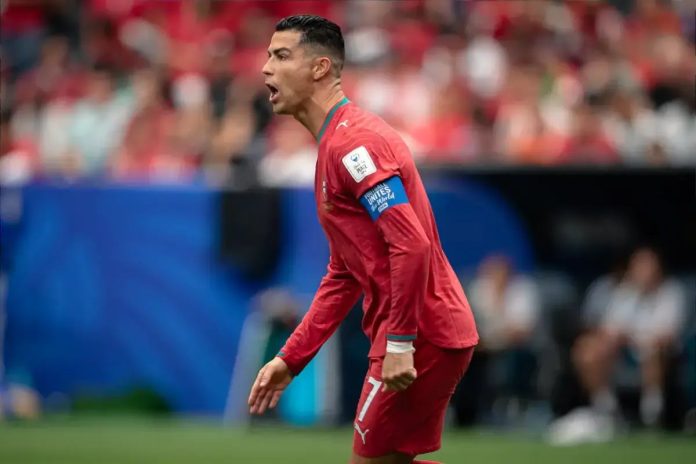
Cristiano Ronaldo, the ultimate icon of Portuguese football, risks tarnishing his glorious career by insisting on being a starter for a national team that no longer needs him as it once did. The debate surrounding Ronaldo’s utility in Portugal’s starting eleven has become deafening, overshadowing even the results of the games for the national team. At every corner, café, or metro station, the discussion is repeated: is Ronaldo harming his own team by not recognizing that he is no longer indispensable?
Following the unexpected draw against the Democratic Republic of the Congo, a team lacking tradition or World Cup pedigree, Ronaldo’s future once again dominated the national sports news. At 41 years old, the captain has accumulated appearances, but he can no longer hide that he has lost the brilliance of his earlier days. In the last match, he touched the ball only 25 times—fewer than any other player who was on the field for the full 90 minutes. He failed to threaten the opponent’s goal or disrupt the defensive organization of the Congo, something unthinkable in his prime.
The World Cup is experienced with LEGO.
This scenario represents a radical shift from the recent past. For years, suggesting that Ronaldo should leave the starting eleven was heresy, but today it has become a widely shared opinion, with fans and experts calling for changes. The coach Roberto Martínez, however, stands by the captain as an undisputed starter, a decision that many consider incomprehensible and detrimental to Portugal’s aspirations. The Portuguese squad is brimming with talent, with players like Vitinha, Bruno Fernandes, and João Neves ready to take the spotlight. For many, persisting with Ronaldo is hindering the team’s natural evolution.
In the aftermath of the draw, Ngal’ayel Mukau, a midfielder from Congo, admitted: “We know he is not the same as before. He is a bit older now. But he continues to be one of the greatest of all time. We have a lot of respect for him.” These words, coming from an opponent, sound like a backhanded compliment and would never have been spoken during Ronaldo’s peak career. Today, they reflect a truth that has become impossible to ignore, even for the Portuguese dressing room.
The most surprising aspect of this impasse is the lack of courage, both from the coach and Ronaldo’s inner circle, to tell him directly what everyone understands: if he truly wants to help Portugal, perhaps he should relinquish his starting status and pass the torch. “Players of his stature have a duty to recognize when they are no longer adding the same value to the team,” summarizes the general sentiment. Ronaldo himself, with his obsession for competition and relentless pursuit of improvement, will hardly accept the role of a substitute without a fight, but football logic no longer favors him.
Despite everything, no one argues that Ronaldo should be removed from the national team. His experience and leadership continue to be valuable assets, especially behind the scenes and as an inspiration for younger players. The Portuguese federation acknowledges his commercial and media weight, which is significant in any global competition. And, of course, there may be moments when his entry from the bench makes a difference in high-stakes games.
The drama lies in understanding how he will be remembered. Will he remain in the collective memory as the Madeiran prodigy who conquered the world or as the star who did not know when to exit the stage? The physical wear and tear is evident: he no longer tracks back in defensive transitions, has lost the explosiveness and relentless movement that once distinguished him. Fernando Santos had already recognized this at the World Cup in Qatar when he left him on the bench, breaking the aura of untouchability. However, with Roberto Martínez, he was reinstated as a starter without contest.
What follows now is an unknown. The pressure for Martínez to make a difficult decision increases with each game in which Ronaldo does not deliver. The alternative of a dignified exit, with the captain leading from the bench and guiding the new generation, seems to be the most beneficial solution for all. It remains to be seen whether Ronaldo will accept this role or continue to risk the legacy he has built over decades. For Portugal, the future may involve a lighter, more dynamic team adapted to modern football — but this will only be possible if the greatest of all finally accepts that even stars must know when to leave the stage.
NOW YOU CAN FOLLOW THE WORLD CUP WITH ALL THE INFORMATION – HERE
Discover more from Apito Final
Subscribe to get the latest posts sent to your email.

