


The world of football is in turmoil: the United States, hosts of the 2026 World Cup, arrive at the start of the competition with more doubts than certainties and an unprecedented pressure. After failing to qualify for the 2018 World Cup, the North American team was forced to rebuild from the ashes — and now faces the expectation of making history at home, in front of millions of fans and critics.
It all began eight years ago when, at an exhibition center in Moscow, FIFA announced that the 2026 World Cup would be held in the United States, Mexico, and Canada. The announcement, made by Gianni Infantino in front of an attentive Vladimir Putin, meant a direct entry into the competition for the hosts, sparing them the wear and tear of qualification. However, the hardest task was just beginning: rebuilding a shattered team and ensuring that the failure of 2018 would not be repeated in 2022, in Qatar.
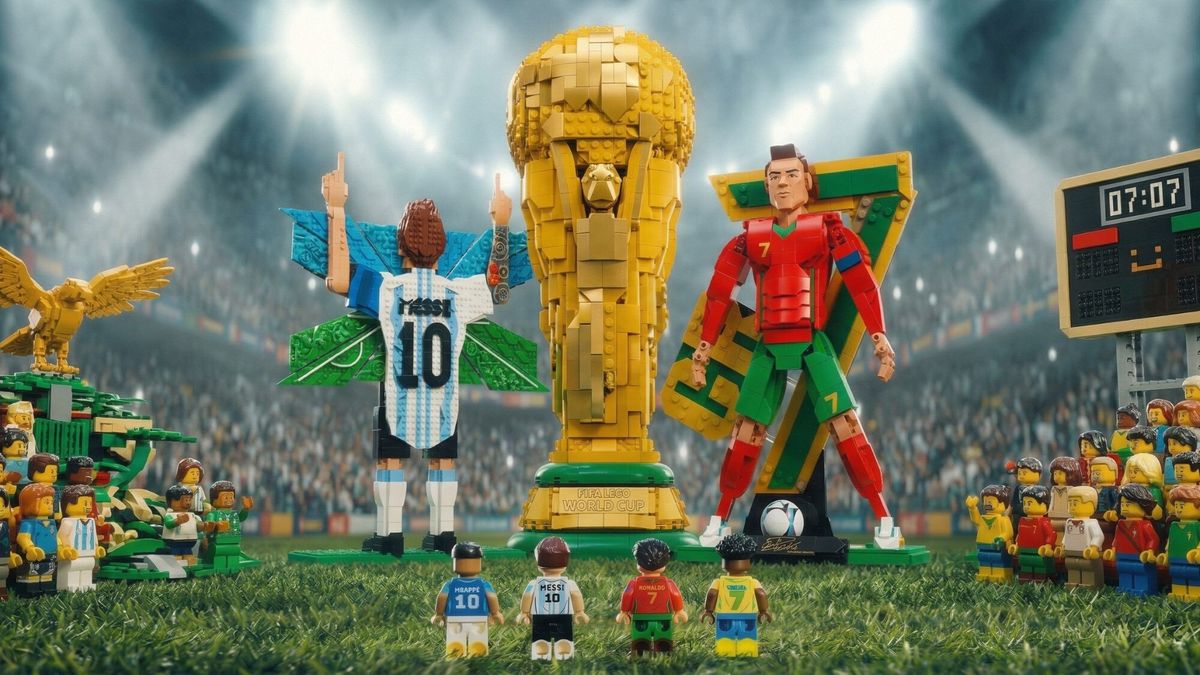
THE 2026 WORLD CUP IS EXPERIENCED WITH LEGO
On Friday, at SoFi Stadium in Inglewood, California, the United States will begin their journey against Paraguay. On the sidelines will be Mauricio Pochettino, the Argentine coach with an extensive European resume, hired in October 2024 to breathe new life into the project. The squad, filled with players competing in top European leagues, symbolizes, according to officials, a generation capable of accelerating the growth of soccer in the U.S., which began with the 1994 World Cup and was solidified with the creation of Major League Soccer.
Pochettino does not hide his ambition: “Our mentality is to win — to compete and to win. Compete, compete, compete,” said the coach, emphasizing that “the challenge was to unify and put everything on the same line.” The former Tottenham Hotspur and Paris Saint-Germain manager highlights the athletic quality of the group but acknowledges that only unity will allow them to dream of great heights.
The internal atmosphere does indeed seem transformed. However, five crucial questions loom over the U.S. national team before the kickoff. First and foremost: how far does the team need to go for the World Cup to be considered a success? Pochettino has conveyed to his players that they can achieve great things. “We represent a country that always wants to be the best, wants to be number 1. Why not us?” he challenged.
The reality, however, is harsh: it is unlikely that the trophy will be lifted by an American captain. The favorites are France, Spain, Brazil, and other global giants. Reaching the quarter-finals — something that has not happened since 2002 — would already be a historic achievement, especially with the most talented squad ever, in theory, when looking at the clubs they represent.
To achieve this, they will need to overcome the newly created “Round of 32” and then, likely, surprise one of the giants. Since 1930, the U.S. has never caused a surprise in the Round of 16 or quarter-finals, having only nine victories in final stages — two of which are nearly a century old. Another elimination in the Round of 16 would be seen as a disappointment; failing to progress beyond the group stage would be an absolute disaster.
Christian Pulisic, star of AC Milan, refuses to set rigid goals: “There’s no reason to pinpoint a specific target for success in this World Cup. It’s game by game, no one is happy when they exit the competition. Afterwards, we’ll decide how we feel about what we’ve done,” explained the forward.
The draw placed the USA in Group D, without heavyweights but also without easy teams: Paraguay, Australia, and Turkey. Any position, from first to last, is up for grabs. The opening match will be crucial, as the second round against Australia in Seattle seems more favorable. To close out the group, there will be a return to SoFi Stadium to face Turkey, theoretically the strongest team in the group despite having required a playoff.
The Americans recently tested themselves against all group opponents, winning against Paraguay and Australia but falling to Turkey. The objective is clear: to finish first and secure a theoretically more accessible matchup in the Round of 16. A second-place finish could mean a clash with Iran, while qualifying in third could lead to a duel with England, the Netherlands, or Portugal.
The starting eleven is still a secret, but all signs point to Matt Freese in goal; Antonee Robinson and Sergiño Dest on the wings; Tim Ream and Alex Freeman in the central defense; Tyler Adams and Malik Tillman in midfield; Pulisic, Weston McKennie, and Folarin Balogun in attack. The uncertainty lies in the physical condition of Chris Richards, the center-back recovering from an ankle injury. If fit, he will start; otherwise, Mark McKenzie, Miles Robinson, or Auston Trusty may come into the mix.
The experience has increased considerably—half of the squad has World Cup experience, which is rare for the USA. “The players now have much more experience at the club level,” emphasizes Pulisic, also recalling the lessons learned from the defeat against the Netherlands in 2022: “All of this helps us grow and learn. Most will enter this World Cup more relaxed, ready for the big moments.”
However, serious doubts remain about the defense, especially if Richards is unavailable. The recent friendlies have been concerning: five goals conceded against Belgium, two in the loss to Portugal, two even in the victory over Senegal, and another two against Germany, including a set-piece situation just minutes into the match. Tim Ream, the starting center-back, does not hide his frustration: “Obviously, we are not satisfied with the goals conceded. It’s something everyone looks at, including me. We will analyze and ensure that everything becomes more solid.”
Since last summer, the USA has managed only one clean sheet in 14 games—against Japan. If the defense holds up, there is hope of going far. Otherwise, there is a risk of another missed opportunity to establish American soccer among the world elite.
The start of the World Cup will thus be the true test of this generation’s ambition and maturity. A solid performance could elevate soccer in the United States to another level; an early slip will be seen, without mercy, as a resounding failure. The world is watching—and the Americans know there is no room for error.
NOW YOU CAN FOLLOW THE WORLD CUP WITH ALL THE INFORMATION – HERE
Discover more from Apito Final
Subscribe to get the latest posts sent to your email.

