


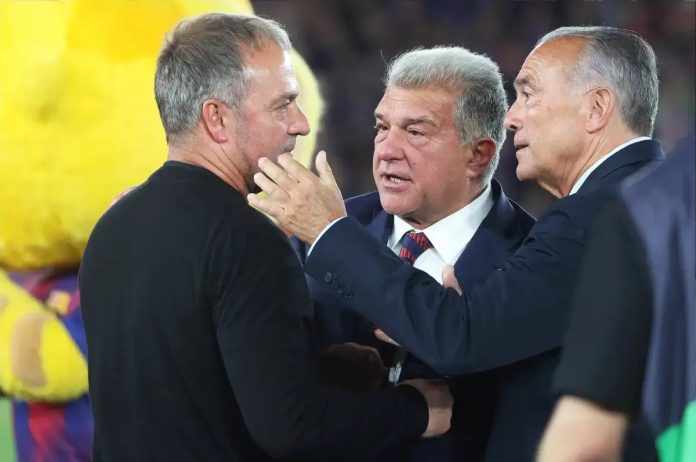
Hansi Flick is revolutionizing Barcelona, but is his legacy as bright as the titles won? The 61-year-old German coach arrived at the Catalan club in 2024 and has since become a unique figure in the blaugrana landscape: he is neither Catalan nor Spanish, has no historical ties to the club, and does not speak Spanish fluently, preferring to communicate in English. However, his controversial and audacious playing style has divided opinions among fans and experts, especially due to the disparity between success in La Liga and difficulties in the Champions League.
Under Flick’s command, Barcelona has returned to dominate the national scene with two consecutive La Liga titles (2024/25 and 2025/26), including an emblematic victory in El Clásico that reaffirmed the club’s supremacy over its eternal rival. Additionally, they won the Copa del Rey in 2024/25 and triumphed in the Supercopa de España in 2025 and 2026, placing Barcelona back at the top of Spanish football. However, the European scenario has been very different, marked by frustrating and controversial eliminations.
In the 2024/25 Champions League, Barcelona fell in the semi-finals in an epic clash with Inter Milan, with an aggregate score of 7-6 that was marked by an absolutely wild second leg. The defeat was even more bitter when Inter was thrashed by Paris Saint-Germain in the final, leaving a sense of missed opportunity for the Blaugrana. In the following season, the elimination occurred in the quarter-finals against Atlético de Madrid, a theoretically inferior team in the domestic league, but one that capitalized on Barcelona’s defensive errors and red cards in both matches to secure advancement.
The main reason for the European struggles lies in Flick’s playing style, which is based on high and aggressive pressing. While it has dominated La Liga, it has proven to be a double-edged sword against European teams capable of exploiting counter-attacks. The result? Barcelona often finds itself vulnerable when caught high up the pitch, with defenders and midfielders exposed, a situation that has proven costly in decisive matches.
Flick’s “gegenpressing” tactic is relentless and requires an extremely high defensive line, with players like Pau Cubarsí and Jules Koundé taking on crucial roles to press and regain possession quickly. However, unlike other teams that moderate their pressing intensity against stronger opponents, Barcelona maintains a high tempo regardless of the rival, a calculated risk that does not always pay off.
Another factor that makes Flick’s Barcelona so unique is the deeply opened flanks, with players like Lamine Yamal and Raphinha positioned along the touchline, exploiting the width of the pitch to create imbalances and open spaces. This offensive strategy is effective in dismantling defenses, but it leaves the club even more exposed to quick transitions, as the wingers rarely drop back to help defensively, and the full-backs push forward to support the attack, widening the space behind them.
Despite the criticism and European setbacks, Flick seems passionate about the project at Barcelona, and the club appears eager to ensure his continuity beyond 2027, when his current contract expires. The coach himself has publicly stated that this will be his last experience as a manager, not considering a move to another club.
“This will be my last job and I am very happy here,” Flick stated in March 2026. “I need to talk to my family, but we have time for that. I love working here. The most important thing for me is my family and the support I feel in Barcelona. But we know how football works, and we haven’t thought about leaving for another club.”
Hansi Flick is a coach who divides opinions with his risky yet effective style, his domestic success, and European disappointments. His legacy at Barcelona is far from straightforward, but it is undeniable that the German has returned the club to the top in Spain and left his mark on one of the world’s greatest football stages. The real question is whether he can, before he departs, break the European barrier and translate his philosophy into a continental triumph that confirms his genius. Until then, Barcelona finds itself at the crossroads between risk and glory.
This article first appeared on [Apito Final](https://apitofinal.pt/).
Discover more from Apito Final
Subscribe to get the latest posts sent to your email.

