


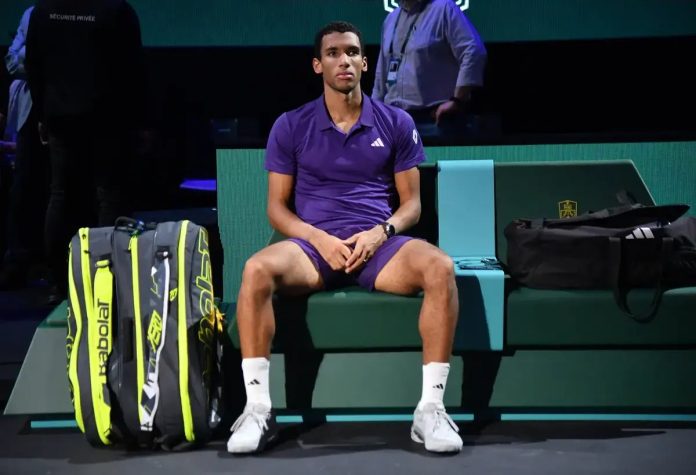
Tennis experienced another tense and revealing episode at the Masters in Monte Carlo, where the match between Félix Auger-Aliassime and Marin Čilić was abruptly interrupted by a medical emergency in the stands. This incident is not an isolated case, but rather part of a concerning trend that highlights the fragile line between sporting spectacle and human vulnerability.
As Čilić was leading 6-5 in the first set, the atmosphere changed rapidly. During the break between games, a spectator collapsed in the stands of the Rainier III Stadium, triggering a wave of concern and confusion. The chief umpire, Damien Dumusois, did not hesitate and immediately communicated the situation to the tournament referee, Stephane Apostolou: “Stephane, I think someone has collapsed in the stands on my left side, upper corner of the stadium. Centre Court.” The response was swift, with the game suspended until medical assistance arrived.
However, what should have been a quick action turned into an agonizing wait. Minutes passed without any help appearing. Dumusois, visibly worried, insisted that someone be sent to the stands: “Stephane, there is still no one there. Could you send someone to update me? We need to know if we continue playing or wait.” Meanwhile, Auger-Aliassime, still serving to stay in the set, tried to maintain his concentration and warm up, bouncing around near the bench.
Marin Čilić also struggled to contain his nerves, walking to the emergency area to try to understand what was happening before returning to his bench. Finally, medical assistance arrived and removed the spectator in a wheelchair, a moment that elicited sighs of relief from the audience. The referee confirmed: “The person is being taken out.” Only then was the match resumed, nearly eight minutes after the last point.
Despite the dramatic interruption, Auger-Aliassime displayed impressive mental strength. In the set tiebreak, he won 7-6 (7-4) and closed the match with a 6-3 victory, securing his place in the round of 16, where he will face Casper Ruud.
This incident at the Monte Carlo Masters is not an isolated case and highlights a growing concern in the professional circuit. Recently, several matches have been interrupted due to medical emergencies among spectators, raising serious questions about the readiness and effectiveness of medical teams at tournaments.
At the Miami Open, for example, the match between Coco Gauff and Sorana Cîrstea was interrupted for nearly ten minutes after a fan fainted in the stands. Referee Jennifer Zhang took the initiative, stepping away from her post to try to help, gathering ice and water while waiting for professionals to arrive. Gauff later criticized the delay of the medical team: “I want a faster response, it seemed like no one was coming, and it was my physiotherapist who ended up helping.”
Another similar situation occurred at the 2024 Australian Open during the semi-final match between Novak Djokovic and Jannik Sinner, when a medical emergency in the stands led to the suspension of the game. Paramedics had to intervene to assist the spectator, prompting applause of relief from the fans.
With the European summer exacerbating extreme weather conditions and making such emergencies more frequent, tournaments are increasingly pressured to strengthen their safety protocols and ensure faster, more effective medical responses. The balance between the excitement of the sport and the protection of spectators’ health is now at the heart of the debate.
Félix Auger-Aliassime, a young tennis prodigy, demonstrated not only talent on the court but also resilience at a time when the sport confronts its greatest human vulnerabilities. The warning has been issued: preparation for medical emergencies can no longer be a luxury but an absolute priority on the stages of world tennis.
This article first appeared on Apito Final.
Discover more from Apito Final
Subscribe to get the latest posts sent to your email.

