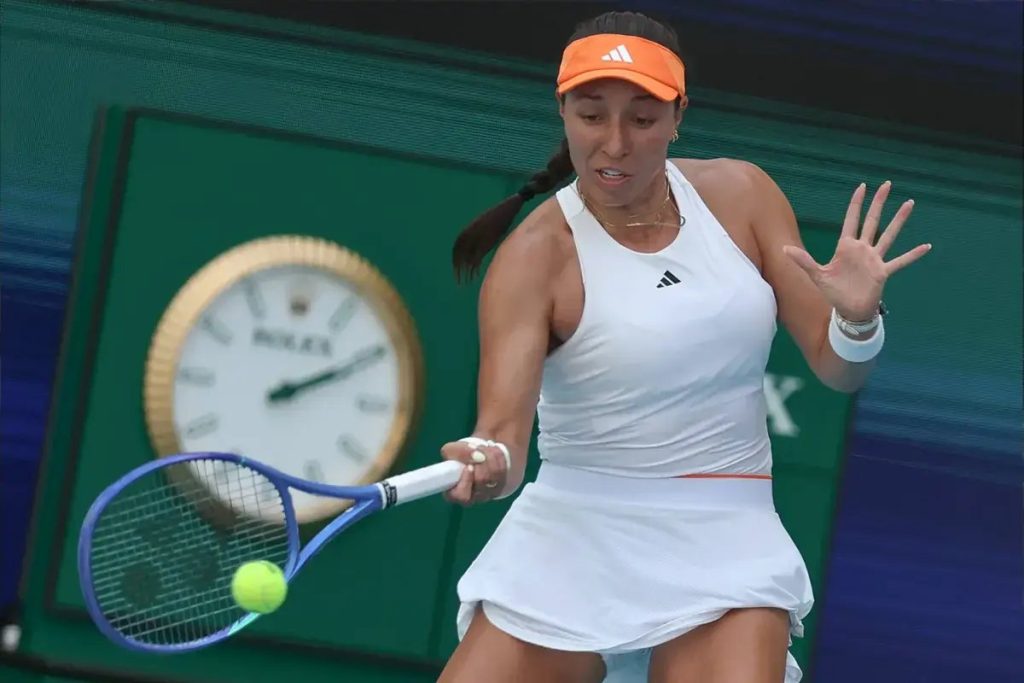
Jessica Pegula is back at the 2026 Charleston Open, bringing with her an intriguing combination of continuity and adaptation. The American tennis player, ranked number 5 in the world, returns to South Carolina not only as the defending champion but also with a new technical approach that has been carefully developed over the past six months. Pegula’s journey since mid-2025 has been marked by a corrective phase, following a brief period of inconsistent form. Between Wimbledon and Cincinnati last summer, she faced a tough stretch, accumulating a record of 2–4. This critical moment led Pegula and her coaching team to reassess key elements of her game.
The result of this analysis was an impressive sequence of performances that places her among the most consistent athletes on the circuit, especially with the clay season about to begin. Since her early exit at the 2025 Cincinnati Open, Pegula has reached at least the semifinals in seven consecutive tournaments, including major competitions such as the US Open, the Australian Open, and the WTA Finals. Her semifinal streak was only interrupted during the Sunshine Double, where she still delivered solid performances, reaching the quarterfinals at both Indian Wells and the Miami Open, being eliminated on both occasions by the current world number 2, Elena Rybakina.
This impressive sequence of results underscores Pegula’s consistency, who also carries the weight of her victory in Charleston in 2025, where she lifted the trophy on green clay as part of a season filled with finals and titles across various surfaces.
Pegula diagnosed her mid-season struggles from last year as not only physical but also a disconnection between execution and her identity as a player. In an interview at the Charleston Open, she reflected: “I didn’t feel like myself. I didn’t feel like I was playing my game.” This self-analysis led to a structured response alongside her coaches, Mark Knowles and Mark Merklein. Instead of introducing new tactics, the focus was on reinforcing existing strengths — such as ball striking, movement patterns, and serving efficiency. The goal was clarity, not reinvention. “My coaches and I worked on a lot of things to get my game back, emphasizing what I really do well, going back to the true roots of my game,” Pegula said.
The adaptations resulted in tangible improvements. Her ability to generate free points on serve increased significantly, while her baseline patterns regained the initial timing that defines her style. “We went back to emphasizing how I play tennis,” said the world number 5. “We returned to the basics of, ‘Okay, this is how you play. It’s special. How can we make this more efficient?’”
In addition to her individual journey, Pegula’s return to Charleston occurs within a broader context: the ongoing growth of American women in the WTA circuit. The tournament draw includes former champions such as Madison Keys and Sloane Stephens, as well as players like Iva Jovic, Sofia Kenin, and Hailey Baptiste, all contributing to a dense competitive field. Several American players remain established among the top 20 in the world, reflecting both depth and continuity at the highest level. Pegula has been a consistent presence in the Top 10 over the past few seasons, while her compatriots continue to achieve results on various surfaces.
“Our depth in the U.S. is really impressive right now,” Pegula said. “I feel like whenever I go deep in a tournament, there are several Americans there. It’s been amazing. I’m happy to be part of this era where all these girls are doing so well in the United States. It has definitely motivated me to see their success.”
The generational dynamic is also shifting, with younger players coming onto the scene and increasing the competitive pressure within the same national group. Pegula acknowledges this evolution, positioning herself as both a participant and a benchmark in this context. “It’s an honor to be part of this incredible group,” she added. “There are so many young players like Iva who are coming up, and I’m quite a bit older, which is really depressing. [Laughs.] I’m happy to be able to inspire and show the next generation that is coming.”
With this renewed approach and an increasingly competitive field, Pegula is ready to face the challenge of the Charleston Open, where expectations are high and the pressure is intense. Defending her title will be a test not only of skill but also of the resilience she has cultivated throughout her journey.
This article first appeared on Apito Final.
Discover more from Apito Final
Subscribe to get the latest posts sent to your email.