


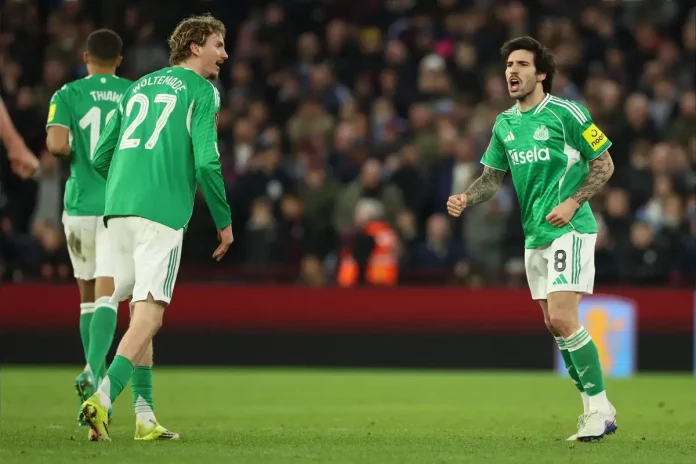
The last weekend brought to light a deplorable display of officiating, and what happened in the match between Aston Villa and Newcastle serves as a glaring example of the failure of the VAR system. Since the onset of discussions regarding the introduction of VAR, many warned that its implementation could result in a decline in the quality of refereeing. One does not need to be a specialist to realize that the presence of cameras to rectify mistakes may lead referees to relax, losing confidence in their own decisions. The case of Lucas Digne, who clearly committed a handball in the area and yet saw referee Chris Kavanagh award a free kick on the edge of the area, is a clear example of this problem.
Nick Greenhalgh, the assistant referee, was only 10 or 15 yards from the incident and failed to identify the mistake. The absence of VAR in this cup match exposed the weaknesses of the referees who, without the security of the system, proved inadequate for the task. However, this is not a defense of VAR, as some may suggest; it is precisely the opposite. The decision in question was clear and indisputable. In the pre-VAR era, such an error would have been corrected. Now, referees seem to be losing their ability to concentrate, relying too much on technology that, ironically, was supposed to enhance their performance. The system that was meant to be the solution has, in fact, corrupted the quality of officiating.
Many share the opinion that the standard of referees has drastically declined since the introduction of VAR. The very existence of this “safety blanket” has made the situation unsustainable. When commentators talk about the relief of playing without VAR, it is evident that frustration is widespread. Referees’ mistakes are being used to justify the presence of VAR, but that is not the function for which the system was designed. What is now observed is an increasing dependence of referees on VAR, which should not have been the initial goal.
Despite complaints from players and fans about the delays in decisions, PGMOL claims it will support the on-field decision whenever possible. However, the role of the referee seems increasingly obsolete; they spend the game waiting for guidance, becoming mere facilitators of decisions that should be theirs. The authority they once had is now fading, and their presence on the field resembles that of a bureaucratic staff member rather than an authority figure.
The VAR system, which only makes partial judgments, has not only made referees less effective but has also destroyed the experience of football. On-field decisions are becoming increasingly questionable, which paradoxically makes the recourse to VAR more necessary. However, since VAR only operates in specific areas and at certain moments, referees must make decisions in other parts of the field without that support, resulting in a widespread collapse of decision quality.
In light of the growing dissatisfaction with the performance of referees, it is unacceptable for football authorities to maintain the status quo. Why not expand the scope of VAR to cover the entire field at all times? If referees are demonstrating an increasing incapacity, why not strip them of their power and leave them as mere spokespersons for VAR? This radical solution may be the only way to save the game from mediocrity.
Recently, a wrong VAR decision disallowed a goal by Liverpool that was in accordance with the rules. Two decades ago, such an error would have been corrected. The same happened with a perfectly valid goal by Oxford and with several wrongly flagged offside situations involving Arsenal. What should have been an effort to make decisions more accurate has resulted in even greater confusion. The introduction of VAR has caused interruptions in the game, a kind of “coitus interruptus,” that spoils the excitement of goals.
When VAR was introduced, many predicted that it would eventually be used in all situations. This logic is becoming increasingly evident, given that the reliability of referees seems to be in free fall. The destruction caused by VAR has not yet reached its end. Only when attendance starts to decline will any kind of change be possible. However, as long as the culture of complaint prevails, nothing will change.
Discover more from Apito Final
Subscribe to get the latest posts sent to your email.

