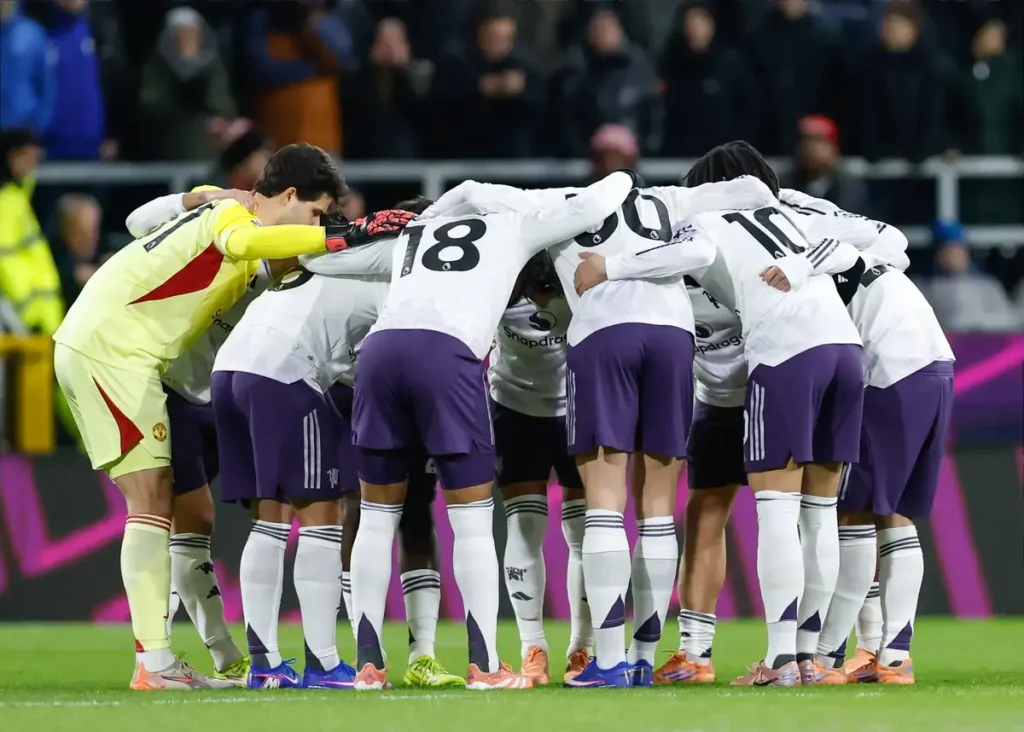
The landscape of English football is more tumultuous than ever, with Manchester United and Arsenal on diametrically opposed trajectories. While the Red Devils grapple with a post-Sir Alex Ferguson crisis, the Gunners seem stuck in a past they cannot shake off. The recent dismissal of Ruben Amorim only intensifies the uncertainty surrounding the Manchester club, raising questions about its future and true identity.
Reflecting on the situation, it is impossible not to recall the famous video by comedian Michael Spicer that went viral seven years ago, where he captures the essence of the conversation about Manchester United: “This is Manchester United Football Club, one of the biggest football clubs in the world.” This phrase resonates with an unsettling truth. The idea of a “DNA” of Manchester United is often evoked, but many wonder if this “identity” truly exists. For many fans, clubs like Ajax and Barcelona, with their deeply rooted philosophies, are examples of what it means to have a true DNA. The connection between Johan Cruyff and these clubs exemplifies the continuity that Manchester United seems to have lost.
Outside the Ferguson era, United is nothing more than a club in search of an identity, a state that places it alongside clubs like Aston Villa in the hierarchy of English football. The reality is that Ferguson never confined himself to a single philosophy during his 26-year reign at Old Trafford. He was a master of adaptation, changing tactics and styles to stay ahead of the competition. Thus, when analysts talk about the “way” or the “DNA” of Manchester United, they are actually yearning to revive the glorious years under Ferguson. However, it is time for the club to free itself from the shadow of its former manager, who, in turn, did not leave a legacy that could endure.
On the other hand, we have Arsenal, which, despite being at the top of the Premier League, seems unable to overcome the pains of the past. The goalless draw against Liverpool, the current champions, left fans in an uproar, creating an atmosphere of despair around the Emirates Stadium. With the possibility of falling further behind in the table, the Gunners missed a crucial opportunity to consolidate their lead. The internal pressure is palpable, and the doubt about the team’s ability to handle pressure is becoming increasingly evident.
Data shows that Arsenal has been a dominant force, leading both the Premier League and the Champions League, but the “bottlers” mentality that has clung to the club is a difficult barrier to break. Mikel Arteta’s challenge is monumental: he needs to convince both players and fans that Arsenal is a club with a rich and victorious legacy, and not just an institution marked by failures and disappointments.
The duality between Manchester United and Arsenal is emblematic. While United strives to reclaim its former glory, Arsenal must learn to leave the ghosts of the past behind. The future of these two powerhouses of English football may be more interconnected than one might think. For one of them, change is imperative, but the big question remains: are they ready to put the past behind them and embrace a new future? Time will tell, but what is certain is that English football will continue to be an exciting stage for these two stories.
Discover more from Apito Final
Subscribe to get the latest posts sent to your email.