The recent setback for Liverpool at Craven Cottage was not just a bitter defeat; it was a loud warning about structural weaknesses that could jeopardize the team’s season. With a late equalizer, the conversation extends beyond the result to the failures that allowed Harrison Reed to score a spectacular goal, ruining what seemed to be a hard-fought victory.
Jamie Carragher, former Liverpool defender and now a commentator for Sky Sports, analyzed the crucial play that preceded Reed’s goal, and his conclusion is clear: Liverpool’s defensive structure left much to be desired. “It was an incredible goal,” Carragher admitted, but emphasized that “it shouldn’t be that easy to get a shot just outside the box.” The issue is not just the result, but how the team allowed this to happen.
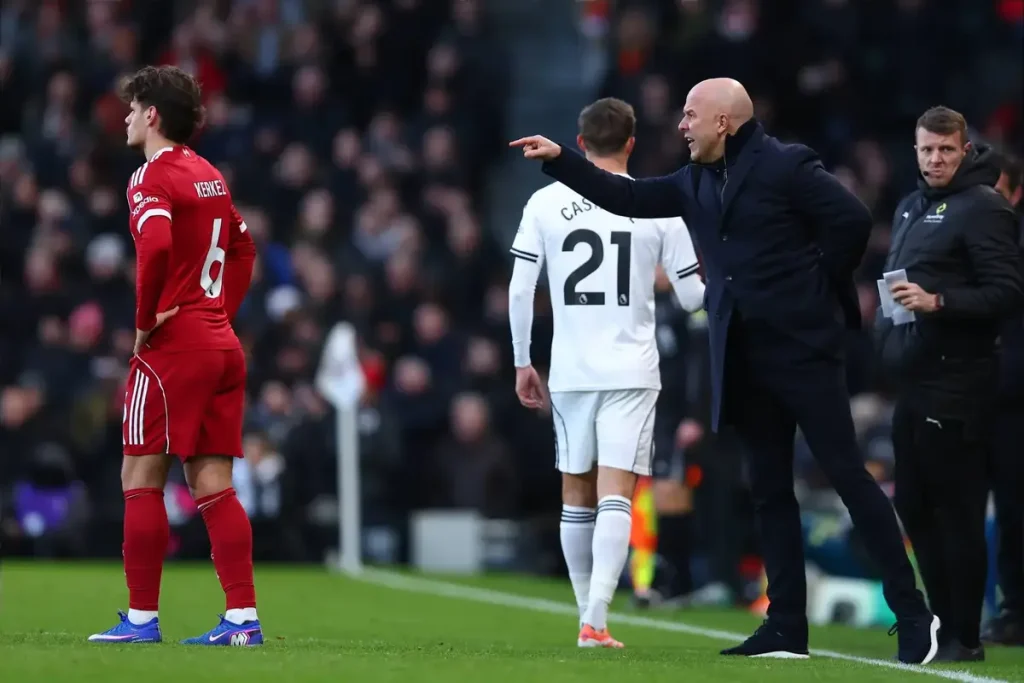
Carragher dismantled the play, focusing on a throw-in from Fulham that occurred nearly ten minutes before the goal, where a worrying pattern was already evident. Liverpool adopted a heavy man-to-man approach, while players like Ibou Konaté, Virgil van Dijk, and Milos Kerkez occupied zonal positions. This setup, according to Carragher, resulted in a congestion around the area, allowing Fulham to exploit shooting angles rather than simply clearing the ball forward.
“We’re giving up space at the edge of the area,” Carragher highlighted, “which unfortunately has become an invitation that was accepted.” The courage of Fulham to withstand pressure and opt to play the ball rather than seek quick relief was praised by the former player, but this should not serve as an excuse for Liverpool’s lack of control.
Curtis Jones, the young talent of the team, acknowledged that during the break there was a discussion about the need to show more grit, reflecting the mediocrity of the first half. This honesty resonates with Carragher’s analysis, who believes that the failures are more structural than merely a matter of bad luck. John Aldridge, another former Liverpool icon, also expressed a resigned acceptance, suggesting that if the team cannot win in the final moments, “that is the only way to accept the situation,” while pointing out that the long-term goal now seems to be merely finishing in fourth place.
This late goal fits into a worrying trend, being the seventh goal with the lowest xG (Expected Goals) that Liverpool has allowed in the league or European competitions since 2017. Despite Liverpool remaining competitive under Arne Slot’s leadership, moments like this highlight how small details can determine the course of games.
Carragher’s analysis, far from being alarmist, is a call to action. While he acknowledges that Reed’s shot could be considered “one of the best of the season,” he emphasizes that the situation that allowed such a goal must be urgently addressed. If Liverpool wishes to control games, it is imperative that they restrict what happens at the entrance to their own area, as much as what they create up front.
In the coming days, the team will need to work hard to correct these gaps if they want not only to compete but also to win. Time is running out, and the fans demand answers.
Discover more from Apito Final
Subscribe to get the latest posts sent to your email.