


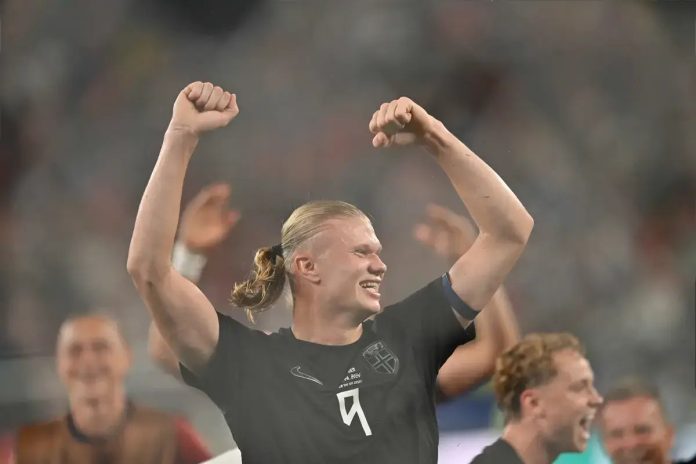
Erling Haaland and Kylian Mbappé will finally go head-to-head in what promises to be one of the most explosive encounters of the group stage of the 2026 World Cup, with the Gillette Stadium in Foxborough serving as the venue for the much-anticipated clash that could decide the fate of Group I. Norway, led by the forward from Manchester City, has returned to the world’s biggest competition after nearly three decades of absence and has already made history, but now faces the ultimate test against a star-studded France team led by a red-hot Mbappé.
The Norwegian national team, led by Ståle Solbakken, surprised many by defeating Iraq and Senegal in their first two matches, scoring seven goals and conceding only three. This impressive start has allowed Norway, for the first time, to secure more than one victory in a single World Cup edition, ensuring their presence in the knockout stage, something unprecedented for the Vikings. Nevertheless, they have never beaten a European team in World Cups—suffering three defeats in five matches—and it is precisely against a formidable France that they may break this curse.
O MUNDIAL 2026 VIVE-SE COM A LEGO
Erling Haaland’s name is at the center of attention: after scoring twice in both of his first two matches, the forward could become only the third player in World Cup history to score two goals in each of the first three matches of the tournament. On the other side, Kylian Mbappé is matching him — he too scored two goals in each of France’s victories in this edition, raising his total to an impressive 16 goals in finals, equaling Miroslav Klose as the second all-time top scorer, just behind Lionel Messi, who has 18. It is worth noting that Mbappé reached this milestone in 12 fewer matches than the Argentine star, further emphasizing his status as a phenomenon in world football.
This clash between Haaland and Mbappé promises not only to shake up the race for the Golden Boot but could also redefine the hierarchy of international football. Norway arrives buoyed by a talented generation and with nothing to lose, while France has the obligation to confirm its favoritism and remain among the main title contenders. The outcome could have a direct impact on the matchups in the Round of 16, making the game absolutely decisive.
However, the protagonists are not limited to the forwards. Goalkeepers have been in the spotlight in this edition of the World Cup, often for the worst reasons. Vozinha, a veteran from Cape Verde, has become a sensation on social media, amassing nearly 16 million followers on Instagram after a monumental performance against the powerful Spain, which resulted in a goalless draw. Meanwhile, Eloy Room from the Curaçao national team set a new tournament record by making 15 saves in a single match against Ecuador, securing the first point ever for his team in a final stage.
Not everyone has had the same luck. Luca Zidane, son of the legendary Zinedine, had a disastrous performance in the 3-0 defeat against Argentina, raising doubts about his reliability at the highest level. Nizar al-Rashdan from Jordan further compounded the situation for the Granada goalkeeper in the second round. Edouard Mendy, for his part, found himself embroiled in controversy after a compromising performance against Norway, which could precipitate Senegal’s early elimination, having lost both of their first group matches.
The goalkeepers’ mistakes have reignited the debate over the official World Cup ball, the ‘Trionda’. Many are questioning whether the innovative design is causing unpredictable trajectories, making life difficult for the guardians of the goal. Adidas assures that it has subjected the ball to more than 300 laboratory tests, aiming to ensure “a more predictable trajectory.” However, researchers from the Women’s University of Seoul and Tsukuba University attribute the erratic behavior to a phenomenon known as “drag crisis,” which occurs when, at a certain speed, the air around the ball becomes turbulent, reducing friction and making the movement less predictable. The controversy recalls the nightmare of the ‘Jabulani’ 16 years ago in South Africa, and promises to continue generating discussion.
Meanwhile, Ecuador has pulled off one of the biggest surprises of this group stage by defeating Germany and securing a place in the Round of 16, something that hasn’t happened in 20 years. After failing to score in the previous two matches, La Tri needed to win Group E against the German giant, a task that seemed impossible. However, Nilson Angulo and Gonzalo Plata were the heroes of a historic turnaround at MetLife Stadium, sealing qualification as one of the best third-placed teams and demonstrating remarkable resilience.
In the coming days, all eyes will be on the Haaland-Mbappé duel and the evolution of the ‘Trionda’ controversy. The race for the Golden Boot is heating up, with every goal and every save potentially deciding the fate of the favorites. The outcome of Group I will determine not only who advances, but also who could be the next to make history in this World Cup, which challenges all expectations with each matchday.
NOW YOU CAN FOLLOW THE WORLD CUP WITH ALL THE INFORMATION – HERE
Discover more from Apito Final
Subscribe to get the latest posts sent to your email.

