


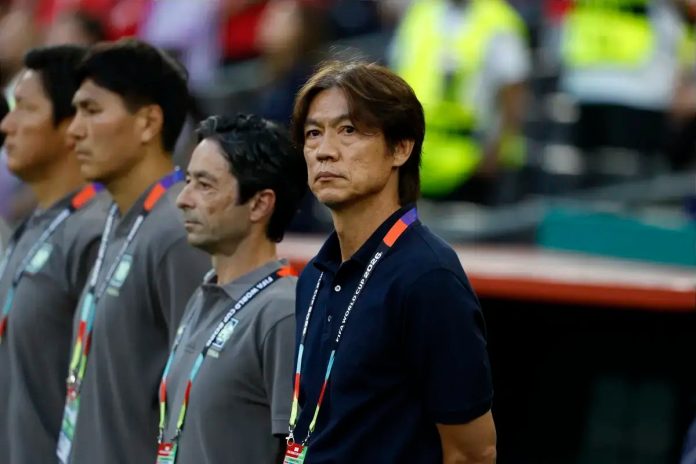
The elimination of South Korea from the 2026 World Cup has triggered a genuine national upheaval, sending shockwaves throughout the entire Korean football community. Not even the legendary status of Hong Myung-bo, the historic captain of the 2002 team, spared him from the wrath of fans and media pressure, leading him to resign just hours after the disappointment was confirmed. Protests escalated to levels rarely seen, with death threats directed at the coach and the locations of the players and coaching staff’s returns to the country kept secret for security reasons.
Hong Myung-bo, who led the national team in both 2014 and this failed campaign, announced his departure on Sunday, visibly emotional. “I am genuinely very sorry,” said the former coach, acknowledging the magnitude of the failure immediately after the team’s exit from the tournament. This forced resignation comes amid a backdrop of significant dissent, exacerbated by the words of iconic Park Ji-sung, former player of Manchester United: “It is miserable that we have reached this point where we need to look back and ask how we ended up here,” he lamented, reflecting the sense of frustration that permeates the entire nation.
THE 2026 WORLD CUP LIVES ON WITH LEGO
The crisis cannot be explained solely by two disastrous weeks in Mexico – discontent had been brewing for months. South Korea started Group A with a promising victory against the Czech Republic, winning 2-1, but soon followed it up with a 1-0 defeat to Mexico, leaving the team, filled with stars like Son Heung-min (Tottenham), Lee Kang-in (Paris Saint-Germain), and Kim Min-jae (Bayern Munich), reliant on a draw against South Africa to secure qualification. However, Hong chose to leave Son on the bench, and the team ultimately lost. Former international Lee Young-pyo did not hold back in his criticism: “It was the worst game by a Korean national team in the 21st century,” he declared live on television, further increasing the pressure on the coach.
The atmosphere during the internship was anything but peaceful. In June, journalists captured disparaging comments about Son’s military history, who obtained exemption from mandatory service after winning the Asian Games in 2018. In response, the players boycotted domestic media obligations for days. Son, who turns 34 in July, may be preparing to bid farewell to the national team, and there will not even be a public ceremony upon his return to the country – the planned event was canceled due to the climate of hostility.
The scandal transcended the pitch and reached national politics. President Lee Jae-myung issued a statement on social media, expressing that he felt “not only confusion but total perplexity at this unexpected outcome” and pointing the finger at mismanagement: “When favoritism and nepotism overshadow competence in the selection of the commander, the result is as predictable as fire burning paper,” he wrote, in an open criticism of the leadership of the Korea Football Association (KFA).
Chung Mong-gyu, president of the KFA since 2013 and a member of the powerful Hyundai family, is at the center of the controversy. He has faced criticism for hiring Hong Myung-bo outside of the usual procedures, repeating the controversy from a year earlier with Jurgen Klinsmann. The dissent spread to the fans, who booed Hong during his very first match, and to the government itself, with the Ministry of Sports recommending the suspension of Chung and other officials. The KFA responded with a court injunction, allowing Chung to remain in office and secure a fourth term in February 2025.
The future of South Korean football is at a critical juncture. The national team has lost international prestige, and a toxic environment threatens to drive away talent and sponsors. The pressure on the KFA to reform its governance is now unsustainable, and there are calls for a complete overhaul of the federation’s structure. With the possibility of Son Heung-min leaving the national team, South Korea risks losing its biggest icon at a time when it needs stability and leadership.
In the coming months, all eyes will be on the federation elections and potential structural reforms. The Federation will need to rebuild trust with fans and restore the international image of South Korean football while dealing with the bitter legacy of this failure. The cycle of change promises to be turbulent – and the country will not forgive another setback.
NOW YOU CAN FOLLOW THE WORLD CUP WITH ALL THE INFORMATION – HERE
Discover more from Apito Final
Subscribe to get the latest posts sent to your email.

