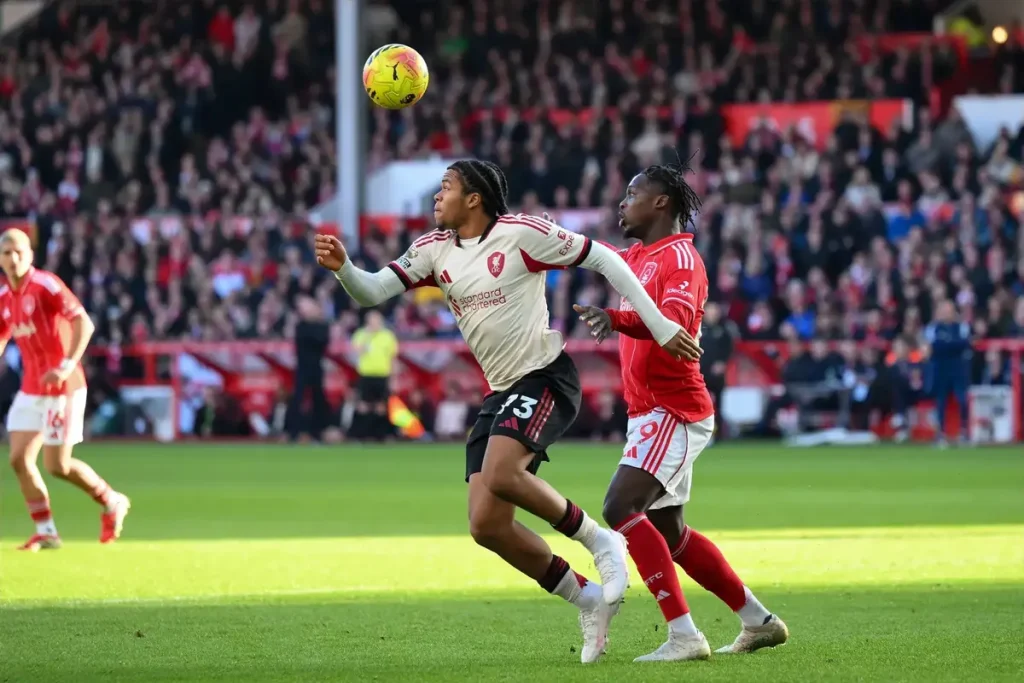
The impressive performance of Rio Ngumoha in Liverpool’s recent 1-0 victory over Nottingham Forest has sparked a heated debate about his playing time. The discussion now goes beyond the simple issue of the young 17-year-old winger’s talent; the real question is whether Arne Slot, the team’s coach, will be able to keep Ngumoha in a limited role for much longer.
After the final whistle, the conversation quickly escalated, with many questioning: “Why isn’t Rio Ngumoha playing more?” This concern is not limited to fans. Former Liverpool forward Daniel Sturridge did not hesitate to voice his opinion: “Whenever I see Rio Ngumoha, he looks electric. Direct, fearless, always trying to affect the game. He deserves more minutes. Simple as that.”
However, Slot’s explanation is based on player development, not on selection preference. “I don’t think there is a young player of 18 or 19 years old who has played as many minutes as Rio… that says a lot about his talent.” The Dutch coach’s argument is supported by concrete data. Ngumoha has already made nine appearances in the Premier League, more than any other player under 18 this season. However, when we analyze the numbers more deeply, the situation reveals itself to be ambiguous: he has only accumulated 89 minutes played in the league, a statistic that places him 55th among young players in the Premier League.
This paradox is crucial to the discussion: on one hand, Ngumoha is frequently on the field, but on the other hand, his appearances have been limited in terms of actual playing time. The match at City Ground perfectly exemplifies this situation. After Florian Wirtz’s injury during warm-up, Liverpool lost control of the game, with Dominik Szoboszlai moved to the right-back position, resulting in a lack of offensive unpredictability. It was then that Ngumoha came into play.
Darren Bent accurately described the impact the young player had on the game: “Rio Ngumoha did an excellent job… he changed the match… he just puts the cross into a very good area.” The play resulted in a situation where Alexis Mac Allister appeared to have scored before VAR intervened, and the dynamics of the game notably shifted after the teenager’s introduction.
This is not an isolated occurrence; Ngumoha has repeatedly influenced matches in short bursts of time, reinforcing the idea that Liverpool is physically protecting him, rather than doubting his technical abilities. The BBC’s analysis also raises a broader concern that many clubs quietly consider: the heavy workload on young forwards can affect their longevity, which is why careful management is often deliberate rather than cautious.
Currently, Slot’s approach seems logical. A 17-year-old winger is facing defenders aged between 25 and 28. Liverpool’s manager highlighted this physical reality: “For him to show that at just 17 years old says something about his talent. But… talent is just the beginning of his career.”
However, the match against Forest also revealed a different risk. The team lacked decisive options on the bench until Ngumoha came on, whose involvement immediately brought width, unpredictability, and direct running that had been absent for over an hour. This is precisely why the debate over the young player’s usage is intensifying rather than fading away. Liverpool is clearly protecting Ngumoha, but performances like this one increasingly suggest that we are postponing something inevitable.
Discover more from Apito Final
Subscribe to get the latest posts sent to your email.