


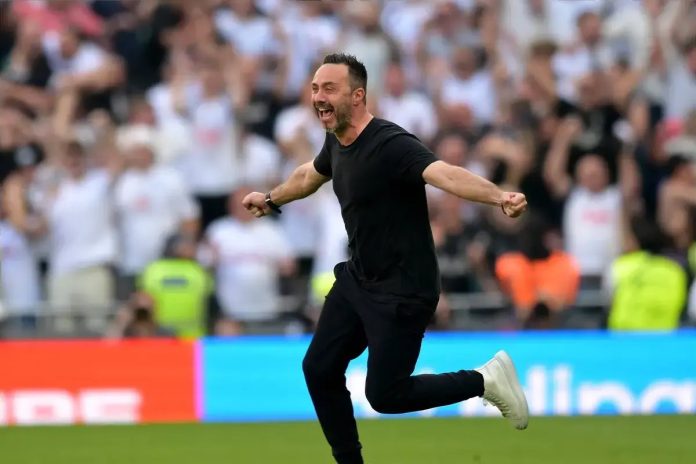
Tottenham is at a critical and decisive moment after dramatically avoiding relegation on the final day of the Premier League. Roberto De Zerbi, the Italian coach who took over at the end of the season, wasted no time in sending a clear and strong message to the management: the club needs a deep revolution, but without radical changes to the squad. “From today we need to start organizing and building a new team. I don’t think it’s necessary to change too many players. We have 10, 11, 12 players good enough to stay. Good players, especially good people. Then, we need to complete the squad with top players,” De Zerbi stated plainly.
The coach does not hide his frustration with how the club has been managed so far, especially at a time when relegation seemed inevitable. Tottenham ended the season with an impressive record of 11 points in the last six games, a clear sign that the team can and should aim higher next season. However, that ambition will only materialize if the club’s structure is aligned and fulfills the promises made to De Zerbi, something the coach knows that, historically, Tottenham rarely manages to achieve.
The ghost of “Never Again” looms over the club, a phrase used to describe the almost catastrophic scenario of relegation that was narrowly avoided. This warning had already been ignored last summer, which cost a trophy-winning coach his position. If the team wants to avoid further misery, radical changes are essential.
At the top of the pyramid, the situation is delicate. The club’s ownership, led by Vinai Venkatesham and the ENIC family, is far from inspiring confidence. Tottenham, once profitable, is now sinking into losses and mounting debts. Vinai’s arrival has not brought the expected improvements, and his connection to Arsenal only heightens fans’ distrust, who have already lost patience with disastrous decisions, such as the hiring of Igor Tudor and the delay in the departure of Thomas Frank.
Fan dissatisfaction is clear: they want Vinai and ENIC out of the club, but they know this will not be an easy battle, nor a short-term one. Until then, Tottenham must find stability, which could start with the sporting structure. Johan Lange, the sporting director, is one of the main targets of criticism. Since his arrival, the club has fallen from the top of the Premier League to a chaotic state, with almost no signings standing out positively. His insistence on not “panicking” during the January window was seen as a serious mistake, as the club needed an urgent response. Lange must go, and the name of Sebastian Kehl, former sporting director of Borussia Dortmund, emerges as the ideal replacement. Kehl understands what it means to manage a big club with ambitions and could be the key to the Spurs’ revival.
The medical department, another thorn in Tottenham’s side, is undergoing a thorough review. After seasons marked by inexplicable injuries and poor clinical management, the club cannot continue to accumulate injuries to key players like Kulusevski, Maddison, and Kudus. The condition of the pitch at the new stadium is also being questioned, but the real issue seems to lie in how injuries are treated and managed.
In terms of sports planning, the reconstruction of the squad will be intense. De Zerbi revealed that only about a dozen players belong to the future project, which means that many departures are expected. Among those likely to leave the club are names like Cristian Romero, whose leadership has been questioned due to injuries and behavior, and Richarlison, who, despite scoring 11 goals, does not seem to be part of the coach’s plans. The situation of Randal Kolo Muani, whose loan is unlikely to be converted into a permanent transfer, and goalkeeper Guglielmo Vicario, who is expected to return to Italy, is also practically defined.
On the other hand, players like Micky van de Ven, Pedro Porro, and Conor Gallagher seem to be the bets for the immediate future, with Van de Ven being the main candidate for the new captaincy, replacing Romero. Loaned players like Luka Vuskovic and Mikey Moore will also have the opportunity to showcase themselves in the preseason, in a battle for spots that promises to be fierce.
As for reinforcements, De Zerbi wants “top-level” players as soon as possible for the preseason, despite the complications of the calendar due to the World Cup. The club aims to strengthen the attack, where a lack of creativity and goals was evident throughout the season. The possible retention of Maddison, Kulusevski, and Kudus, when recovered, could bring new life to the offensive sector. Additionally, names like Andy Robertson are targets to add experience and leadership, while Marcos Senesi could be a quick and effective signing for the defense.
The goalkeeper position is also open, with the need for a solid competitor for Antonin Kinsky, and James Trafford emerges as a possibility, although there are reservations regarding his immediate starting role.
Finally, the coach makes it clear that Tottenham needs a revolution, but a measured one, focused on building a strong and cohesive team that can regain lost prestige. The upcoming season will be crucial to determine whether this “De Zerbi revolution” is merely a dream or the beginning of a new era for the Spurs.
The truth is that Tottenham is at a critical turning point: the club must act quickly, with clear decisions, and above all, with courage, to prevent the ghosts of the past from haunting the team and its supporters again. This summer promises to be hot in London, and the revolution at Tottenham could be the biggest spectacle off the pitch in the Premier League.
This article first appeared on Apito Final.
Discover more from Apito Final
Subscribe to get the latest posts sent to your email.

