


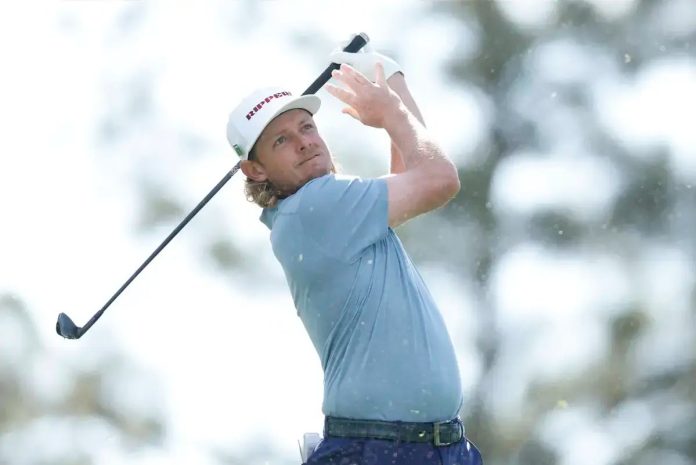
The phenomenon known as “The LIV Effect” is igniting the world of golf, and Cameron Smith is at the epicentre of this storm. After a devastating collapse at the Masters in Augusta 2026, the Australian saw his reputation dramatically shaken, with six consecutive missed cuts in majors raising a question that refuses to go away: is his connection to the controversial LIV League destroying his career?
In 2022, Cameron Smith seemed unstoppable. After a historic victory at the Open Championship in St Andrews, where he shone with a final round of 64, it was expected that he would continue to be one of the major protagonists in the majors. However, since signing a multi-million pound contract with LIV Golf, valued between 140 to 150 million dollars, his performance in major tournaments has been disappointing. At this year’s Masters, Smith displayed an unstable game with rounds of 74 and 77, finishing seven strokes over par and missing the cut by three strokes. This was his sixth consecutive missed cut in majors, a worrying record that starkly contrasts with his results before joining LIV.
Before the move to the LIV League, Smith had a solid record at Augusta: three consecutive top-10 finishes between 2020 and 2022, including an impressive second place in 2020 and a third in 2022. Already within LIV, the results started reasonably, with a 34th place in 2023 and a sixth in 2024. However, from 2025 the reversed trend became evident, with the Australian missing the cut in all four majors that year, an unprecedented feat for a professional of his calibre. The continuation of this poor form in 2026, with another missed cut at the Masters, only reinforces the idea that something is deeply wrong.
This case is not isolated. Jon Rahm, Masters champion in 2023, has also felt the weight of the move to LIV, unable to secure a third major since then. At the 2026 Masters, Rahm managed to make the cut but was far from the lead, finishing with rounds of 78 and 70, 16 strokes behind leader Rory McIlroy.
The scenario at this year’s Masters reveals a worrying panorama for LIV Golf. Of the 10 players from the League present in Augusta, half failed to make the cut. The most emblematic case was Bryson DeChambeau, who arrived as a favourite after two consecutive victories in LIV, but unravelled with a triple bogey on the last hole on Friday, finishing the tournament six strokes over par. Among those who survived, only Tyrrell Hatton, with four under par, seemed capable of challenging McIlroy. The early defeat of DeChambeau, the most prepared LIV player for Augusta, highlights the league’s lack of competitiveness on the big stages.
Golf analyst Brandel Chamblee had no doubts in criticising the LIV players: “They are not being challenged, they are not being tested, and therefore they are not prepared.” This brutal analysis is reflected in the numbers: Cameron Smith, despite the difficulties in the majors, remains competitive in LIV, with an 8th place in Adelaide, another in Singapore, and occupies the second position in scrambling in the 2026 season. The problem seems to be the inability to perform at the highest level when the pressure of the big tournaments is on.
On social media, the outrage is palpable. Smith’s dark streak has not gone unnoticed by fans, who see in it a pattern that has lasted for two years. Comments like “Another player who would benefit immensely if he returned to the DP World and the PGA Tour” or “The LIV Effect” proliferate, suggesting that the connection to LIV is undermining the performance of its athletes. Koepka’s departure from LIV before 2026 only adds fuel to this narrative.
The discontent among fans is clear: “LIV destroyed great players,” writes one follower. Many point to the lack of competitiveness inherent in the LIV format, which has no cuts during the weekend, removing the pressure of “making the cut” that defines the majors. “They took the LIV money and stopped practising, they show up on game day just to have fun, without any competitive edge,” comments another fan.
Cameron Smith now enters a decisive phase of his career and the 2026 majors season. The question that remains is whether there will be a possible response without a radical change in his competitive schedule. The “LIV Effect” is proving to be a heavy shadow that threatens to extinguish the shine of players who were once absolute stars in the most prestigious competitions in the world of golf. For Smith and others, the clock is ticking – the future of their legacy may very well depend on what they do next.

