


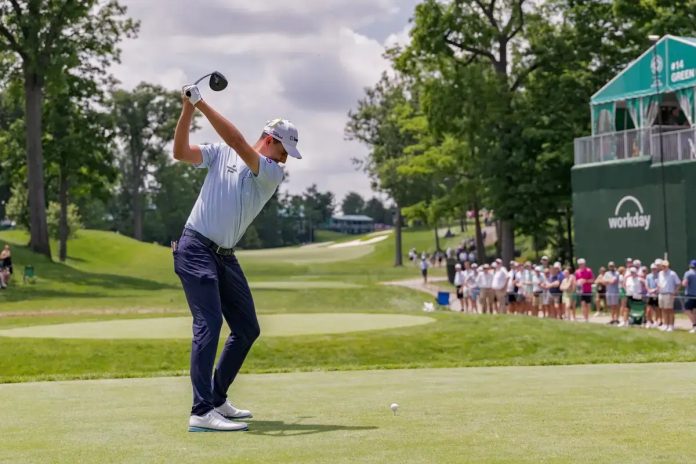
A controversial decision at the 2026 Travelers Championship is igniting social media and dividing opinions among fans and experts, after Mac Meissner benefited from an unlikely exemption thanks to the presence of a fixed television camera in a bunker at TPC River Highlands. In a moment of high tension, Meissner saw his bunker shot – already one of the most complicated in golf – radically transformed by an external element unrelated to the pure challenge of the course.
Everything happened on Friday during the round of the Travelers Championship when Meissner’s ball became partially buried in the sand of a bunker near the green, a situation that typically requires extreme skill. However, his swing was blocked by a broadcast camera installed in the bunker, leading PGA Tour officials to grant him a free drop – a decision that quickly went viral on social media, with thousands of fans questioning the fairness and seriousness of the organization.

*The World Cup is experienced with LEGO*
[THE 2026 WORLD CUP IS EXPERIENCED WITH LEGO](https://www.lego.com/pt-pt/categories/football/football-gifts-toys)
The controversy erupted when Joseph LaMagna, a golf analyst, shared on X: “So Mac Meissner just got a free drop in a bunker because his shot interfered with a bunker camera?? The PGA Tour isn’t serious,” he commented on June 26, in a post that quickly surpassed 98,000 views. Many fans did not hesitate to express their outrage, arguing that the presence of television elements should not alter the outcome of a shot. A plugged ball represents one of golf’s greatest challenges, forcing the player to deal with particularly adverse conditions. However, in this case, the broadcast camera altered the context, creating an unprecedented and controversial situation.
The official explanation is based on the PGA Tour’s Model Local Rule F-23, concerning Temporary Immovable Obstructions (TIO). These structures—cameras, towers, stands—are implemented to serve the spectacle, not the course, and according to the rules, if they interfere with a player’s stance or swing, relief is permitted, even in bunkers. It is important to note that, according to Rule 12, the bunker must test the player’s skill, and Rule 15, which addresses loose impediments and movable obstructions, does not apply to fixed cameras. The case of Meissner thus reignites the debate about the extent to which television presence can influence the competitive outcome of a tournament.
This is not the first time a camera in a bunker has changed the course of events. In 2020, at the Players Championship, Mackenzie Hughes faced a similar situation, with his ball buried just inches from a television camera. Jon Rahm, in 2023, also benefited from relief due to a TIO, generating a similar wave of indignation among fans. The common denominator: the increasing interference of television media in the integrity of competition.
The context of this decision is even more relevant considering that, at the beginning of 2026, the PGA Tour tightened other relief procedures, reducing, for example, the “preferred lies” from a full club length to the length of a scorecard, reinforcing the idea that the outcome should reflect, as closely as possible, the actual position of the ball. This tightening in certain areas contrasts with the flexibility demonstrated in TIO cases, increasing the sense of a duality of criteria.
The online reactions were swift. Under the original post, fans expressed disbelief and sarcasm, comparing it to the U.S. Open, which took place just days earlier: “Going from Shinnecock to TPC River Highlands is a real shock.” Others questioned the television broadcast itself: “Seriously? Did the broadcast think it was an unplayable ball or did I miss the part about the free drop?” One fan went further: “The broadcast insisted it was an unplayable ball, but I suspected something sinister was going on.” The cameras themselves faced criticism: “The bunker cameras are not as amusing as the producers think.” And the question arose: “How much does a bunker camera actually cost?” For many, frustration goes beyond this case, questioning the use of TIO in major events: “The PGA Tour should ban TIO from the Championship Series.”
Mac Meissner, still an emerging name on the circuit, has cemented his reputation for a consistent and understated approach since turning professional. According to our findings, the Tour did not create a rule tailored to this situation – the exemption already existed, it was just applied. However, this episode reignites the old discussion: is the presence of television distorting the fairness of competition at the highest level?
Looking to the future, this incident promises to fuel a deep debate about the role of technology and television broadcasting in major tournaments. With public pressure and that of the players themselves increasing, it is not out of the question that the PGA Tour may be forced to reconsider the framework of the TIO, seeking to balance the television spectacle with the purity of the sporting challenge. For Meissner, this controversy could serve as a catalyst to establish his name among the elite of golf, but for the sport, the question remains: to what extent can the pursuit of the best television angle continue to overshadow the integrity of the competition? The answer may determine the future of broadcasts and the rules of professional golf in the upcoming seasons.
NOW YOU CAN FOLLOW THE WORLD CUP WITH ALL THE INFORMATION – HERE
Discover more from Apito Final
Subscribe to get the latest posts sent to your email.

