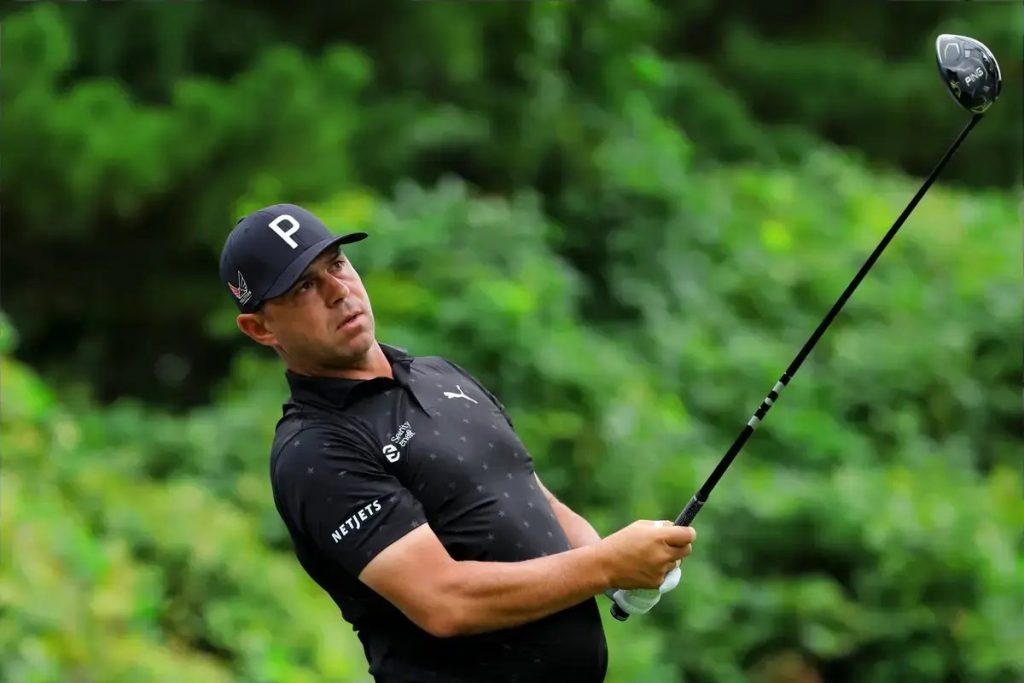
Gary Woodland, one of the most respected names in modern golf, made a shocking revelation that has left the sports world on high alert. During his participation in the 2025 Procore Championship, Woodland faced a devastating episode that brought to light his history of PTSD, a moment he described with a trembling voice and tear-filled eyes. What happened that day serves as a brutal reminder that behind the facade of an invincible athlete, there may be invisible battles, and Woodland’s courage in sharing his experience is a sign of the necessary change in sports.
“Butch, these things are affecting me, man. Don’t let anyone come up behind me,” were words that said it all. A simple contact from a scorer approaching was enough to make his world crumble. Woodland not only lost himself in tears but also in confusion. He couldn’t remember which hole he was playing, a situation that culminated in a series of emotional crises that led him to cry in the bathrooms of the course. “I started to cry,” he confessed to Rex Hoggard from Golf Channel. “I’m here for them. I can’t leave them alone playing in pairs.”
The moment was even more significant because Woodland was there as the vice-captain of the U.S. Ryder Cup team, supporting Scottie Scheffler and the rest of the squad. The pressure of being a leader, along with his internal struggle, made everything even heavier. His caddy, Butch Harmon, handed him a pair of sunglasses to hide his pain, but the fight continued, leading him to seek refuge in every bathroom throughout the day.
In September 2023, Woodland underwent surgery to remove a brain lesion and received a formal diagnosis of PTSD about a year earlier. Since his experience in Napa, the Tour has begun implementing safety protocols to ensure his well-being during competitions. “I have a lot of fight in me, and I’m not going to let this win,” he stated, his voice nearly breaking. “But it has been difficult.”
At 41 years old, Gary Woodland received the Courage Award from the PGA Tour for 2025 for his bravery in returning to competition, but he made it clear that his battle is not over. His decision to speak openly about his struggle resonates beyond his personal journey, as the challenges of mental health in professional golf are not new.
Mental pressure has been a silent constant in the lives of professional golfers. Bert Yancey, a legend from the 1960s, struggled with bipolar disorder and underwent psychiatric treatment before returning to competition, becoming one of the first voices in golf to advocate for mental health awareness. Steven Bowditch, another PGA Tour winner, revealed that he faced severe depression early in his career, but sought therapy and managed to regain his form, using his experience to foster conversations about mental health in a sport that rarely addressed such issues.
Rory McIlroy also contributed to this discussion in 2021, sharing that he cried alone in his hotel room, overwhelmed by loneliness and pressure. For decades, golfers have been pressured to keep their emotions in check; showing vulnerability was seen as weakness, not courage. Gary Woodland’s public breakdown changes this paradigm. He is not just a golfer who has lost form or confidence; he is the 2019 U.S. Open champion and a vice-captain of the Ryder Cup, struggling with the consequences of an invisible neurological issue. His honesty resonates differently than what golf has heard before, and it is this shift in narrative that may finally open the doors to a healthier discussion about mental health in sports.
Discover more from Apito Final
Subscribe to get the latest posts sent to your email.