


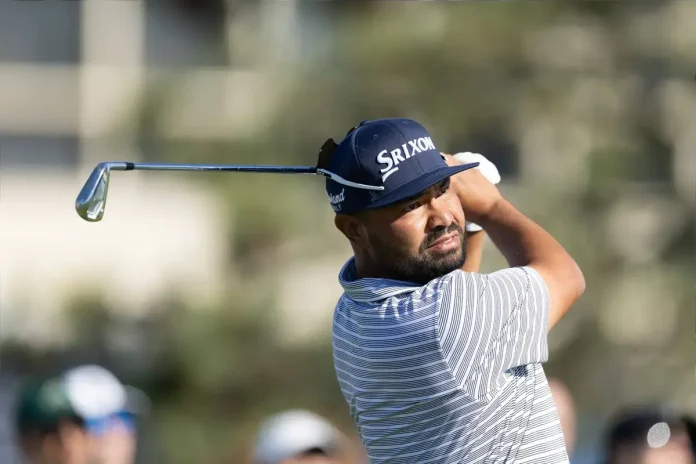
The revolution in the PGA Tour is taking shape, with drastic changes that promise to transform the golf circuit into something more competitive and fan-focused. Leading this transformation is Tiger Woods, the golf icon who, as president of the Future Competition Committee (FCC), is spearheading the push for a new model that aims to challenge established norms. The current U.S. Open champion, J.J. Spaun, does not hesitate to express his concerns and vision regarding these changes.
“I would say it’s harder now,” Spaun stated during the pre-tournament press conference for the 2026 Genesis Invitational, held at Riviera Country Club. “But we are ultimately trying to make this the most competitive tour in the world. I don’t know what to say about what they’re planning to do with the development tours and the Korn Ferry, which may be becoming a bigger stage, not so much as a development tour for the PGA Tour. But it’s definitely more competitive now.”
Spaun’s journey to the top of professional golf illustrates the challenges athletes face today. Growing up in Southern California, Spaun did not have the privilege of being shaped by elite academies or the demanding circuit of the American Junior Golf Association (AJGA). His training took place at local events and at California State University in San Diego, where he turned professional in 2012.
In the past, the path for players like Spaun, Stewart Cink, or Tom Lehman was clearer, primarily based on Q-School or secondary circuits like the Korn Ferry Tour. At that time, a player with average performance had better opportunities to establish themselves on the Tour. However, the current situation is alarming; the 2026 season has already seen significant cuts, with the number of participants in standard events reduced from 156 to 144 and fully exempt spots cut from 125 to only the top 100 in the FedExCup standings.
Changes to the Korn Ferry Tour rules have made the ascent to the PGA Tour even more complicated. Only the top 20 players on the KFT regular season points list earn PGA Tour cards, a significant reduction from the 30 in 2023 and 2024. Additionally, the number of PGA Tour cards available in the Final Stage of Q-School has been limited to the top 5, with no ties.
Woods is determined to reimagine the Tour, focusing on elite matchups and creating opportunities for young players. He has been spending “hours on end” in meetings to develop an ideal competitive model. During the 2026 Genesis Invitational, Woods revealed that the schedule is being restructured to avoid direct competition with the NFL, with the intention of moving marquee events, such as the Genesis Invitational, to the end of summer.
“We are trying to create opportunities for the new generation coming from PGA Tour U or Korn Ferry, trying to bring more youth here, because eventually they will take over the game. The biggest challenge has been creating that competitive model and the environment to foster it,” Woods stated.
Although 2027 is the target for the complete structural revolution, Woods acknowledged that the transition will be gradual. “We would like it to happen in 2027, but we may have to implement it over a few years. We may not be able to do everything in 2027, but parts of it will certainly be integrated or changed in 2026 and 2027,” he added.
In addition, PGA Tour CEO Brian Rolapp was present at the extension of the Genesis Invitational sponsorship, which included an exclusive meeting for players about these changes. The pressure on Woods is intense, especially as he considers the possibility of being the captain of the U.S. team at the 2027 Ryder Cup in Ireland. When asked if he had been approached to take on that role, Woods replied: “No one has asked me about that.”
The voices of other players are also emerging in this scenario, such as John Daly, who expressed his desire to be part of the 2027 team, even if he is not the captain. At the last Genesis Invitational, Woods admitted that due to the lumbar disc replacement surgery he underwent, the workload associated with the changes to the Tour has been so intense that he is unsure if he will have the time to take on the role of captain.
“I haven’t made my decision yet. I’m trying to understand what we’re doing with our Tour. This has consumed hours and hours every day, and I’m trying to figure out if I can do justice to our team, to our Team USA, and to everyone involved in the Ryder Cup,” Woods shared.
The future of the PGA Tour is at stake, and the changes proposed by Tiger Woods promise not only to shape the competition but also to redefine the role of youth in professional golf. What is clear is that the pressure for innovation is increasing, and players like Spaun are attentive to the impact these transformations will have on their careers.
Discover more from Apito Final
Subscribe to get the latest posts sent to your email.

