


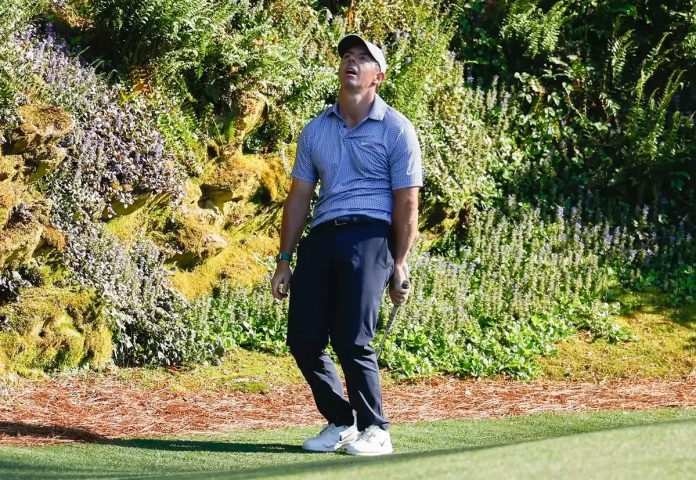
Augusta is in a state of excitement with the joint leadership of Rory McIlroy and Cameron Young at the Masters 2026, but is this 54-hole advantage truly a guarantee of winning the coveted green jacket? Despite the 51 Masters champions confirming their favourites after leading in the penultimate round, including McIlroy last year, a recent shadow hangs over the favourites: the leader’s curse after 54 holes seems more alive than ever this year on the PGA Tour.
In a year marked by surprises and turnarounds, only four of the 13 leaders after the third round managed to hold onto their lead until the end, an alarming rate of just 30.7%. This phenomenon is not exclusive to solo leaders but also manifests in players who seemed destined for victory in the final strokes. Recent examples are startling:
– Hideki Matsuyama, who was leading by just one stroke on the final hole of the WM Phoenix Open, collapsed with two consecutive bogeys, ultimately losing to Chris Gotterup in a playoff. – Shane Lowry saw victory slip through his fingers after making two double bogeys in the last three shots of the Cognizant Classic, allowing Nico Echavarria to triumph. – Daniel Berger, with a five-stroke lead with nine holes to play at the Arnold Palmer Invitational, faltered at the finish and succumbed to Akshay Bhatia in a playoff.
Are we witnessing an isolated phenomenon or a growing trend on the circuit? Analysing recent data, the conversion rate of leaders after 54 holes has fluctuated: in 2025, 53.3% of leaders confirmed victory; in 2024, this percentage rose to 66.7%; and in 2023, it was 57.1%. Therefore, the current leadership crisis may be an anomaly, but it highlights the brutal pressure weighing on favourites.
Cameron Young arrives at this Sunday’s Masters with renewed confidence after an impressive comeback. After starting the tournament four strokes over par, Young shot a 65 on Saturday, the best of the day and his best so far at Augusta. “I like the position I’m in,” declared Young, who has previously led after 54 holes in his career, at the Wyndham Championship in August last year. “If someone had told me at midday on Thursday that I’d be two behind the leader on Sunday, I would have taken it immediately, especially seeing Rory play.”
On the other hand, McIlroy, who once held a historic six-stroke lead after 36 holes — the largest ever seen at the Masters — saw that lead slip away due to tee shot difficulties and a round of 73, one over par, on a day when the average strokes were the lowest since 2018. “I need to focus on the positives, although there aren’t many,” said McIlroy. “I managed to recover and hit good shots in the final part, but I know I’ll need to do better to have a chance tomorrow.”
With extensive experience in leading after 54 holes — he has done so 21 times on the PGA Tour, converting 12 into victories — McIlroy knows what’s at stake and the pressure it entails. Young, meanwhile, feels that his victory at the last Players Championship has given him greater visibility, although he recognises that the Northern Irishman’s popularity will attract more fans. “I don’t feel I’ll be the crowd favourite, but support has grown over the past year. It’s going to be intense because Rory is a global golf icon,” he said.
For golf enthusiasts and Masters followers, Sunday promises to be an epic battle between a rising star and a legend in pursuit of yet another title. Will the 54-hole leader’s curse be broken? Or will we witness another dramatic chapter of disappointments and surprises at Augusta? One thing is certain: the story of the 2026 Masters is far from written.

