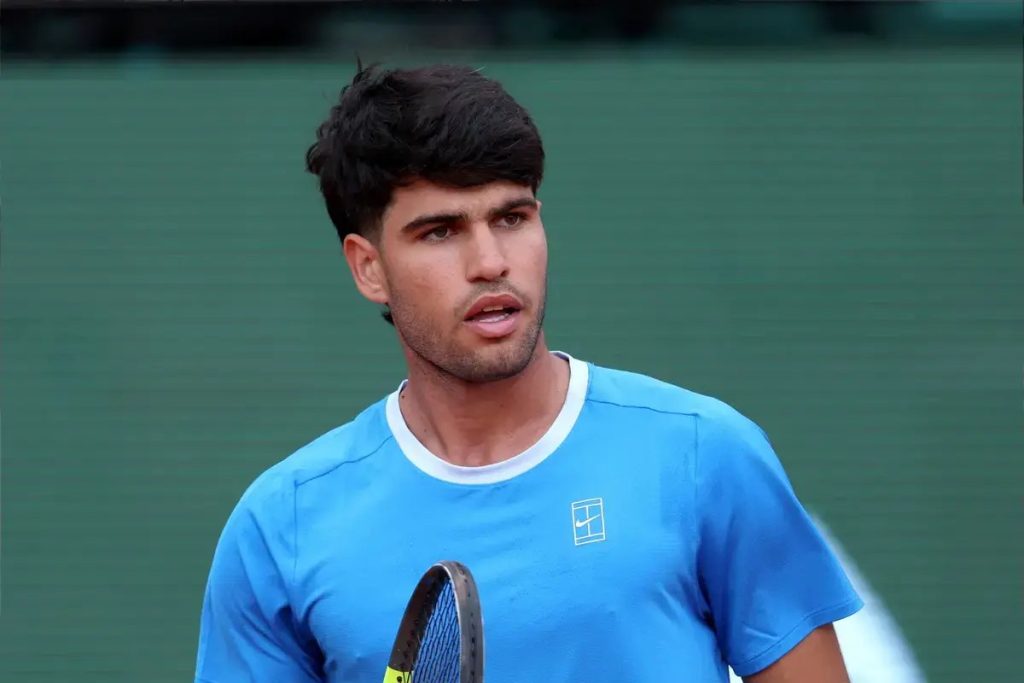
Carlos Alcaraz is once again in the spotlight—not for his exploits on the court, but for the way he manages his career and, above all, his personal life. Recent statements from his coach, Carlos Moya, have sparked a debate about the balance between sporting success and individual well-being, at a time when the young Spanish phenomenon is forced to take a break due to injury.
The 21-year-old prodigy, who has been absent from the courts since suffering a wrist injury in Barcelona, has already missed the French Open and confirmed that he will also not be present at Wimbledon. His main goal now is to fully recover in order to return in peak form for the American hard court season. The topic of the sacrifices required of those competing at the highest level has come to the forefront again, with Alcaraz emphasizing on several occasions the importance of taking breaks and spending quality time with family and friends. The player himself stated during last year’s Cincinnati Masters 1000: “I love having time for myself. I must be honest. I always say that’s what I work for: yes, I love playing tennis and stepping onto the court, but sometimes it’s weeks on end, so I need to spend time with my loved ones, at home, doing nothing. For me, it’s necessary to be able to come back with desire and hunger. I had fantastic days; after the French Open, I went to Ibiza and returned stronger for the grass season; after Wimbledon, I took a week of complete rest, went to southern Spain, and then spent two weeks at home.”
THE 2026 WORLD CUP LIVES ON WITH LEGO
These words from Alcaraz reveal the silent pressure that many top athletes face — a solitude masked by the shine of trophies and spotlights. The exhausting schedule of the circuit, which hardly offers any respite throughout the year, inevitably distances players from their personal circles, forcing them to miss important moments with the people closest to them. The need to maintain a strict routine to compete at the highest level has evident costs on emotional balance and personal relationships.
Carlos Moya, former world number one and coach of Alcaraz, has now publicly reinforced the call for respect regarding his pupil’s privacy and lifestyle. In an interview with the podcast Punto de Break, Moya was emphatic: “Even if Carlos decided to retire now, he would be one of the greatest of all time and he is only 23 years old. I completely understand when he says he has other interests outside of tennis and I agree with him. He is young, let him live and enjoy life.” Moya’s words come at a time when media pressure and expectations on Alcaraz have reached stratospheric levels, serving as a reminder of the need to protect the human side of athletes.
Alcaraz’s forced withdrawal from major competitions due to injury raises pertinent questions about the mental and physical health of young tennis talents worldwide. With the US Open and the American Masters on the horizon, the focus of the Spaniard and his coaching team is to ensure a full recovery, without rushing that could jeopardize the future. The question remains: will Alcaraz be able to maintain his mental freshness and motivation upon returning, after an atypical summer away from the main stages? And is tennis prepared to give more space to the individuality of its protagonists in an increasingly demanding and unforgiving circuit?
What is certain is that, following these statements, the discussion about the balance between life and career in high-performance sports gains new strength. The message from Alcaraz and Moya could not be clearer — success is not only measured in titles, but also in the ability to know when to stop, breathe, and appreciate what is outside the courts. The return of the young Spaniard is eagerly awaited, but his example can already inspire a change in mindset in world tennis.
NOW YOU CAN FOLLOW THE WORLD CUP WITH ALL THE INFORMATION – HERE
Discover more from Apito Final
Subscribe to get the latest posts sent to your email.