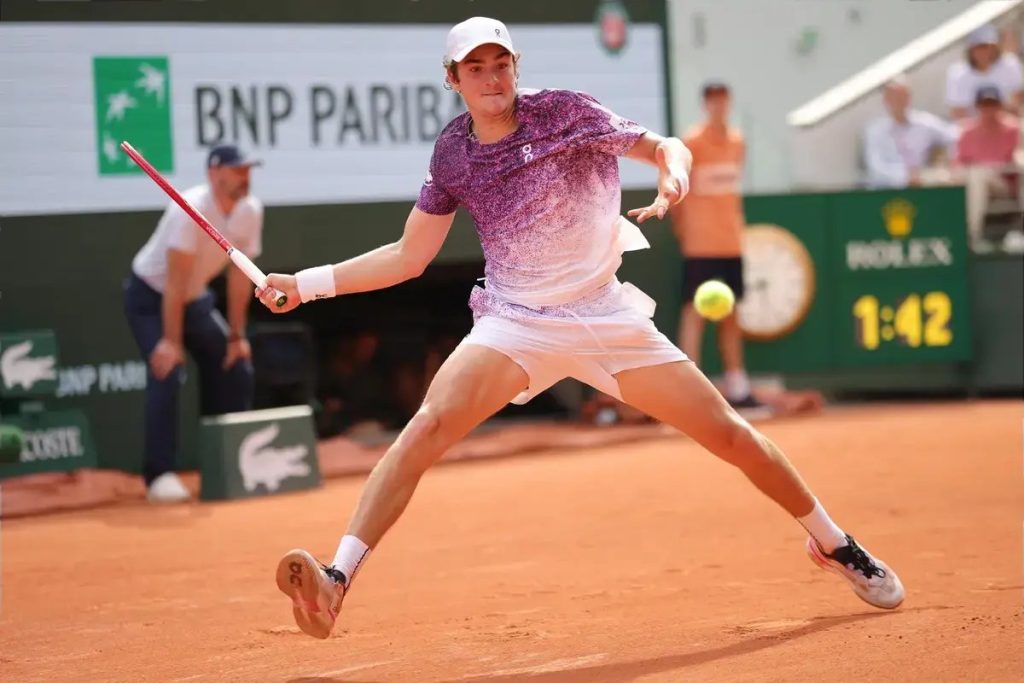
João Fonseca delivered one of the biggest surprises in world tennis by defeating Novak Djokovic in an epic battle that will forever be etched in the history of Roland Garros. The young Brazilian, long considered a promising talent yet to fulfill his potential, finally proved that his time has come, triumphing after being two sets down, with a final score of 4-6, 4-6, 6-3, 7-5, 7-5.
This victory not only left Djokovic, a 24-time Grand Slam champion, frustrated, but it also shook the expectations of those who believed this could be the tournament where the Serbian would achieve his 25th major title, especially after the early elimination of Carlos Alcaraz and the surprising defeat of Jannik Sinner. At 39 years old, Djokovic saw this event as a golden opportunity to continue his legendary journey, but Fonseca had other plans.
Tim Henman, the former British number one, did not hold back in his praise for the young Brazilian and made a historical comparison that is sure to spark discussion. Live on TNT Sports, Henman stated that Fonseca’s victory over Djokovic is a symbolic moment, akin to Roger Federer’s triumph over Pete Sampras at Wimbledon in 2001. “The first time Federer played on Centre Court was against Sampras. The first time Fonseca plays on Court Philippe Chatrier is against Djokovic. He needs to savor this moment,” Henman emphasized, highlighting the maturity and tactical intelligence that Fonseca displayed both on and off the court, even on his mother’s birthday.
Another tennis giant, Mats Wilander, also acknowledged the mental and physical quality of the Brazilian player, stating that “the ability to play five sets at this level is simply unbelievable.” Wilander pointed out that Fonseca combines physical strength with a strong mind, a great love for competition, and a rare intelligence to sense the support of the fans and use it to his advantage. “For our sport, it is essential to have a South American at the top,” emphasized the Swede, who also highlighted the evolution of Fonseca’s serve and the extraordinary quality of his forehand, which can vary the height and angle of his shots impressively.
The impact of this victory is tremendous, not only for the young Brazilian but also for world tennis, which sees the emergence of a new star capable of challenging the biggest names on the circuit. After a period in which it seemed he was struggling with pressure and trying too hard in his game, Fonseca showed a remarkable improvement in movement and strategy, making it clear that the hype surrounding him is now justified.
With this unforgettable triumph in Paris, João Fonseca not only toppled one of tennis’s greatest champions but also sent a clear warning to the entire competition: the future of world tennis has a name, and that name is João Fonseca. The race for the next Grand Slam title is more exciting than ever, and the young Brazilian is definitely at the forefront, poised to shine even brighter.
This article first appeared on Apito Final.
Discover more from Apito Final
Subscribe to get the latest posts sent to your email.