


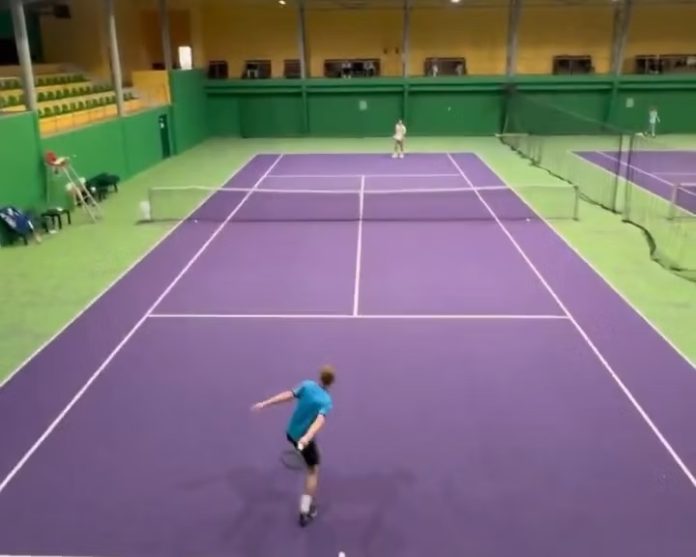
In the unforgiving world of tennis, the line between glory and disgrace can be defined by a mere moment of carelessness. This is exactly what happened at an ITF J60 tournament, where young prodigy Deividas Bandzevicius, just 17 years old, saw his triumph turn into a bitter disqualification right after an epic three-set match. The drama unfolded in the first round, where Bandzevicius defeated Emiliano Bratomi with a tight score of 6-4, 4-6, 7-6(5), but the celebration that followed turned the tide against him.
In a crucial moment, with the score at 6-5 in the decisive tiebreak, Bandzevicius sealed the point with a spectacular play that seemed to guarantee a memorable victory. However, carried away by emotion, he tossed his racket into the air in a gesture of euphoria that quickly transformed into a nightmare: the equipment flew uncontrollably towards his opponent. Bratomi, in an impressive reflex, managed to dodge it using his own racket and was momentarily shocked, clutching his knees. Despite the young Lithuanian raising his hands in a sign of apology, claiming it was an accident, the referees had no doubts — the disqualification was immediate.
This episode, which has ignited social media and divided opinions, raises crucial questions about discipline in tennis, even in junior categories. On the fine line between legitimate emotion and unsportsmanlike behavior, the ITF rule is clear: “Physical abuse” includes any unauthorized contact with opponents, referees, or spectators, and the irresponsible throwing of a racket is not exempt from penalties, regardless of intent. Thus, victory on the scoreboard does not outweigh conduct on the court.
This decision brings to mind other famous incidents where emotion came at a high cost. In 2022, in the same ITF junior circuit, French player Michael Kouame lost control and slapped his opponent after an unexpected defeat, a gesture that also proved costly for him. In the senior ranks, the most high-profile case was undoubtedly the disqualification of Novak Djokovic at the 2020 US Open, when an accidental ball strike hit a line judge in the neck, leading to his expulsion despite the lack of intent.
Other recent examples include Alexander Zverev, who was expelled and fined $40,000 after violently attacking the umpire’s chair at the 2022 Mexico Open, and Denis Shapovalov, who was disqualified in the Davis Cup nine years ago after hitting an umpire with a ball thrown in frustration. These episodes show that tennis does not forgive emotional slips, even for established stars.
For young players learning to manage the pressure of intense competitions, these cases serve as harsh but essential lessons. The disqualification of Bandzevicius, although controversial to some, is a cruel reminder that respect for the rules and for one’s opponent takes precedence over any outcome. If even a champion with 24 Grand Slam titles could not escape these sanctions, there are no exceptions for the new generation.
Tennis is a sport of steel nerves and iron discipline. The line between control and losing one’s mind can determine entire careers. Bandzevicius learned this the hard way, in a scenario that, despite his youth, already resonates through the halls of world tennis. In the eyes of the ITF, the message is clear: in tennis, emotion has its limits — and crossing them can be very costly.
This article first appeared on Apito Final.
Discover more from Apito Final
Subscribe to get the latest posts sent to your email.

