


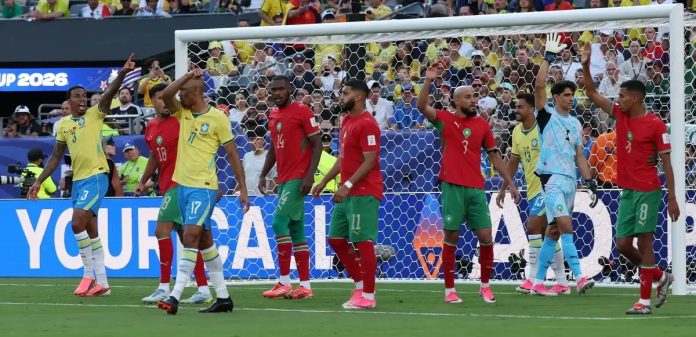
De breathtaking and absolutely unprecedented: Morocco made history in world football by becoming the first national team to line up in a World Cup with 11 players born outside the country. This remarkable achievement occurred during Morocco’s debut in the 2026 World Cup against Brazil, in a match that ended in a 1-1 draw, but whose true impact far exceeds the result on the pitch.
On June 13, 2026, on the world stage, the Moroccan national team presented an initial lineup predominantly composed of members of the diaspora, with Azzedine Ounahi being the only player born on Moroccan soil. However, the historic moment was realized in the 64th minute when Ounahi was substituted by Samir El Mourabet. From that moment on, Morocco literally had its entire eleven on the field made up of players born in five different countries – four in Europe and one in America – none of them in Morocco. Never before had a national team dared to go so far, nor elevated the concept of ‘internationalization’ of a squad to this level.
This episode marks a turning point in the paradigm of national teams and ignites the debate on identity, belonging, and integration in high-level football. Morocco, with one of the largest diasporas in the world, has managed to capitalize on the talent spread across various continents and create a competitive team, unafraid to break with tradition. The significance of this decision goes far beyond symbolism: it reflects a modern and pragmatic approach to building national teams, where the connection to the country comes as much from blood and culture as from the place of birth. The implications are profound, potentially paving the way for other teams facing similar challenges and seeking to leverage the best of their human resources scattered across the globe.
After the meeting, the Moroccan coach did not hesitate to emphasize the importance of this moment: “Our strength lies in diversity. These players represent Morocco with pride, regardless of where they were born. We are a global family,” he stated at the post-match press conference. For his part, Sofiane Boufal, one of the internationals born in France, reinforced the idea of unity: “I have always dreamed of playing for Morocco. I have always felt Moroccan, even though I was born abroad. Today we proved that our roots go beyond geography.” These words clearly show that the Moroccan national team embodies a new spirit, where the nationalist sentiment is fueled by different experiences and cultural backgrounds.
The impact of this unprecedented decision may be felt in the upcoming matches of the 2026 World Cup. With a multicultural squad accustomed to different playing styles, Morocco could surprise more traditional and predictable opponents. Furthermore, this new approach may create additional challenges in tactical analysis for rivals, as many of these players compete in top European leagues and have high-level international experience. It remains to be seen whether Moroccan innovation will translate into tangible sporting results or if it will serve primarily as a case study for the future of national team football.
For fans, this reinvented Morocco has become a media and social phenomenon, fueling heated discussions about what it truly means to “represent a nation” in the 21st century. For FIFA, which has long debated the eligibility criteria for players, this moment could accelerate future regulatory changes or, at the very least, compel a deep reflection on the balance between tradition and modernity in national teams. One thing is certain: Morocco has already secured a place in history — and not just for the draw against Brazil.
NOW YOU CAN FOLLOW THE WORLD CUP WITH ALL THE INFORMATION – HERE
Discover more from Apito Final
Subscribe to get the latest posts sent to your email.

