


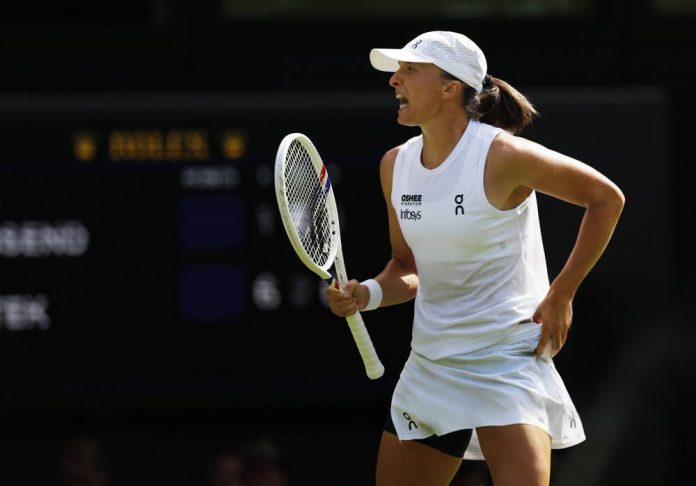
Iga Swiatek broke her silence and sent a clear message to critics of her psychologist, Daria Abramowicz, fiercely defending the importance of mental work in high-level tennis. The Polish player, who has already won six Grand Slam titles and led the world ranking for 125 weeks, reacted to insinuations that her professional relationship with Abramowicz had crossed acceptable boundaries, making it clear that few understand the true nature of the support she receives.
The controversy began when Dariusz Nowicki, a Polish sports psychologist, raised doubts about the dynamic between Swiatek and Abramowicz, suggesting that “certain limits” had been crossed and labeling the relationship as “disturbed.” According to Nowicki, “if we look at it strictly from a professional standpoint, it is a disturbed relationship in which certain boundaries of professional distance between psychologist and client are crossed.” These statements, made to Interia Sport, ignited social media and Polish media, raising suspicions about the psychologist's role in the athlete's success.
THE 2026 WORLD CUP LIVES ON WITH LEGO
The impact of these criticisms goes far beyond the media environment. Swiatek, currently ranked number three in the world, is seen by many as the ultimate reference of her generation in women's tennis. At just 25 years old, she began working with Abramowicz in 2019, when she was still a young prospect outside the top 100. Since then, she has transformed into a winning machine, admired for her consistency and mental strength on the court. The discussion about her relationship with the psychologist is not just a personal matter; it touches on the debate about the importance of psychological support in high-performance sports—a topic that is becoming increasingly central, especially after high-profile cases like that of Naomi Osaka.
Nowicki went even further, warning of “perception errors” and arguing that “a psychological distance from the athlete is essential,” emphasizing that “someone in this group must maintain common sense and emotional self-control, and the psychologist should be that element.” However, Swiatek was quick to respond, in an interview with The Times, dismantling the critics' arguments and highlighting the fundamental role of Abramowicz in her personal and professional development. “People on social media like to give opinions, but they don't know how we work, what kind of support I need, and how people in my position need trustworthy individuals,” said Swiatek, who assured that she would be “a completely different person” without the psychologist's support.
The Polish champion also confided that when she started working with Abramowicz, she was “super insecure” and lacked “emotional or cognitive skills” to compete at the highest level. “She helped me develop as a player,” Swiatek explained, adding that even after her first major successes, the psychologist was crucial in helping her cope with the pressure. “When I achieved my first successes, she also helped me deal with that, because when you win, you think it's all a dream come true, but so many things change.”
This public defense of Abramowicz comes at a delicate moment for Swiatek, who is facing challenges on the circuit and media pressure following recent emotional episodes at Wimbledon. The incident reignites the debate on mental health in sports, an increasingly unavoidable topic that divides opinions among experts, former players, and fans. Swiatek's response is a direct message to all those who question the legitimacy of psychological support, reinforcing the idea that, in modern tennis, mental work is as crucial as physical or technical training.
Swiatek's immediate future will involve trying to reclaim the top spot in the rankings while maintaining emotional stability, now under even greater scrutiny. This controversy could either serve to further unite the Polish player's team or, conversely, increase the pressure surrounding her. One thing is certain: Swiatek is not willing to give up Abramowicz's support and is ready to fight this battle off the courts with the same determination she faces her opponents on them. The tennis world watches closely the outcome of this story that could redefine the perception of the role of psychologists in elite sports.

O MUNDIAL 2026 VIVE-SE COM A LEGO
NOW YOU CAN FOLLOW THE WORLD CUP WITH ALL THE INFORMATION – HERE
Discover more from Apito Final
Subscribe to get the latest posts sent to your email.

