João Fonseca, the 19-year-old Brazilian prodigy, is facing a storm of expectations that threatens to crush his emerging talent. Considered by many to be the next big name in world tennis, Fonseca has been the subject of immediate and almost unrealistic comparisons to the legendary Roger Federer. But the young player revealed in a revealing interview that this pressure is a burden too heavy to bear — and that he has learned to play for himself, not for others.
“João is a bit like me,” Federer said in January, highlighting the need for patience and time for Fonseca to unlock his full potential. But as attention grows and expectations explode, the young player’s balance on the court remains fragile and inconsistent. Irregular results are piling up, and frustration is beginning to show during matches, at a time when the pressure of the spotlight is more intense than ever.
Fonseca does not hide the difficulty of dealing with such attention so early in his career: “At first, it was madness for me, to be honest. It was something different. I felt the pressure from people, all those expectations.” The young Brazilian recounts that, almost overnight, many fans and observers began to see him as the next Roger Federer, a comparison he himself considers unrealistic. “I felt that people thought I was going to be the next Roger Federer, almost from one moment to the next. Things don’t work that way.”
The constant pressure from fans, media exposure, and inevitable comparisons have become difficult to manage as Fonseca was still trying to adapt to life on the professional circuit. “I tried to understand all of this, but it was complicated. Now, I think I understand that I only play for myself, that I owe nothing to the people and that I don’t play for them, I play for myself.”
This emotional weight is visible in every point, in every reaction, especially when the Brazilian crowd makes its presence felt in the stands, intensifying the impact of each victory and defeat. And the reasons for the excitement are justified: Fonseca has established himself as one of the biggest prospects on the ATP Tour after reaching his first quarter-final in a Masters 1000, at the Monte Carlo Masters, earlier this year.
The experience gained during the clay season, with participation in Monte Carlo, Munich, Madrid, and now Rome, has been crucial for his growth. Facing consecutively the top three players in the world in Masters 1000, the young Brazilian is learning what it takes to compete consistently at the highest level.
Fonseca does not hide his admiration for Roger Federer, who remains his greatest inspiration. The Swiss, an eight-time champion of Wimbledon and co-founder of the agency Team8 that represents Fonseca, is a central figure in his career. “He is my idol. The simple way he played is incredible. It looks easy to play like that, but it’s not. He was an inspiration to me,” the Brazilian confessed during last year’s Wimbledon tournament.
However, as the comparisons to Federer increase the excitement surrounding him, so too do the pressures for Fonseca to one day match the aura and achievements of the Swiss. Still, the young player arrives in Rome, at his favorite tournament, with more maturity, experience, and prepared to bear the weight of the spotlight.
After breaking into the top-25 last year, winning two ATP titles and quickly establishing himself as one of the biggest prospects in men’s tennis, Fonseca’s journey has not been without difficulties. He went through a tough phase in the spring, which ultimately strengthened him both mentally and professionally.
On the eve of the Italian Open, the Brazilian appears optimistic about the slow conditions at the Foro Italico, which he considers ideal for his aggressive baseline game, allowing him to construct points more calmly. “I feel good here in Rome, no doubt. A lot has changed since last year. I am much more mature, not only technically but also physically and mentally,” he assures.
Fonseca highlights the good performances he has had on clay this year and is eager to make his debut in Rome. A potential clash with Félix Auger-Aliassime, the fourth seed, in the third round promises to be another test for the young Brazilian.
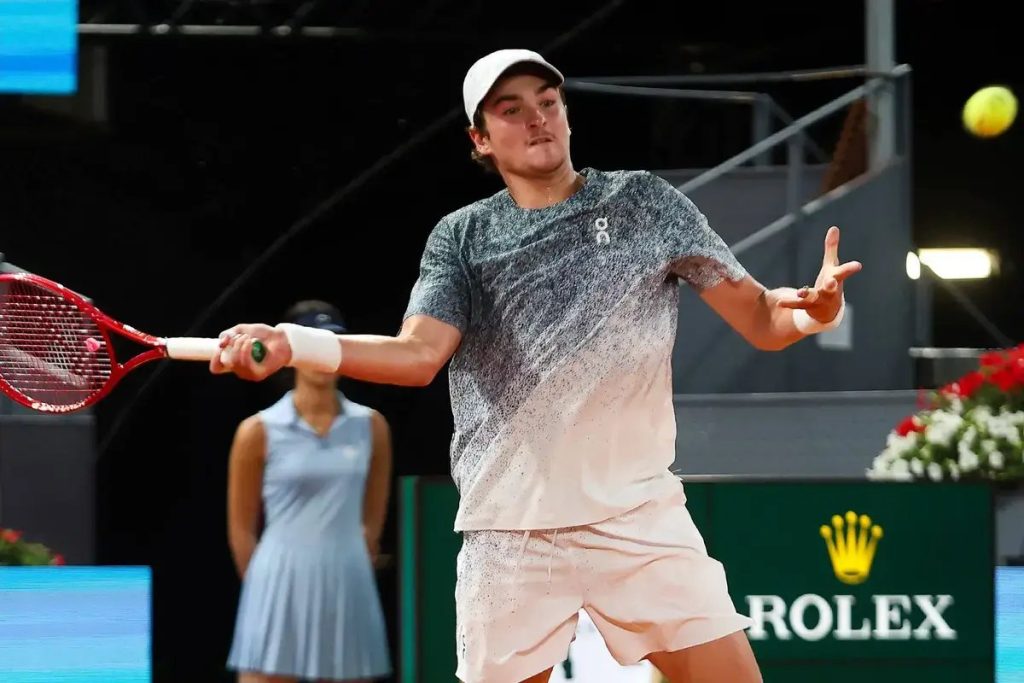
With a record of 10 wins and 8 losses in the 2026 season, following some physical issues at the beginning of the year, Fonseca’s best result was his impressive performance at the Monte Carlo Masters. In Madrid, he faced fellow young talent Rafael Jodar in a battle that ended with the Brazilian’s defeat in three sets, after physically giving way in the deciding set.
These two players, both born in 2006, are seen as the future giants of tennis, and their rivalry promises to keep interest in the circuit for many years to come. Now, with the start of the tournament in Rome approaching, all eyes are on Fonseca: will he finally confirm his potential and reach a new advanced stage in a Masters before the start of the Roland Garros?
João Fonseca is turning pressure into fuel, but the real test will be whether he can play for himself and not for the expectations that the world of tennis placed on his shoulders so early in his career. The future of men’s tennis may be in his hands — but he already knows that the key is to play for himself, not for others.
This article first appeared on Apito Final.
Discover more from Apito Final
Subscribe to get the latest posts sent to your email.