


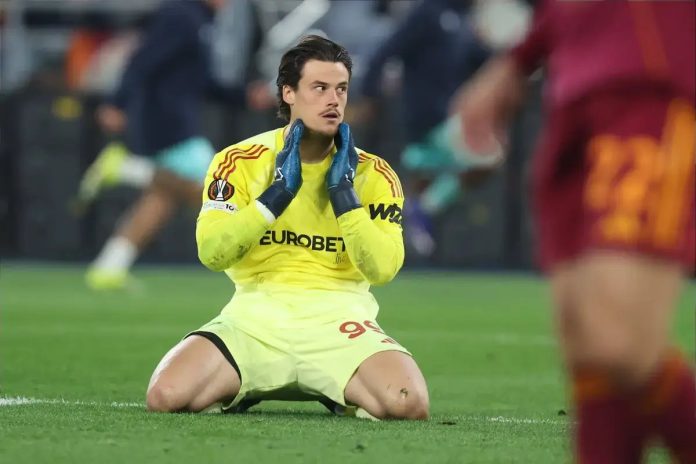
Mile Svilar, a promising talent and one of the top-performing goalkeepers in Europe, currently finds himself at a legal crossroads that prevents him from representing any national team. This impasse, involving Serbia and Belgium, has already mobilized a team of lawyers and could escalate into a courtroom battle. While his Roma teammates head off for international commitments, Svilar remains isolated in Trigoria, a situation that even intrigues the club’s staff.
With an impressive save rate of 78.9% in Serie A and a total of 88 stops, Svilar’s absence from call-ups is alarming. The former Benfica goalkeeper is in a footballing limbo, without a country, waiting for a resolution that does not seem to be in sight. His legal team is tirelessly working to find a viable solution to this situation, which has already lasted for months.
The origin of this complicated situation dates back to September 1, 2021, when Svilar played 45 minutes for the Serbian national team in a friendly match against Qatar, replacing goalkeeper Rajković. Born and raised in Antwerp, Belgium, Svilar was developed through the Belgian youth teams, from the lower levels up to the under-21s, having passed through the academies of Beerschot, GBA, and Anderlecht. The decision to represent Serbia was influenced by his father, Ratko, a former goalkeeper who has nine caps for Yugoslavia. Although he inherited Serbian nationality from his father, Svilar feels a strong desire to represent Belgium, his home country. However, FIFA regulations currently do not allow him that change.
FIFA’s rules on nationality changes were adjusted in 2020, offering greater flexibility. For a player to change national representation, several criteria must be met: they must hold nationality of the country they wish to represent at the time they played for their first national team (Svilar meets this requirement), they must not have played more than three matches for the first national team (met), none of those matches should have been in the finals of World Cups or continental championships (also met), and at least three years must have passed since their last cap (which Svilar also meets). However, the main obstacle lies in the age. The regulation prohibits changes for players who are over 21 years old at their last match. In Svilar’s case, he turned 22 just four days before his last appearance.
A group of lawyers has been working hard to persuade FIFA to consider an exception for Svilar, arguing that he meets all the requirements except for a margin of just 96 hours. With the World Cup approaching and despite Belgian coach Domenico Tedesco relying on the renowned Courtois for goalkeeping, Svilar’s fate remains uncertain. What is certain is that this case is generating intense debate and could set an important precedent, regardless of its outcome. Svilar’s fight for a football identity is far from over, and the football community is closely watching the unfolding of this intriguing story.
This article first appeared on Apito Final.
Discover more from Apito Final
Subscribe to get the latest posts sent to your email.

