


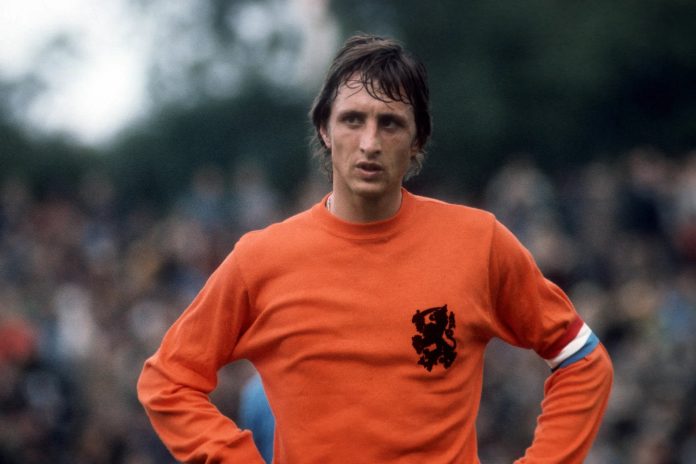
Johan Cruyff, a football legend, is undoubtedly one of the most iconic players in the history of the sport. His name is not only synonymous with footballing talent; it also represents the revolutionary spirit that transformed the game. However, behind his glorious legacy lies a lesser-known facet: his brief yet notoriously caricatured foray into the world of music. Prepare for an intriguing journey that reveals that even the greatest icons can have their moments of discomfort.
Cruyff, known as the “Pythagoras in boots,” did not limit himself to shining on the pitch. He was the maestro who not only donned the legendary number 14 shirt but also challenged norms, including in fashion, by wearing two stripes on his adidas jerseys while sponsored by Puma. For many young people in the Netherlands during the 1960s, he represented a fusion of the art of football and the music of the Beatles and the Rolling Stones. But, like all mortals, Cruyff also made mistakes.
One of those mistakes was his attempt to establish himself as a musician. In 1969, he released a single titled “Oei Oei Oei (Dat Was Me Weer Een Loei),” which roughly translates to “oh, oh, oh, another blow.” The song, written by Peter Koelewijn, tells of an unhappy night in the life of a cousin of the singer, filled with setbacks and disappointments. Although it reached number 21 on the charts in the Netherlands and sold even more copies in Spain, where he became an icon after his transfer to Barcelona, the song did not have the same impact as his footballing achievements.
The most notable aspect of the recording was Cruyff’s struggle to balance his on-field confidence with his insecurity in the studio. Dutch DJ and producer Marcelle van Hoof recalled that during the recording, Cruyff was so nervous that he needed a little push in the form of a drink to loosen up. However, even with an extra glass, the final result was only acceptable, and the live performance was a complete fiasco. Cruyff, who normally dominated the pitch, appeared shy and hesitant, looking at the ground and barely able to remember the lyrics.
Koelewijn, who worked with Cruyff, revealed that the player had little sense of rhythm and that his insecurity was palpable. “He asked for a ‘cola-tic,’ a mix of cola and gin, and then asked for more. That’s how he started to relax.” After a few drinks, Cruyff became more at ease, but his true nature as a musical artist never materialized.
However, the story doesn’t end there. During his live performances, Cruyff revealed that, in Ajax games, he would deliberately fall, simulating injuries to win free kicks and promote his sponsors. “He would lie there for two minutes,” Koelewijn commented, revealing the cunning of a player who always had control over his narrative.
Thus, even when it seemed that Cruyff was failing in his attempt to become a musical icon, he demonstrated that, behind the man, there was always the sharp mind of a true sports genius. Johan Cruyff did not need a career in music to be a rock star; that was his essence from the very beginning. With a legacy that transcends football, Cruyff remains a fascinating figure, a legend who teaches us that even the greatest among us can be surprised by their own limitations.
This article first appeared on Apito Final.
Discover more from Apito Final
Subscribe to get the latest posts sent to your email.

