


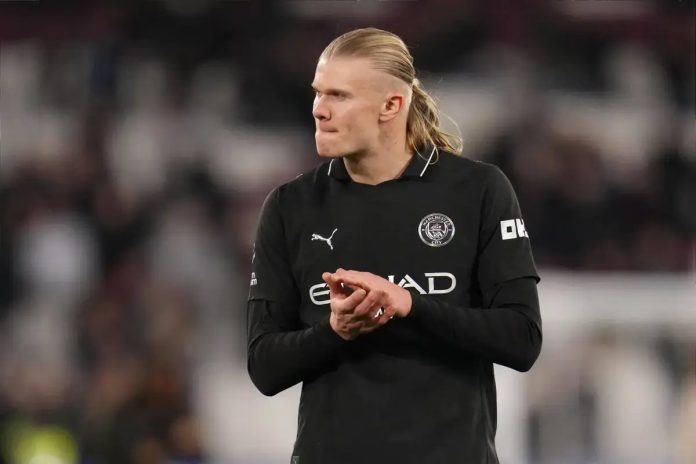
Erling Haaland has been an unstoppable force since arriving at Manchester City, scoring an impressive 153 goals in 187 matches. This achievement places him tied for fourth in the club’s all-time scoring charts, alongside legend Colin Bell. If the Norwegian star maintains his colossal contract until June 2034, he is likely to surpass the record of 260 goals set by Sergio Aguero, and by a significant margin.
The forward has already won two Premier League titles and claimed the Golden Boot in both seasons. Additionally, he was the top scorer in the UEFA Champions League in the 2022/23 season, a tournament that City won for the first time, completing a historic treble. That same year, Haaland broke the record for most goals in a single Premier League season and, in December 2025, became the fastest player to reach 100 goals in the competition. He is currently well-positioned to secure his third Golden Boot in four years, having recorded 11 hat-tricks across all competitions.
It is essential to highlight these achievements at the beginning of any discussion about Haaland, especially when criticism arises. The lingering question is: “But, beyond that, what has Erling Haaland really brought to Manchester City?” If Pep Guardiola’s team wants to overturn a 3-0 deficit in the Champions League against Real Madrid next Tuesday, it will have everything to do with the presence of this generational talent in attack.
However, after nearly four years of the “Haaland Project” at Man City, the question arises: could the situation not be… better?
Despite the impressive statistics, doubts persist about whether Guardiola is using Haaland correctly, whether Haaland is adapting to Guardiola’s style, and whether he and his teammates are maximizing each other’s potential, surfacing incessantly after every underwhelming performance. In City’s last five matches across all competitions, the only victories occurred in the two games that Haaland did not participate in. Although he remains at the top of the Premier League scoring chart, his tally is just four goals in the last 18 matches. The conversation seems to oscillate between the reality of a player simply going through a rough patch and a goal-scoring phenomenon who should not be facing such difficulties.
The debate over whether City is better or worse with its only indisputably world-class player remains a contentious topic. Haaland is, at once, the most obvious solution to the team’s problems and a symbol of an existential dilemma currently facing “Guardiolism.”
The question many are asking is: does Haaland fit into Pep Guardiola’s football? After four years, a series of successes, and some recent failures, the answer seems to be no. Haaland, aside from his incredible finishing abilities, does not offer much to Guardiola’s playing philosophy. While he has been an excellent focal point as a traditional striker, his physical form and playing style have revealed limitations, especially when exposed to the constant pressure that characterizes Guardiola’s approach.
On the other hand, Guardiola continues to insist on his unique approach. If he were to yield and start playing like others, what would be the purpose of his philosophy? In the tight spaces where players like David Silva and Ilkay Gundogan shone, Haaland often appears clumsy and, even on his best days, merely competent. His stature allows him to be an intimidating presence, but the continuous pressure expected from an elite forward is not something he can replicate, which causes discontent among the fans.
With Haaland’s arrival at City, many believed he was the missing piece of the puzzle. After a debut season with 52 goals in 53 matches, it seemed he had found his place. However, the following season brought unexpected challenges. The team, which was already one of the best in Europe, now appears to be struggling to find the ideal harmony. Haaland’s impact seems to be stifling the team’s dynamics, which, prior to his arrival, had already achieved almost perfect football.
The truth is that Guardiola’s team is still digesting what happened after winning the treble. Unsuccessful transfer windows and Guardiola’s loyalty to the older players who have contributed so much are having consequences. While City secured a fourth consecutive Premier League title, much of that was due to remarkable individual performances from players like Phil Foden and Rodri, along with some decisive moments from Haaland. But the decline that followed in the winter of 2024 highlighted the need for swift corrective action.
With a new generation entering the locker room, including debutant Nico O’Reilly, City now boasts 11 new additions compared to January last year. The signings of forwards like Jeremy Doku and Savinho, among others, indicate that the team is being shaped around Haaland, but also reveal that many players seem to have stagnated or regressed.
The discussion about Haaland’s effectiveness in Guardiola’s system is not going to disappear anytime soon. As City prepares to face Real Madrid in Manchester and Arsenal at Wembley, Haaland will have the opportunity to demonstrate once again that the effort to integrate him is worthwhile. The pressure is on, but what is at stake is much more than mere statistics; it is about the future of one of the greatest coaches in football history and the identity of a team that wants to remain a powerhouse in the game.
Discover more from Apito Final
Subscribe to get the latest posts sent to your email.

