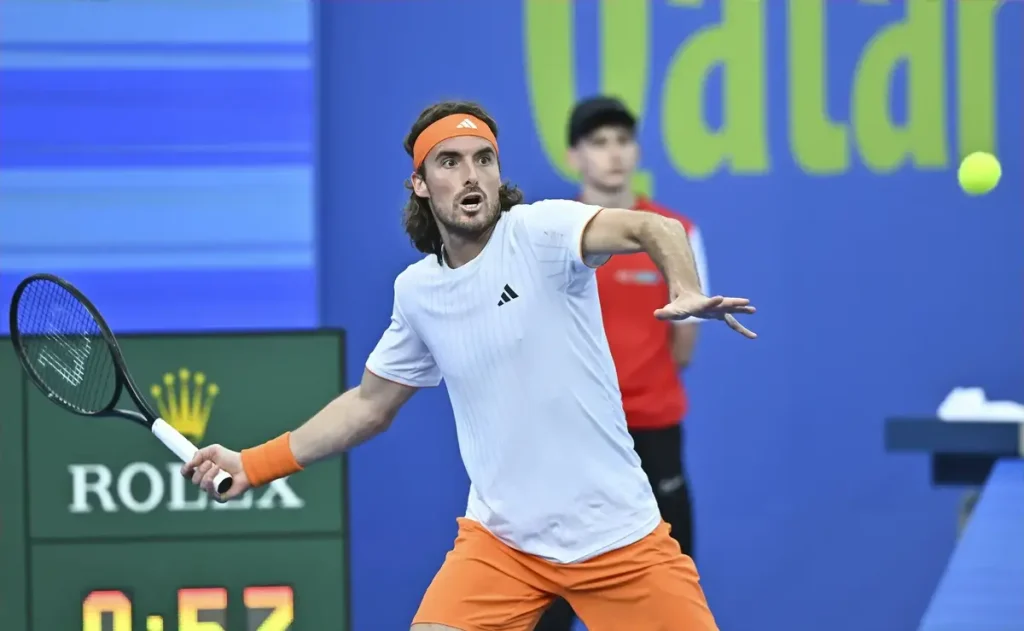
Stefanos Tsitsipas, one of the most talented tennis players today, did not hold back in criticizing his former coach Goran Ivanisevic, revealing that his time on the team was marked by a climate of “anxiety.” This statement comes to light following a series of disappointing performances, culminating in his early exit from the Dubai Championships, where Tsitsipas failed to defend the title he won the previous year. With his ranking suffering a drastic decline, the pressure on the Greek player is mounting.
In a revealing conversation with The National newspaper in Dubai, Tsitsipas described his brief and intense period alongside Ivanisevic, which lasted only through last year’s grass season, ending in July. Ivanisevic’s criticisms were pointed, especially following his departure at Wimbledon, where Tsitsipas withdrew in the first round. The former world number 2 did not mince words, stating that he was “shocked” by the Greek’s lack of preparation, comparing his own condition to that of Tsitsipas.
He said: “He wants to, but does nothing. All, ‘I want, I want,’ but I don’t see progress.” Ivanisevic, who now coaches young French player Arthur Fils, is known for having helped figures like Novak Djokovic and Marin Cilic reach the top of the tennis world. However, his impact on Tsitsipas’s career has been lacking, and the apparent lack of synergy between the two seems to have been a determining factor in their separation.
Tsitsipas’s new approach, now supported by his father Apostolos and Dimitris Chatzinikolaou, captain of the Greek Davis Cup team, seems to give him a renewed sense of belonging and calm. “I feel at home with my team. I feel they belong exactly where they are. And I feel there is no anxiety around my team,” said the 27-year-old athlete. This change in environment has been crucial, according to him, for his performance and well-being.
Reflecting on his experience with Ivanisevic, Tsitsipas emphasized that not all great players become good coaches. “I learned that just because you are a good tennis player doesn’t mean you can be a good coach. Sometimes, the people who are right for you are not necessarily the best players in the world.” This incisive observation suggests that the tennis player is redefining what he seeks in a coach, prioritizing compatibility and clarity over prestige.
Tsitsipas’s statement not only reveals a more vulnerable side of the athlete but also a discontent with figures who position themselves as holders of absolute knowledge: “People who pretend to know everything and have this kind of persona of ‘I’m in charge and I know how things work,’ I don’t really like that.”
As Tsitsipas struggles to reconnect with his best game and avoid a sharp drop in the rankings, his journey will be a testament not only to his capabilities as an athlete but also to the importance of environment and relationships at the highest levels of competitive sports. The future is uncertain, but the Greek is determined to rebuild his trajectory with a new mindset, free from the anxiety that has accompanied him in recent times.
Discover more from Apito Final
Subscribe to get the latest posts sent to your email.