
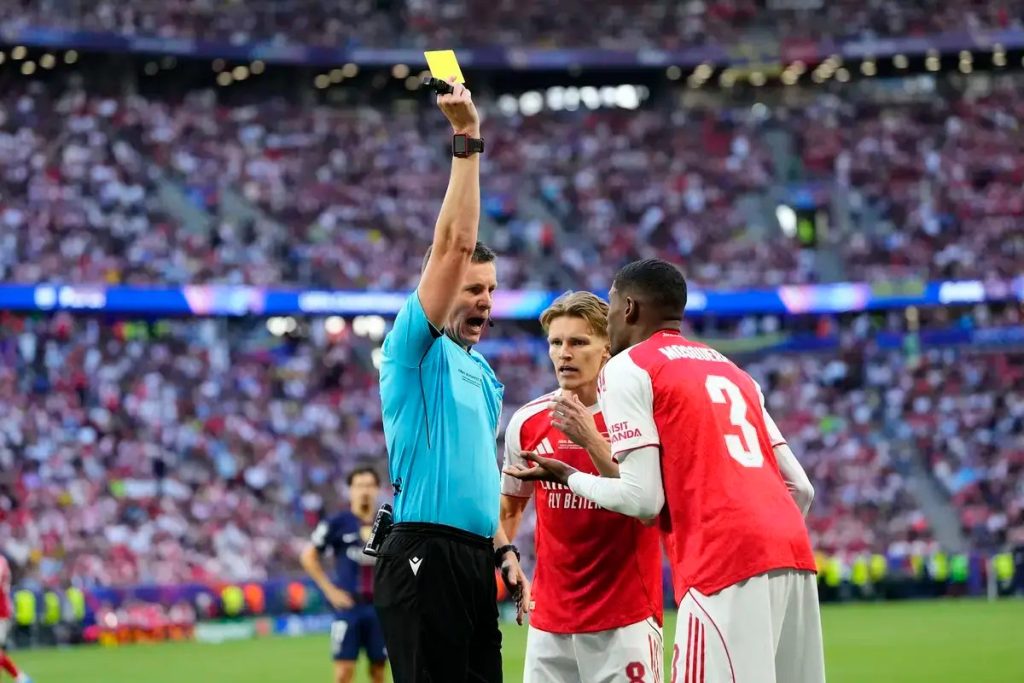
The final of the Champions League turned into a real thriller during extra time, with Arsenal and PSG engaged in a fierce battle that kept fans on the edge of their seats. At the center of the controversy is a decision that could prove decisive: why did Cristhian Mosquera, the Gunners’ defender, escape a red card after committing a foul that resulted in a penalty against Khvicha Kvaratskhelia?
Graham Scott, a former referee from the Premier League, explained in detail the reason that led the referee to spare Mosquera from being sent off, even after the young player had been cautioned with a yellow card shortly after half-time for time-wasting. The incident occurred inside the penalty area, where Mosquera fouled Kvaratskhelia, allowing Ousmane Dembélé to convert the penalty and restore parity on the scoreboard.
“It was clearly a penalty for PSG and there was a strong argument for showing a second yellow card to Mosquera,” Graham Scott began. “However, the incident was more of a clumsy and careless attempt than reckless. The player still genuinely tried to play the ball, which, according to modern rules, avoids automatic dismissal.”
The concept of “double punishment” applied by referees today explains this scenario: if a defender makes a legitimate effort to contest the ball inside the penalty area, even if clumsily, the awarding of a penalty is already a sufficient punishment, eliminating the need for a red card for stopping a promising attack. The criteria for considering a tackle as “reckless” implies an intention or excessive force, something that was not detected in Mosquera’s challenge, sparing him from expulsion.
Mikel Arteta immediately reacted to his team’s relief, substituting the young defender shortly after to protect him from potential physical or disciplinary consequences, a decision that could have a crucial impact on the outcome of the match. Playing an extra half hour with ten men against PSG’s powerful attack would be a tactical nightmare for the Londoners.
Now, Arsenal maintains its full structure on the field and can still dream of winning the most coveted trophy in European football. If they can capitalize on the numerical advantage to score a decisive goal, this controversial incident could be remembered as the key moment that defined the 2026 Champions League final. The tension is at its peak, and history is yet to be written.
This article first appeared on Apito Final.
Discover more from Apito Final
Subscribe to get the latest posts sent to your email.