


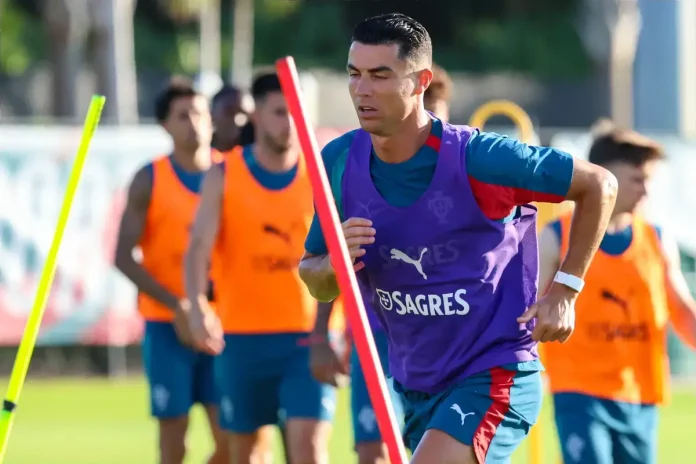
Cristiano Ronaldo is preparing to make history by becoming only the second footballer to play in six World Cup finals, matching the feat of Lionel Messi. At 41 years old, the Portuguese captain is once again the center of attention, but this time the pressure is even greater: for Portugal to dream of the World Cup title in 2026, Ronaldo must deliver the tournament of his life.
The Portuguese national team begins its World Cup campaign against the Democratic Republic of Congo, in a debut marked by anticipation and uncertainty surrounding Ronaldo’s role. After Messi became the first player to participate in six World Cups the day before, Ronaldo matches the Argentine rival, fueling a rivalry that has spanned two decades and shows no signs of ending. However, while Messi, at 38, remains the brain and engine of Argentina, Ronaldo no longer has the same influence or physical presence in the Portuguese attack. The question arises: would Portugal be stronger without its greatest icon on the field?
THE 2026 WORLD CUP LIVES ON WITH LEGO
Despite his advanced age, Ronaldo remains a lethal finisher, but his explosive pace and constant pressure on opposing defenses are behind him. Playing in the Saudi League for four seasons, following his tumultuous departure from Manchester United in 2022, the forward has faced criticism regarding his competitiveness on the international stage. Can a player competing in a peripheral league be decisive on a stage like the World Cup?
Ronaldo’s journey in the final stages began at the age of 21, when he started every match for Portugal in the 2006 World Cup and scored the decisive penalty in the quarter-finals against England, in a campaign that ended with an honorable fourth place. However, since the Madeiran forward took on the role of the team’s main attacking reference, Portugal has never gone beyond the quarter-finals, even failing to progress past the group stage on two occasions.
It is important to emphasize that not all national failures can be attributed to Ronaldo. The Seleção das Quinas has often been too conservative in its approach to matches. In 2018, for example, Ronaldo shone in the group stage with four goals, but Portugal was eliminated in the round of 16 by Uruguay. Interestingly, all eight of Ronaldo’s goals in World Cups have occurred in the group stage—a surprising statistic for one of the greatest goal scorers in football history. In knockout stages, Ronaldo remains goalless, as does his assist tally, where he has only one—also in the group stage.
The comparison with Messi becomes inevitable: the Argentine has six assists in World Cups, highlighting the difference in profile between the two. Messi is more of a playmaker, while Ronaldo is more of a finisher—and this is reflected in the number of key passes. Ronaldo’s dominance in set pieces has also been a topic of debate, given the decline in effectiveness from direct free kicks (only one goal in major tournaments, precisely in the 2018 World Cup).
Recently, Bruno Fernandes, named Player of the Year in the Premier League, has been sharing free-kick responsibilities with Ronaldo. The 31-year-old midfielder of Manchester United arrives at the World Cup after a brilliant season: nine goals and an absolute record of 21 assists in the English league. Fernandes positions himself as the new brain of the national team, playing a role similar to Messi’s in Argentina. When asked about the prominence in set pieces, the Portuguese coach admitted: “We will decide game by game, but Bruno has shown enormous quality.”
The Portuguese midfield, in fact, is one of the most complete in the tournament, featuring names like Bernardo Silva, Vitinha, and João Neves. In defense, Rúben Dias and Gonçalo Inácio ensure solidity at the center, with João Cancelo and Diogo Dalot providing depth on the flanks. Still, there is no clear alternative to Ronaldo in the attacking line. Gonçalo Ramos, the natural substitute, has recorded only 12 goals in 45 matches for PSG this season, far from the 18 of the previous season. This lack of direct competition reinforces Ronaldo’s almost unquestionable status in the starting eleven.
The 2026 World Cup presents itself as the ultimate test for the Madeira legend. Portugal boasts an exceptional generation of talent and the arguments to aspire to the trophy, but the dependence on Ronaldo persists. If he wants to conquer the only title that eludes him, Ronaldo will have to defy the weight of age and reinvent himself once again, demonstrating that he is still capable of making decisive contributions at the highest level. The upcoming matches will be crucial in determining whether the captain is up to the challenge or if the moment has finally come to pass the baton.
What follows could define not only the legacy of Cristiano Ronaldo but also the immediate future of the national team. An early elimination will reignite the debate over renewal, while a successful campaign will further cement the mythical status of the Madeiran. The football world is watching — and Portugal is living the emotions to the fullest, waiting for another unforgettable chapter in the story of its greatest star.
NOW YOU CAN FOLLOW THE WORLD CUP WITH ALL THE INFORMATION – HERE
Discover more from Apito Final
Subscribe to get the latest posts sent to your email.

