


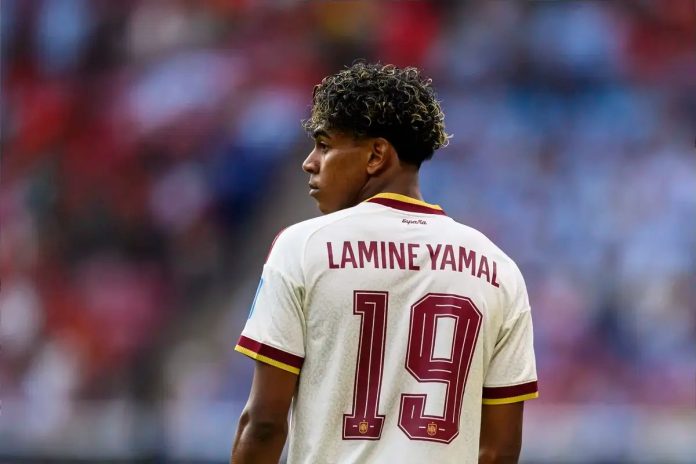
The old guard should take heed: the new generation of stars in world football is stealing the spotlight and challenging the dominance of Messi and Ronaldo at the 2026 World Cup. Young prodigies, some of whom are astonishingly young, are making their mark on the grandest stages in the United States, Mexico, and Canada, showcasing boldness and talent while changing the landscape of international football before the incredulous eyes of fans.
Eighty-five players aged 21 or younger were called up for this edition of the World Cup, but only a few truly managed to seize the moment and leave their mark. Among them is Senegalese Ibrahim Mbaye, who, at just 18 years and 143 days, made history by becoming the fourth youngest ever to score in a World Cup. His goal, albeit late, against the powerful France in a 3-1 defeat in New Jersey did not go unnoticed and has already earned him comparisons to past African legends.
THE 2026 WORLD CUP LIVES ON WITH LEGO
Five days later, it was Lamine Yamal’s turn, the new Spanish jewel, to show why he is being touted as one of the standout names of this World Cup. At 18 years and 343 days old, Yamal opened the scoring in Spain’s emphatic 4-0 victory over Saudi Arabia in Atlanta. But the surprises do not stop there: Gilberto Mora, the Mexican attacking midfielder, made history by becoming the youngest ever player to represent a host nation in a World Cup, at just 17 years and 240 days, when he came off the bench in the win against South Africa in the opening match on June 11.
This explosion of young talent has profound implications for competition and the future of international football. We are witnessing a genuine paradigm shift: while attention remains focused on Messi, Ronaldo, or Modric, these young players are preparing to take center stage and redefine what it means to be a star in a tournament of this magnitude. Countries like Senegal, Morocco, Mexico, Ivory Coast, Switzerland, and Bosnia-Herzegovina are reaping the rewards of training projects that focus on renewal and the courage to launch players without fear or complexes.
Amid this new wave, Ayyoub Bouaddi, an 18-year-old midfielder for Lille and Moroccan international, delivered an eye-catching performance against Brazil. In his debut match on June 13, he became the second youngest player of the century to complete over 50 passes in a World Cup match (66). Alan Shearer, former captain of the England national team, commented after the game: “Bouaddi was calm on the ball and tried to dictate the pace in midfield.” The young player would go on to set another record as the first player under 18 to have two matches with over 50 passes since 1966, completing 64 passes against Scotland.
Another name that has been making headlines is Yan Diomande from Ivory Coast. At just 19 years old, the RB Leipzig midfielder has already attracted the interest of giants like PSG and Liverpool. His dribbling ability and creativity were clearly evident in the 1-0 victory over Ecuador, where he created five scoring opportunities, and later against Germany, where he provided two assists despite the loss. Thomas Frank, former manager of Tottenham and Brentford, did not hold back his praise: “Diomande is the name of the moment for everyone in this World Cup. What he can do is etched in my memory.” Thanks to this talent, Ivory Coast has finally managed to advance past the group stage for the first time in its history.
Switzerland also has reasons to smile with Johan Manzambi, who was a goalkeeper in his youth and idolized Manuel Neuer. Now, he is a lethal attacking midfielder. He scored three of Switzerland’s seven goals in the group stage and, at 20 years and 247 days, became the youngest ever to score twice as a substitute in a World Cup match, against Bosnia and Herzegovina, turning a 0-0 draw into a resounding 4-1 victory. Manzambi is also one of only three players under 21 with four or more direct goal involvements in a World Cup this century, joining names like Kylian Mbappé and Thomas Müller.
The impact of these young players goes beyond the numbers. Bosnian Kerim Alajbegovic, at 18 years and 276 days, scored a goal from outside the box against Qatar, becoming the youngest player to achieve this feat since 1966, surpassing Mbappé’s record. These individual accomplishments are clear signs that the new generation has arrived to stay, ready to challenge the established stars and, who knows, usher in a new era in world football.
With the knockout stage approaching, all eyes are on these prodigies. Will they be able to maintain their level under pressure? How far will they take their national teams? Regardless of the outcome, the 2026 World Cup has already entered history as the stage for the definitive affirmation of this new wave. Get ready: Messi and Ronaldo have worthy successors, and the world is about to witness their crowning.
NOW YOU CAN FOLLOW THE WORLD CUP WITH ALL THE INFORMATION – HERE
Discover more from Apito Final
Subscribe to get the latest posts sent to your email.

