


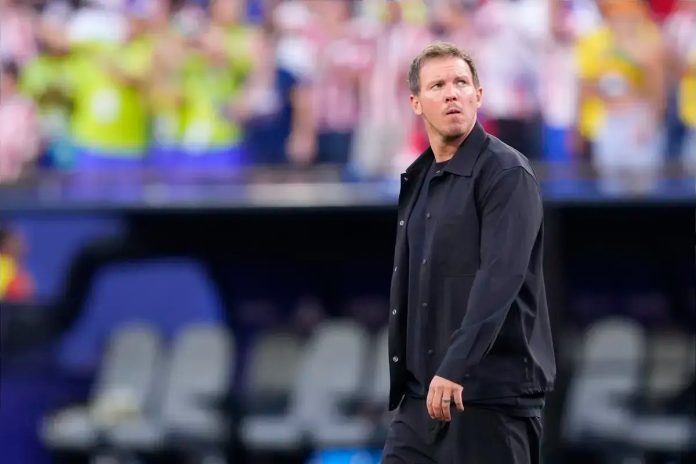
Julian Nagelsmann surprised the football world by announcing his resignation as the head coach of Germany after a catastrophic elimination in the round of 16 of the World Cup against the modest Paraguay. The abrupt departure of the young coach, at just 38 years old, plunges German football into an even deeper crisis at a time when public pressure and dissent were reaching unprecedented levels.
The fateful match took place this Monday in Boston, where, after a 1-1 draw at the end of extra time, the Mannschaft was ultimately eliminated in a penalty shootout. Nagelsmann, whose contract with the German Football Association (DFB) was formally set to run until the Euro 2028, accepted the resignation request made by the board, as reported by the reputable outlets Bild and Sky Germany. This decision now leaves the German national team without a defined direction at a particularly delicate moment in the competitive cycle.
The World Cup 2026 is experienced with LEGO.
The failure at the World Cup adds to a series of significant disappointments for one of football’s historical giants. It is worth noting that Germany had already been eliminated in the group stage both in Russia 2018 and Qatar 2022, an unthinkable scenario for a team that boasts four World Cup titles in its history. The departure of Julian Nagelsmann, following the dismissal of Hansi Flick in 2023, marks only the second time a German national team coach has left the position before the end of their contract due to poor results, highlighting the level of dissatisfaction and urgency for change within the federation.
This dramatic outcome ignites the debate about the immediate future of German football. The name of Jürgen Klopp, former Liverpool manager and current global head of football at Red Bull, has now emerged as the main target of the DFB to lead the reconstruction. Klopp, who won the Champions League and the Premier League during his time at Anfield and left the English club in 2024, reportedly has a release clause that makes his hiring for the national team’s coaching position easier. Klopp’s potential arrival is seen as a lifeline to restore competitiveness and prestige to the national team.
Despite the official silence, sources close to the federation have confirmed that discussions with Klopp are already underway, as he is widely recognized for his charisma, leadership, and ability to revitalize struggling teams. The urgency for change is heightened as Germany prepares to host the upcoming European Championship, where the pressure to restore its image and satisfy demanding German fans will be at its peak.
Following the announcement of his departure, Nagelsmann limited himself to stating, in brief comments to the press: “I accepted the federation’s decision because I believe it is the best for the national team at this moment. I wish Germany all the success for the future.” These words, marked by resignation, illustrate the weight of the responsibility that the coach felt throughout his tumultuous tenure.
With the technical leadership now vacant, the German national team faces crucial weeks to ensure a swift and efficient transition. The next steps of the DFB will be closely monitored at a time when fan confidence is at historic lows and the demand for results is absolute. Klopp, should he accept the colossal challenge, will have the mission of restoring the mystique and hunger for titles that made Germany a powerhouse in world football. The outcome of this crisis will be decisive not only for the future of the national team but also for the balance of power in the international landscape.
NOW YOU CAN FOLLOW THE WORLD CUP WITH ALL THE INFORMATION – HERE
Discover more from Apito Final
Subscribe to get the latest posts sent to your email.

