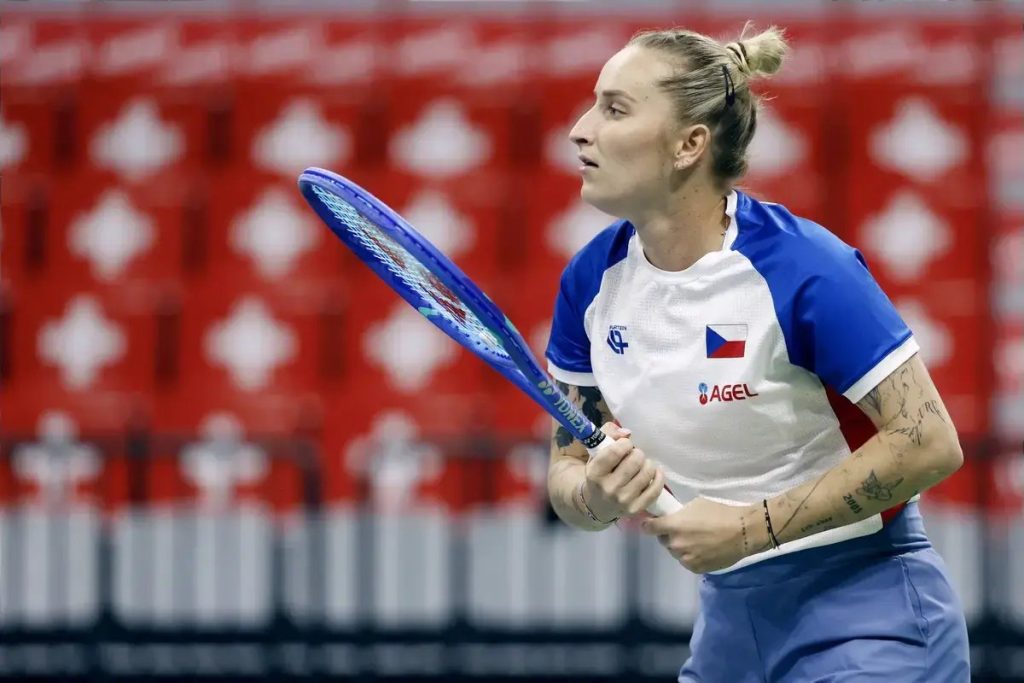
The scandal involving Czech tennis star Marketa Vondrousova continues to ignite the sports world, with explosive statements emerging from one of the sport’s biggest voices, Andy Roddick. The former world number one and 2003 US Open champion does not hold back in his criticism of the doping case that threatens the career of the 2023 Wimbledon champion, focusing on a technical issue that could turn the judgment on its head.
Marketa Vondrousova is facing a possible suspension of up to four years after being accused by the International Tennis Integrity Agency (ITIA) of refusing to undergo a doping test at her home in Prague in December 2025. The player, one of the most promising figures in Czech tennis, claims she was at a breaking point both mentally and physically after months of intense stress. According to her, she refused entry to a doping inspector who arrived at her home after 8 p.m., arguing that the official did not properly identify himself. On the other side, the inspector insists he followed all protocols, leaving a factual dispute that promises to be at the center of the investigation.
The crux of the case lies in the strict rules of doping controls, which require players to provide a one-hour window daily for testing. Non-compliance—whether due to absence or refusal—can be penalized with the same severity as a positive test, further exacerbating public and legal scrutiny, especially since the distinction between failed tests and confirmed violations is crucial.
In his podcast “Served,” Andy Roddick dismantled the entire emotional narrative and focused on procedural clarity. For him, it all comes down to a single question: was the test requested within the time window that Vondrousova had previously declared? “If it’s not within the hour she indicated, then they are wrong. If it’s outside that window from eight to nine, or whatever time she gave, everything she says makes sense,” stated the former champion. “But if it’s within that period, my opinion changes completely. It’s that simple.”
Roddick explained in detail how the “whereabouts” system works, based on his experience as a top player. Athletes must indicate a fixed one-hour period each day when they are available for testing, often adjusting this window for predictable times, even during travel and tournaments. He himself used the period from five to six in the morning, knowing he would be in the hotel, with the address and room number entered into the system.
Regarding Vondrousova’s argument, which invokes psychological stress and anxiety—exacerbated by the traumatic history of the attack on Petra Kvitová in 2016—Roddick acknowledges the human dimension, but does not relinquish the rigidity of the rules: “I understand the stress, the breaking points, and I sympathize with that. But just because I’m stressed doesn’t mean I can make my own rules. That’s not an excuse for missing a test within the agreed timeframe.”
Even more emphatic, the former tennis player emphasizes that responsibility is mutual: the anti-doping authorities also cannot disregard the protocols. “If you are the agency that has the schedule to test the player, you cannot make your own rules. It’s a two-way street. If it’s outside the protocol, they have nothing. If it’s within, she has nothing,” he concludes.
This clash between the athlete and the ITIA promises to shake the world of tennis, highlighting not only the complexities of the fight against doping, but also the tensions between athletes’ mental health and the rigidity of anti-doping regulations. As the investigation progresses, Marketa Vondrousova’s career is at stake, with a potential punishment that could forever alter her sporting trajectory. The truth about the timing of the test could be the decisive factor that makes all the difference in this case that is already in the international spotlight.
This article first appeared on Apito Final.
Discover more from Apito Final
Subscribe to get the latest posts sent to your email.