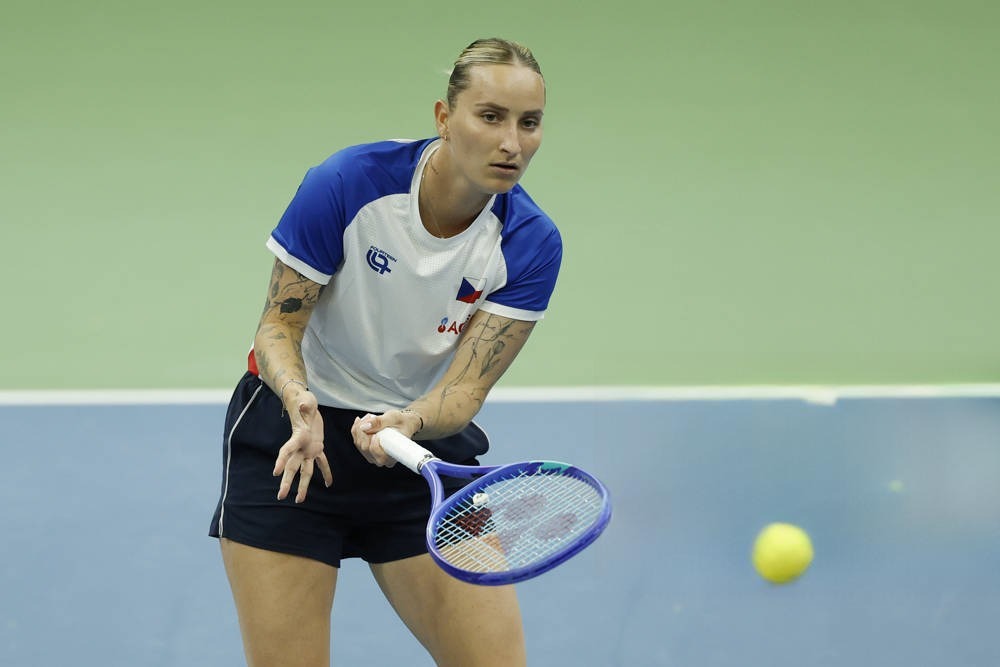
World tennis is in shock: Marketa Vondrousova, the 2023 Wimbledon champion and one of the biggest prospects on the circuit, has now been banned from competition for four years, a decision that threatens to completely destroy her career and leaves fans and colleagues in disbelief. At 26 years old, the Czech player will not be able to compete until June 21, 2030, joining a blacklist of controversial doping cases that has already involved names like Simona Halep, Jannik Sinner, and Iga Swiatek.
The announcement of the maximum sentence, released by the International Tennis Integrity Agency (ITIA), states that Vondrousova refused to submit to a doping test in December of last year, after a control agent visited her residence around 8 PM on December 3. This refusal, according to the current anti-doping regulations, is equivalent to a positive test, which led to the heaviest possible punishment: a four-year suspension. Following the decision, Vondrousova shared an emotional outpouring on social media, stating: “Today, however, I cannot say what comes next. The last seven months have left marks that will not disappear overnight. They have taken away the joy, confidence, and sense of security that I once had. And, honestly, I don’t know how long it will take to find those things again.” The tennis player also added: “For the first time in my life, I don’t have a plan. For the first time in my life, I don’t know where the path will take me… they have changed me. Even if this chapter ends with more pain than I ever imagined, it does not erase who I am, what I believe in, or everything I have given to this sport.”
This case is particularly relevant because instances in which a player refuses a doping test are extremely rare in professional tennis. The rules set by the World Anti-Doping Agency (WADA) require each athlete to indicate a one-hour window daily for potential tests, but officials can show up outside of that window, as happened with Vondrousova. Despite the controversy, the regulation is clear: refusal constitutes a serious violation. Karen Moorhouse, executive director of the ITIA, justified the severity of the penalty: “We recognize that this is a significant suspension. The reason is that there cannot be an anti-doping system where an athlete is in a better position by refusing a test than they would be if they had taken the test and tested positive. Therefore, the structure of the rules provides a starting point of four years for refusal, just like for a positive test.”
The decision is already causing a wave of reactions in the tennis world. Former player and commentator Patrick McEnroe was one of the first to speak out against the punishment, calling it “ridiculous” during a Zoom call with ESPN’s Chris Oddo: “Four years is ridiculous. It’s too harsh. Two years, I can still understand. Even that seems tough to me. One year, fine, that would be acceptable. But four years? I believe she will appeal. She should be punished, but four years is too extreme.” This indignation echoed among colleagues on the circuit. Sorana Cîrstea wrote: “I can’t believe this. We are with you.” Meanwhile, Slovakia’s Rebecca Sramkova encouraged the Czech player: “Come back stronger than ever.” American Coco Gauff showed her support with three hearts on Vondrousova’s post, indicating that the locker room is united.
The case also raises questions of fairness, as some fans and experts are comparing Vondrousova’s situation with other recent cases. It should be noted that Italian Jannik Sinner, the current world number one, had his doping suspension reduced to just three months after testing positive – a disparity that many find incomprehensible, given that Vondrousova did not even fail the test itself, but merely refused to take it.
The Czech tennis player now has the option to appeal to the Court of Arbitration for Sport, based in Switzerland. Until then, she remains suspended and barred from competing, training with official teams, or participating in any sanctioned events. Vondrousova’s future is completely uncertain, with her career at serious risk of being irreparably marked by this scandal.
The impact of this decision extends beyond the athlete’s career: it reignites the debate over the rigor and fairness of anti-doping processes in international tennis and places pressure on regulatory bodies to ensure transparency and equity. The outcome of the appeal could set important precedents, not only for Vondrousova but for all athletes subjected to such procedures. The controversy is far from over, and the world of tennis is waiting, in suspense, for the next chapter of this saga that threatens to shake the integrity of the sport.
NOW YOU CAN FOLLOW THE WORLD CUP WITH ALL THE INFORMATION – HERE
Discover more from Apito Final
Subscribe to get the latest posts sent to your email.