


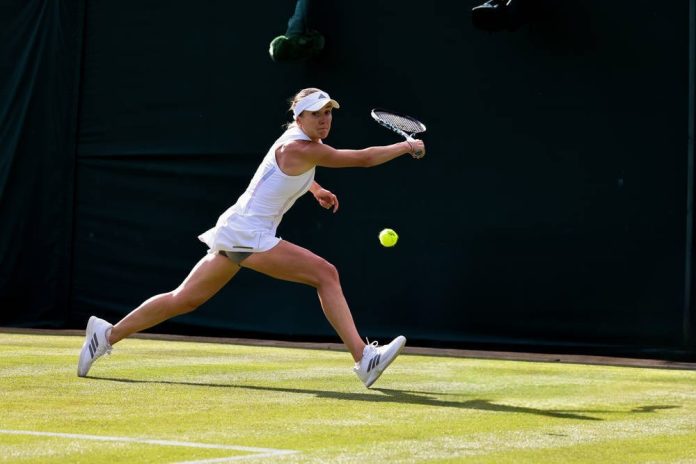
Elina Svitolina suffered an early exit at Wimbledon, surprising the tennis world with an unexpected defeat to Daria Snigur, ranked 77th in the world. The Ukrainian, eighth in the WTA rankings and a two-time semifinalist at the British tournament, was eliminated in the first round, unable to counter the young compatriot, who triumphed 7-5, 6-2 in a match marked by Svitolina's evident physical issues. This elimination immediately raised a question that has been troubling several stars on the circuit: the grueling schedule that, according to the player herself, is pushing the physical and mental limits of the players.
The match took place on the hallowed grass courts of the All England Club, a venue where Svitolina has often shone, but this time the story was quite different. Snigur, less highly ranked and without the opponent's history, managed to capitalize on the physical and mental breakdown of the favorite, controlling the key moments of the match and securing one of the most significant victories of her career. For Svitolina, the defeat was not just a sporting result—it became a wake-up call about the overload that the leading figures in world tennis are subjected to, in an era where the number of tournaments and competitive demands seem endless.
The importance of this news goes far beyond the simple elimination of a seeded player. Svitolina, one of the most respected figures on the women's circuit, brings the issue of the calendar back into discussion, which has caused injuries, frustrations, and a widespread sense of exhaustion among athletes. At a time when the fight for points and rankings increasingly demands constant participation in tournaments, the physical and mental health of players is clearly at risk. Svitolina's early exit may just be the most visible symptom of a structural problem that threatens the integrity of the competition and the future of the players themselves.
In a press conference following her defeat, the Ukrainian did not hide her indignation, stating emphatically: “Of course, we have difficulty adapting. Now, with so many tournaments, we are always on the defensive. If you don’t play one week, there are other players doing so, and you are fighting for the ranking. It’s always a struggle for something. When you’re in the middle of the fight, sometimes it affects you mentally, so we have to take a step back, maybe skip some tournaments and rest. Sometimes, the structure of the calendar forces you to play. It’s not for a good reason, and it’s very sad to have to face this situation that affects so many players. Obviously, it’s influencing our performance and our physical condition,” Svitolina said, delivering a fierce critique of the current model of the circuit.
A semifinalist of the 2026 Australian Open also emphasized the impact of physical issues on her performance at Wimbledon: “There were several factors that influenced my performance. I wouldn’t say I was at 100% as I wanted. As I’ve said before, grass is not very favorable and it’s very unpredictable. Now I finally have time to rest. I can finally go home, enjoy time with my daughter and my husband, work on some aspects, and recover. That will be my priority,” confessed Svitolina, showing her determination to prioritize her recovery over any immediate ambitions.
Despite the limitations, the tennis player did not consider withdrawing and made a point of explaining her stance: “It’s very rare for me to withdraw from a tournament. I always give myself the chance to win. Sometimes, when you’re not playing well, you don’t feel good, and then the other player is playing well, everything combines. It’s very hard and difficult to bear. The grass doesn’t give you any easy opportunities to win. I’m not very sad. I believe we should look at the positive side. I refuse to see this tournament as something negative,” Elina Svitolina further stated, demonstrating resilience and a remarkable spirit of overcoming challenges despite adverse circumstances.
This public outburst promises to further ignite the debate on the need to reformulate the competitive calendar of women's tennis. Several players have already come forward to express similar concerns, and the organizers of the major circuits will inevitably feel pressure to rethink the structure of the events, or risk seeing more stars sidelined by injury or burnout. For Svitolina, the next step will be, above all, to recover physically and psychologically before returning to the circuit. In the landscape of world tennis, this episode could be the catalyst for urgent changes that ensure not only the spectacle but also the health and well-being of the protagonists.
O MUNDIAL 2026 VIVE-SE COM A LEGO
AGORA PODE ACOMPANHAR O MUNDIAL DE FUTEBOL COM TODA INFORMAÇÃO – AQUI
Discover more from Apito Final
Subscribe to get the latest posts sent to your email.

