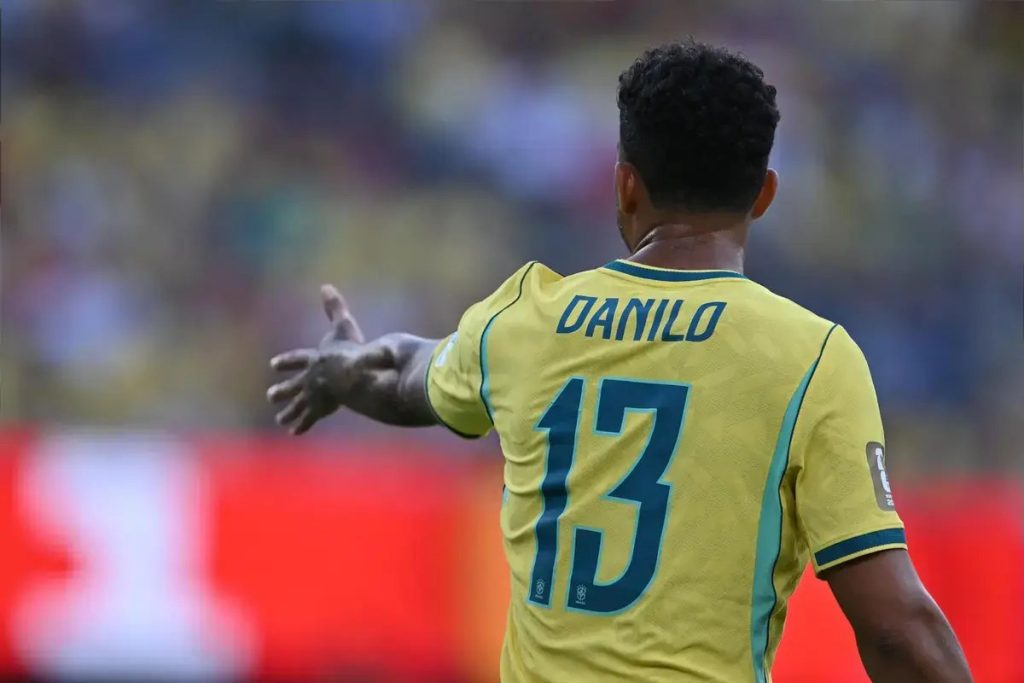
Danilo poured a genuine bucket of cold water on fans’ expectations by admitting, without mincing words, that Brazil is far from matching the competitive maturity of powerhouses like France or Argentina. In the wake of the disappointing draw against Morocco, the experienced defender did not hide his frustration and called for a cool and realistic analysis of the national team’s current moment, just ahead of the crucial clash with Haiti scheduled for early Saturday morning.
The Brazilian international, who came on at halftime to take up the right side of the defense, got straight to the point at the press conference held after the match. “We have to be clear. We do not have the maturity of France or Argentina. We do not have that maturity as a team, which does not mean we cannot perform well, prove ourselves, win, and go far,” stated Danilo, who has previously played for FC Porto, leaving no doubt about the difference in pace between the top national teams in the world and the current Brazil. The 1-1 draw with Morocco in the opener left scars, and Danilo did not hide that the team fell short of expectations: “The best way to improve and correct is to face reality and analyze clearly everything that happened. We must be sure that that first half [against Morocco] was well below our capabilities and what is expected from the Brazilian national team,” added the defender, who is currently playing for Flamengo.
These statements gain particular relevance in a context where Brazil, traditionally one of the favorites in any competition, presents a team in transition with several key players recovering from injury. The absences of Éder Militão and Wesley have necessitated changes in the defensive line, with Danilo competing for a starting spot with Roger Ibañez. The instability in the lineup and the lack of automatisms have been pointed out as factors explaining the hesitant performance of the national team in recent matches.
Danilo went even further in analyzing the team’s structure, revealing details about the technical options available to the squad. “There are six, seven, or eight players who are regular starters and always play, and there are three or four who are rotated depending on the game, the opponent, and the strategy. This is how football is played today. Strategies always change based on the opponent. Today, we probably already have 80% of the team defined for the game against Haiti, and there are three or four players still up in the air,” explained the full-back, making it clear that uncertainty and rotation are part of the new paradigm of national team football. With a smile, he concluded: “Coaches are a bit crazy. Sometimes they make decisions and choices for which no one can find an explanation.”
Danilo’s sincerity contrasts with the usual triumphalist discourse, but it may reveal a sign of maturity and healthy self-criticism at a time when the national team needs, more than ever, to rediscover its identity and confidence. The match against Haiti presents a golden opportunity to dispel doubts and win back the fans, in a competition where every slip can be fatal for Brazil’s aspirations.
The immediate future involves securing a convincing victory against a theoretically inferior opponent, who will certainly be attentive to Brazil’s emotional and tactical instability. Another slip-up could seriously jeopardize their path in the competition and increase the pressure on the team and coaching staff. Danilo, with his experience, is willing to take on responsibilities and lead by example, but his warning must not fall on deaf ears: without mental and collective growth, the national team risks becoming just another squad, far from the glories of the past.
NOW YOU CAN FOLLOW THE WORLD CUP WITH ALL THE INFORMATION – HERE
Discover more from Apito Final
Subscribe to get the latest posts sent to your email.