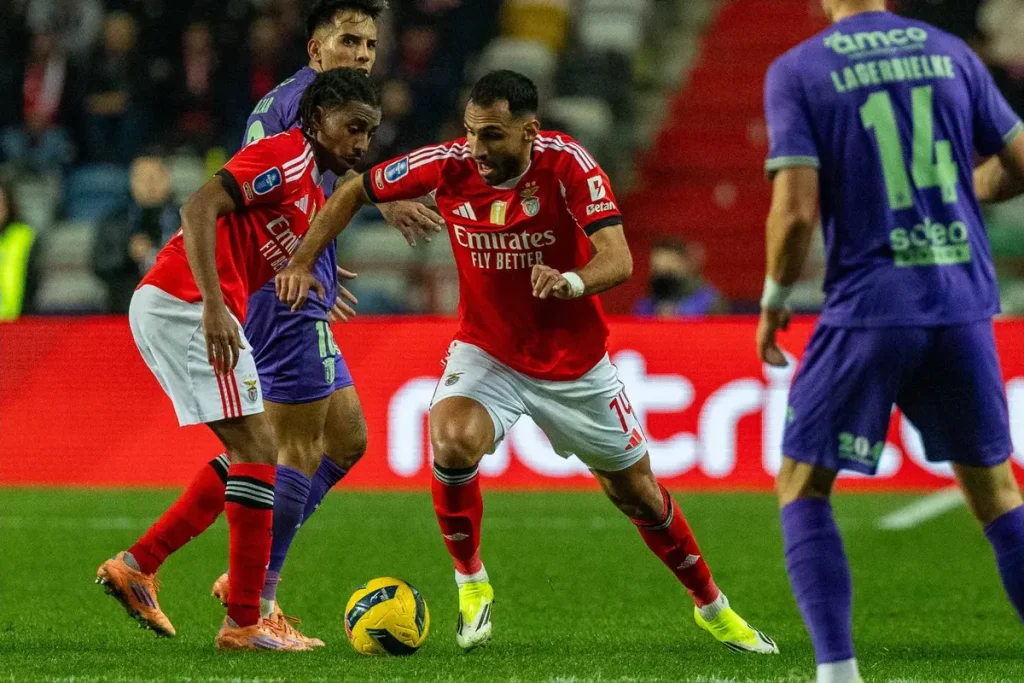
In the thrilling clash between Benfica and SC Braga, the performance of the refereeing was undoubtedly one of the most discussed topics. Pedro Henriques, a specialist in football analysis, did not overlook the crucial moments that marked the match. With meticulous analysis, he highlighted a series of decisions that raised questions about the effectiveness of VAR and the referee’s disciplinary management.
Controversy began just six minutes in when Nicolás Otamendi, in an attempt to intercept a play, stretched his leg and brought down Florian Grillitsch. Although the referee awarded a direct free kick, Henriques argued that a card should have been shown, as the foul was clear and prevented a promising attacking play.
Moving to the ninth minute, the presence of VAR was felt when a penalty initially awarded was correctly overturned. Otamendi, in touching Zalazar’s foot, did not commit a foul inside the area, but the infraction did prevent the Braga player from continuing in a clear goal-scoring opportunity. “The VAR decision was correct, but it should also have helped with other disciplinary incidents,” Henriques stated, indicating that the technology could have played a more active role in managing the game.
In the 31st minute, SC Braga’s goalkeeper, Lukas Hornicek, was cautioned for delaying the restart of play, a situation that, according to Henriques, should be strictly penalized, even if it occurs early in the match. “All players must be held accountable for wasting time, regardless of the phase of the game,” he added.
The match continued to be marked by controversial moments, such as when Mario Dorgeles did not receive a penalty at the 45-minute mark after losing his balance and colliding with Richard Ríos. “He himself caused the foul,” highlighted Henriques, reflecting on the referee’s decision.
In the second half, at the 55-minute mark, a critical moment occurred when Vítor Carvalho had a handball in the area. “It’s a difficult situation, but the hand was away from the body, and a penalty should have been awarded,” analyzed Henriques, pointing to the need for a closer look at plays involving handball.
The 62nd minute brought a correct decision: a clear penalty in favor of Braga after a foul by Paulo Oliveira on Pavlidis. “The referee did not hesitate, and the decision was absolutely fair,” praised Henriques. However, the controversy did not stop there. At the 69-minute mark, a violent challenge by Prestianni on Ricardo Horta should have resulted in a review of the yellow card, considering the risk to the opponent’s physical integrity.
The match culminated in more difficult decisions, such as the expulsion of Nicolás Otamendi in the 89th minute for accumulating yellow cards. “A casting error, the foul he suffered was not called, and he ends up being sent off for protesting,” commented Henriques, highlighting the irony of the situation.
With six minutes of stoppage time and a match full of questionable decisions, Pedro Henriques’ analysis not only raised questions about the effectiveness of VAR but also about the consistency of refereeing decisions. “It is essential that officiating evolves and that VAR is used more effectively to ensure fairness in the game,” he concluded, making it clear that the discussion about refereeing and its implications is far from over.
Discover more from Apito Final
Subscribe to get the latest posts sent to your email.