


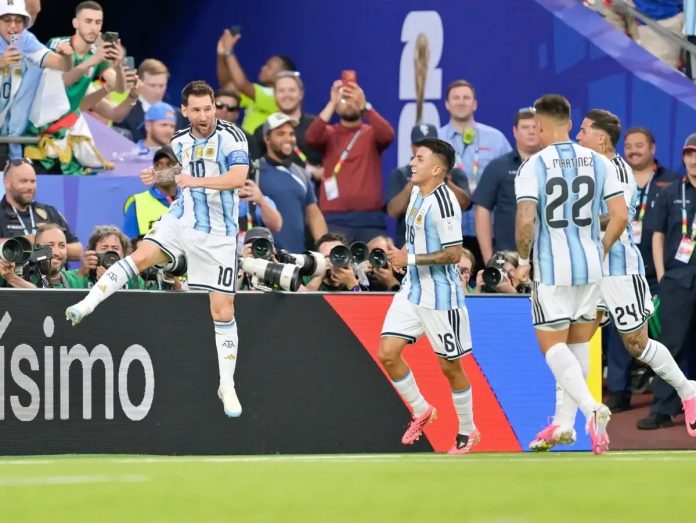
Lionel Messi once again took center stage by scoring a hat-trick against Algeria, but the real spectacle lies in the numbers emerging from the first 24 matches of the World Cup, offering an unprecedented perspective on who is dominating, who is disappointing, and who is surprising. What do the accumulated data really say now that all 48 countries have finally taken to the field? Prepare to discover statistics that debunk myths, reveal trends, and issue warnings to giants and outsiders alike.
Since the start of the competition, there have been iconic moments: Messi celebrating intensely, players from the Democratic Republic of Congo dancing after an unexpected victory, and Dailon Livramento from Cape Verde challenging Spain with an unprecedented performance. The facts confirm that the first round of matches brought everything: from the total dominance of favorites to the tactical coldness of teams considered small, along with genuine defensive disasters and impeccable displays from goalkeepers.
THE 2026 WORLD CUP LIVES ON WITH LEGO
In Mexico’s 2–0 victory over South Africa, the North American team advanced on the field at the slowest pace of the tournament, showing no urgency against a toothless South African side. Ironically, the South Africans finished the match with as many red cards as touches in the opponent’s area, revealing their complete offensive ineptitude. In the clash between South Korea and the Czech Republic, a throw-in from Vladimir Coufal allowed the Czech Republic to open the scoring, but it was Hwang In-beom’s goal, capping a sequence of 25 passes, that made it into the top plays for the longest buildup leading to a goal since 1966.
Canada 1–1 Bosnia and Herzegovina exposed the Bosnians’ reliance on set pieces — seven of their eight shots came from such situations — while the Canadians squandered opportunities in droves. The United States thrashed Paraguay 4–1, defying all analyst predictions, as they allowed 53 touches from the Paraguayans in their area — a figure only surpassed by Curaçao against Germany, who ended up losing 7–1 in a stunning defeat.
The draw between giants and “underdogs” has become routine: Portugal, Spain, Switzerland, Turkey, and Uruguay dominated possession and passing accuracy but failed in the most crucial aspect — converting shots into goals. Spain, for instance, recorded an average of 0.08 xG per shot, even lower than teams at the bottom of the Premier League like Burnley. The outsiders have tightened defensively, proving they are no longer easy prey.
Brazil’s performance, which ended in a 1–1 draw with Morocco, revealed a creative but vulnerable midfield, with Vinícius Júnior proving decisive whenever he was given the ball. Carlo Ancelotti, Morocco’s coach, was pivotal in stifling the Brazilian attack with adjustments at halftime.
Nine draws in 24 matches represent a statistical novelty: there has never been so much parity in this early stage. The Haiti 0–1 Scotland match was the most balanced, with both teams recording exactly 1.05 xG.
A disparity in values was also evident: Germany, whose starting team was worth €559 million more than that of Curaçao, confirmed its favoritism with a crushing victory. Meanwhile, Japan, which drew 2–2 with the Netherlands, scored two goals with only 19 touches in the opponent’s area — a remarkable feat.
The matches resolved in the dying moments also marked this phase: Amad Diallo and Caleb Yirenkyi secured victories for Ivory Coast and Ghana in the final minutes, frustrating their opponents. Sweden thrashed Tunisia 5–1, but the numbers indicate a misleading result — Sweden exceeded its expected goals (xG) by 3.67, the largest deviation so far.
In the Belgium 1–1 Egypt match, Romelu Lukaku came on and, in less than five minutes, forced an own goal, demonstrating the impact of individual players in tactically balanced games. Iran, with the second oldest team ever in World Cups (31.8 years on average), drew 2–2 with New Zealand in a match full of excitement and twists.
After the final whistle of the first 24 matches, one thing is certain: this World Cup is being shaped both by the coldness of the numbers and the passion of the stands. The big teams must rethink their strategies — ball possession without effectiveness no longer intimidates the smaller teams, which now display defensive organization and tactical maturity.
Looking ahead, it is expected that the favorites will seek greater effectiveness in decisive areas, while the outsiders will try to capitalize on the balance and resilience shown. The upcoming matches promise to redefine hierarchies and put even more pressure on those who cannot afford to fail. Those who ignore statistical trends risk being caught off guard — and in this World Cup, surprises are plentiful.
NOW YOU CAN FOLLOW THE WORLD CUP WITH ALL THE INFORMATION – HERE
Discover more from Apito Final
Subscribe to get the latest posts sent to your email.

