


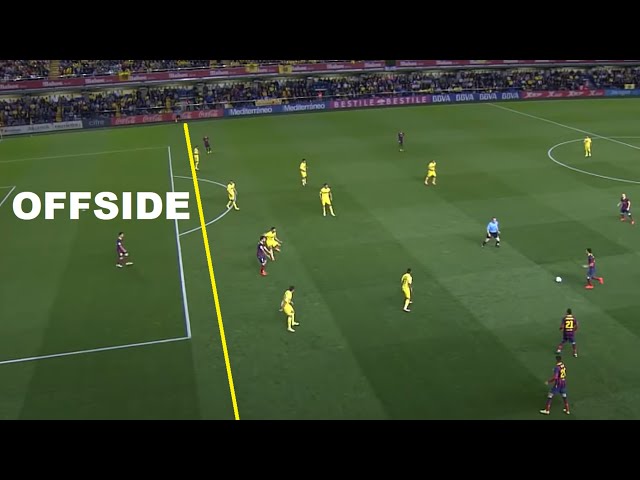
When a forward finds themselves with an open goal and the play is ruled offside by a narrow margin, the stadium erupts in controversy and disbelief. Offside continues to be, even in this technological era, the biggest puzzle for fans, players, and even referees, leading to endless discussions and decisions that can determine championships.
Football, played by two teams of eleven players, requires that, except for the goalkeeper, no one can touch the ball with their hands, and the objective is simple: to score more goals than the opponent. But there is a rule that has always confused the less knowledgeable and tested the skills of referees — offside. In clear terms, a player is offside if, at the moment the ball is passed to them, they are in the opponent’s half and closer to the goal line than both the ball and the second-to-last opponent. If the player in an offside position actively participates in the play, the opposing team is awarded an indirect free kick. It is up to the assistant referee, positioned on the sideline, to signal the infringement, but the final decision belongs to the main referee, now with the support of VAR technology, which can intervene in goals or plays of direct influence.

THE 2026 WORLD CUP IS EXPERIENCED WITH LEGO
The relevance of the offside rule goes far beyond mere technical interpretation. This rule is vital to prevent forwards from “camping” near the opposing goal, which would make the game monotonous and facilitate easy goals. The offside rule requires teams to be tactically intelligent and fuels historic rivalries, often proving decisive in major competitions. Clubs like Benfica, FC Porto, and Sporting have both benefited from and suffered due to offside decisions, which sometimes ignite controversies that define entire eras.
A complex issue arises when discussing the so-called interference without touching the ball: a player can be sanctioned for offside if, even without touching the ball, they disturb the vision or action of the opposing goalkeeper. According to IFAB laws, a player in an offside position must be penalized if they actively interfere with play, for example, by blocking the goalkeeper’s view. The uncertainty remains when it is necessary to decide whether the player actually had an impact on the play, leading to heated debates and controversial decisions. The Football Association clarifies: “For offside purposes, the upper limit of the arm corresponds to the base of the armpit,” ensuring millimetric precision that often only technology can guarantee.
Technology has indeed revolutionized offside decisions. Since 2022, with the World Cup in Qatar, FIFA introduced semi-automated offside technology, a system that uses 12 tracking cameras and multiple sensors on players and, in some cases, on the ball itself. This innovation generates 3D animations that facilitate the assessment of plays and help inform referees and fans, reducing the margin of human error. “The semi-automated offside technology is an evolution of the VAR systems implemented globally,” said Gianni Infantino, president of FIFA, at the launch of the technology. “This advancement results from three years of research to provide the best for teams, players, and fans,” he added, highlighting the positive impact of the system in major tournaments like the Euro 2024 and the Champions League.
Despite the advancements, errors persist. VAR has tightened the net on decisions even further, with goals ruled out by mere centimeters, something unthinkable a decade ago. However, human interpretation continues to weigh heavily, especially when images are inconclusive or when technology is not available. Referees are often criticized for questionable decisions, and decisive matches can be resolved by the faintest of virtual lines.
The offside rule has existed since the formal foundation of football in 1863 and has undergone adjustments over the years. In 1990, a crucial change allowed an attacker to be level with the second-to-last defender without being penalized. Arsène Wenger, former Arsenal manager, has suggested that the criteria should be even more lenient, proposing that a player should be considered onside if any part of their body with which they can score a goal is aligned with the second-to-last opponent.
The future promises more changes and debates. The offside rule is, and will continue to be, the greatest enigma of football — a rule that frustrates attackers, challenges defenses, and fills newspapers with ink. With new technologies, it is expected that controversies will diminish, but the passion and drama surrounding this fundamental law of the game will never disappear. In the coming times, the introduction of semi-automated offside technology in more leagues will continue to transform football, making decisions faster and more accurate, but also raising new questions about the essence of the beautiful game.
NOW YOU CAN FOLLOW THE WORLD CUP WITH ALL THE INFORMATION – HERE
Discover more from Apito Final
Subscribe to get the latest posts sent to your email.

