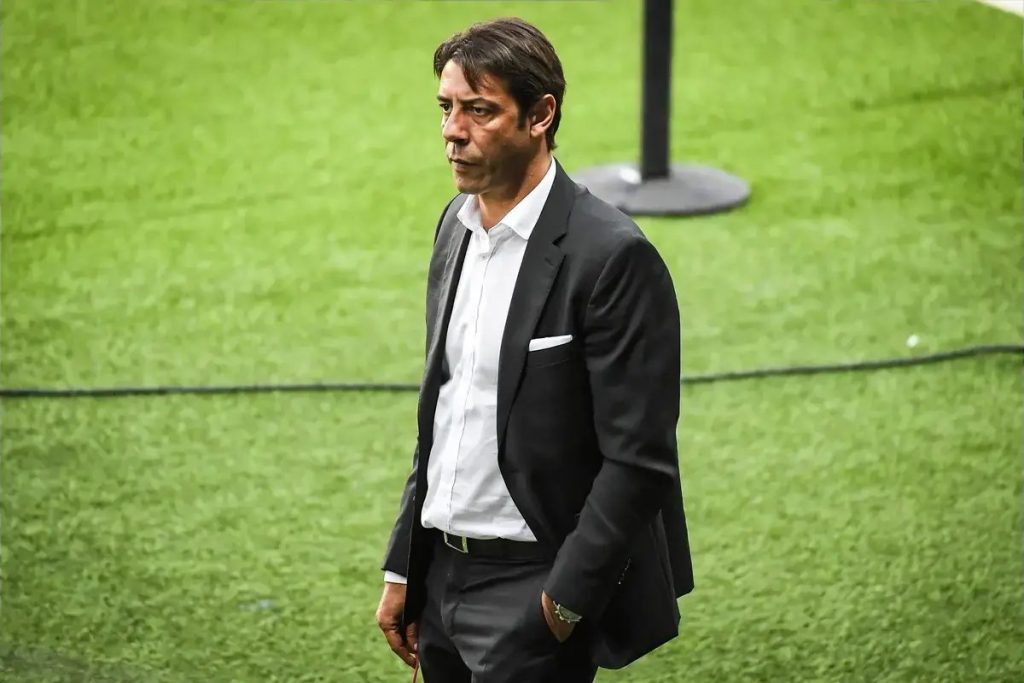
Rui Costa is once again at the center of the red storm, transformed into the favorite target of criticism, outbursts, and frustrations from a fan base that seems to have found in the president of Benfica its preferred punching bag. Even after seasons marked by controversial decisions, painful eliminations, and disputed refereeing, it is Rui Costa who continues to be held accountable for everything that goes wrong in the Benfica universe, regardless of external factors or the nuances of Portuguese football itself.
The president of Benfica, who took office in 2021, now finds himself under intense scrutiny following the defeat in the 2025 Taça de Portugal final, fueling a wave of dissatisfaction that has been growing since earlier incidents, such as the controversial penalty awarded against Benfica in the match against Arouca (2024/25 season) or the handball by António Silva sanctioned this season. The discontent extends beyond the pitch: “Six million Benfica supporters (let’s accept this number as accurate) complain that the club was immensely harmed in the 2025 Taça de Portugal final,” it is said, echoing the sense of injustice that prevails among fans and commentators. However, many of those same fans are the first to direct fierce criticism at Rui Costa, overlooking external factors that have impacted the team’s performance.
THE 2026 WORLD CUP IS EXPERIENCED WITH LEGO
This trend of turning Rui Costa into the scapegoat for all the club’s ills raises serious questions about the atmosphere of demand and intolerance at the Luz. Any decision made—whether to renew a coach in March 2023, to wait to close a deal with another in May 2026, or to opt for securing essential revenues for the club—is invariably met with opposition. “Caught for having renewed with a coach in March (2023) and caught for merely wanting to renew with another in May (2026). Caught for wanting to receive 15 million euros and caught for not having resolved everything sooner, even if that meant not receiving 15 million euros,” reads a scathing description of the vicious cycle of criticism that spares no one, including the president.
The importance of this situation goes far beyond a mere outburst. The toxic environment surrounding Rui Costa could have profound repercussions on the club’s stability, the cohesion of the squad, and the ability to attract new talents, whether players or coaches. With internal dissent growing, any decision—no matter how rational—quickly becomes decontextualized and used as ammunition by those seeking to assign blame. Rui Costa himself has acknowledged on several occasions the difficulties of leading a club of Benfica’s size and demands, but he refuses to fall into the temptation of personalizing battles or fueling public wars: “He did not err in not succumbing to the temptation of making Marco Silva’s presentation a sort of settling of accounts. Whether or not it was with José Mourinho,” it is emphasized, highlighting the president’s reserved stance during a time of great agitation.
The president has already admitted that “in five years, he won a National Championship, a League Cup, and two Supertaças Cândido de Oliveira. It’s little. It’s very little. He won four national trophies out of 20 possible. It’s little. It’s very little.” Rui Costa does not shy away from the numbers, but refuses to take the blame for all the failures, especially when there are evident external factors harming the club. Did he make a mistake by dismissing Roger Schmidt so late? Yes. Did he make a mistake by not keeping Bruno Lage? Yes. But one cannot ignore the context of each decision, nor demand that the president be simultaneously responsible for all the ills and the savior of all solutions.
The immediate future of Benfica now depends on Rui Costa’s ability and the club’s structure to recover internal stability, shield the locker room, and quickly find a sporting direction that restores titles and confidence to the fans. With Marco Silva confirmed as the new coach, the next challenge is to build a competitive squad and respond on the field to the criticisms and doubts that are multiplying outside of it. The atmosphere of demand will not ease; on the contrary: each game will be a new test of Rui Costa’s leadership ability and the resilience of a club accustomed to fighting against everything and everyone — but which, in recent times, seems more focused on fighting against itself.
NOW YOU CAN FOLLOW THE WORLD CUP WITH ALL THE INFORMATION – HERE
Discover more from Apito Final
Subscribe to get the latest posts sent to your email.