


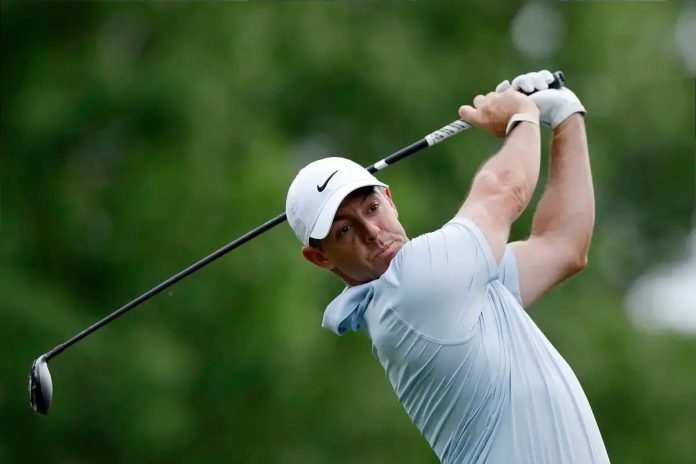
Rory McIlroy takes sharp jabs at Bryson DeChambeau and LIV players, reigniting controversy in the golf world
As financial uncertainty surrounding LIV Golf once again shakes the world of golf, the future of players linked to this league remains a topic of intense debate. But what does it really mean to refuse to return to the PGA Tour when that option exists? Rory McIlroy, one of the sport’s biggest stars, did not hesitate to provide his answer — and he did not hold back on criticism.
“At the end of the day, if you want to be the most competitive player possible, this is where you need to be. And if you don’t want to play here, I think that says a lot about you,” McIlroy stated during the Truist Championship, clearly throwing shade at figures like Bryson DeChambeau, who have expressed little desire to return to the PGA Tour. DeChambeau, for instance, has conditioned his potential return on a relaxation of media policies, something that the tour itself recently changed.
When the exit of funding from the PIF was confirmed, DeChambeau was one of the first to react, stating that if LIV were to close, he would prefer to focus on creating digital content rather than returning to traditional circuits. Cam Smith, Jon Rahm, and Thomas Pieters also declined offers to return through the returning members program, while Anirban Lahiri revealed that he knows several LIV Golf colleagues who simply do not want to return to the PGA Tour.
The move to LIV Golf was not solely a monetary issue. The grueling schedule of the PGA Tour, the lack of profit participation, and the absence of financial guarantees beyond the prize money were longstanding complaints among players. In contrast, LIV offered a shorter season, guaranteed contracts, and a significantly higher financial base—something the PGA Tour has so far refused to acknowledge.
McIlroy aligned himself with the vision of PGA Tour CEO Brian Roloff, who has repeatedly argued that “anything that strengthens the PGA Tour is worthy of consideration.” This stance is crucial, especially as the PGA Tour has shown a willingness to do whatever it takes to bolster its position in the market.
“I’m not going to judge anyone for not wanting to play on the PGA Tour. Does that mean they can go play on the DP World Tour? If that’s the case, it makes the DP World Tour stronger, and I would be delighted, because that’s my tour of origin,” McIlroy added.
Since the launch of LIV Golf in 2022, McIlroy has been a fierce critic of the league and the players who chose to join it. He called Brooks Koepka a “hypocrite” after Koepka moved to LIV in 2022, having publicly denied any interest in doing so. McIlroy made it clear that his criticism was not just aimed at Koepka, but at all those who said one thing publicly and did another in private.
Furthermore, McIlroy condemned players who left the PGA Tour and then attacked the organization that gave them their careers: “I have no problem with those who took the money, but the message is clear for those who left and still try to burn the house down on their way out: don’t try to set everything around you on fire.”
These statements ignited the internet and fans quickly became divided. Many questioned McIlroy’s consistency, pointing out that he himself chooses the tournaments he plays, receives appearance fees at events outside the PGA Tour, and has the freedom to train for an entire month in Augusta before the Masters—a privilege that few players have.
In response, McIlroy explained that players have minimum participation commitments, but can organize their schedule as they wish, using that flexibility to their advantage. However, critics argue that this freedom contradicts the idea that not wanting to play on the PGA Tour “says something” about the player.
Another hot topic raised by fans was the financial impact that LIV Golf has had on the sport. The arrival of the league revolutionized prize values on the PGA Tour, which have increased dramatically: iconic tournaments now offer prizes ranging from 20 to 40 million dollars, with total prize money growing by more than 140 million between 2022 and 2023. McIlroy has publicly acknowledged that LIV forced the PGA Tour to react financially.
On the other hand, some argue that LIV players have gained “generational wealth” with a comfortable schedule and reduced effort, now being seen as “second tier,” while many on the PGA Tour struggle to survive without television exposure or worthy prizes.
Another argument that complicated the debate came to light: the fact that some LIV players are not even allowed to compete on the PGA Tour. Jon Rahm, for example, has admitted that he would like to play in some major tournaments on the PGA Tour, but he is banned. Recently, Rahm resolved a pending issue with the DP World Tour to maintain eligibility for the Ryder Cup, but the “choice” to return is not entirely free for many.
This scenario shows that the controversy is not limited to an individual decision, but involves complex issues of control, contracts, and policies of golf organizations. McIlroy’s position, although firm, is not without challenge at a time when the future of global golf is more uncertain and divided than ever. Who dares to say that the war between the PGA Tour and LIV Golf is not the greatest drama in contemporary golf?
This article first appeared on Apito Final.
Discover more from Apito Final
Subscribe to get the latest posts sent to your email.

